Overview
Selecting appropriate electrostatic discharge (ESD) protection devices for system interfaces requires systematic matching based on the specific type and operating characteristics of the interface. The key is to strike a balance between protection capability and signal integrity.
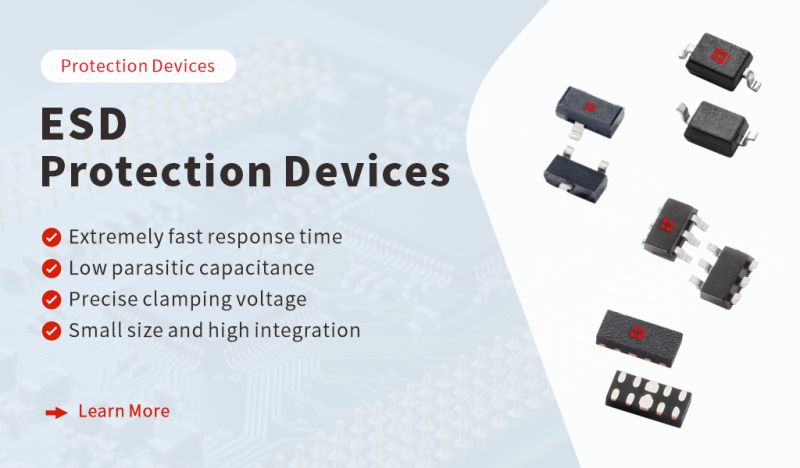
I. Core Selection Parameters
1. Reverse Cut-off Voltage (VRWM)
- Definition: The highest voltage at which an ESD device can maintain a high-impedance state without affecting the normal operation of the circuit.
- Selection Principle: Must be higher than the highest operating voltage of the protected line, with a margin of approximately 20%.
- Example: For a 5V circuit, a device with VRWM ≥ 6V should be selected; for a USB-C interface supporting PD fast charging and a voltage up to 20V, a device with VRWM ≥ 20V should be selected.
2. Clamping Voltage (VC)
- Definition: The voltage value that the device limits the line voltage after conduction when an ESD event occurs.
- Selection Principle: Must be lower than the maximum withstand voltage of the downstream protected chip (IC). This is crucial to ensuring the chip is not damaged by high voltage.
- Example: If the I/O port of the backend MCU has a withstand voltage of 3.6V, then the clamping voltage VC of the ESD device must be lower than 3.6V.
3. Junction Capacitance (Cj)
- Definition: The parasitic capacitance inherent in the ESD device itself.
- Selection Principle: For high-speed signal interfaces, junction capacitance is a decisive factor. Excessive capacitance will degrade signal quality, leading to signal attenuation, edge distortion, or even communication failure.
- Example: High-speed interfaces (e.g., USB 3.0/3.1, HDMI 2.0/2.1): Ultra-low capacitance devices must be selected, typically requiring Cj < 0.5pF; Low-speed interfaces (e.g., power, buttons, audio): Capacitance requirements are not high; several pF or even higher capacitance can be tolerated.
4. Peak Pulse Current (IPP) / ESD Tolerance Level
- Definition: The maximum ESD current that the device can safely discharge, directly corresponding to the ESD protection level.
- Selection Principles: The selection should be based on the industry standards the product must meet.
- Examples: Consumer electronics: Typically need to meet IEC 61000-4-2 Level 4 standards, i.e., contact discharge ±8kV, air discharge ±15kV, requiring an IPP ≥ 30A for the device; Automotive electronics: Standards are more stringent (e.g., ISO 10605), and may need to withstand impacts of ±15kV or even higher, requiring an IPP ≥ 40A.
II. Selection by Interface Type
Different types of interfaces have different focuses in their ESD protection solutions.
| Interface Type | Key Challenges | Recommended ESD Protection & Key Parameters |
| High-Speed Data Interfaces (USB 3.0 / Type-C / HDMI) | High signal integrity requirement, PD fast charging support | Ultra-low capacitance (Cj < 0.5pF) is critical. For USB-C VBUS lines, choose high VRWM (e.g., 24V) and high IPP components. |
| Ethernet Interface (RJ45) | Differential signals, possible common-mode interference | Typically use integrated TVS diode arrays, optionally combined with common-mode filters to suppress both ESD and common-mode noise. |
| Power Input Interfaces | High energy, possible surge/pulse events | Focus on high power rating and surge current capability. Multi-stage protection using “TVS diode + varistor” can handle different energy levels. |
| Low-Speed / Control Signals (Buttons, SIM, Audio) | Space constraints, less sensitive to capacitance | Use small-footprint components (e.g., SOD-923, DFN0603) to save PCB space. Pay attention to low leakage current, especially for battery-powered devices. |
III. Key Design and Layout Considerations
- Proximity: ESD protection devices must be placed as close as possible to the protected interface or connector, ideally less than 3-5mm. This ensures that ESD energy is dissipated before entering the circuit board.
- Short and Wide Ground Path: The ground pin of the ESD device must be directly connected to the main ground plane via a short, wide, low-impedance trace. Avoid using long, thin traces or multiple vias in series; it is recommended to use multiple vias in parallel to connect to ground.
- Avoid branching traces: Protected signal lines should pass through ESD devices before connecting to the back-end chip. Branching lines between ESD devices and interfaces are strictly prohibited; otherwise, devices on the branch will still be subject to ESD damage.
Following these selection principles and design specifications will allow you to build a reliable ESD protection system for all interfaces of your system, significantly improving product stability and reliability.
Choosing the right ESD protection device can make or break your system’s reliability.Get our comprehensive ESD Selection Guide to quickly identify the best components for every interface type, from high-speed USB to power inputs.
📥 Download the ESD Selection Guide now and ensure your designs are fully protected.
ESD-Selection-Guide.pdf">https://en.semiware.com/uploads/documents/ESD-Selection-Guide.pdf