In LED series drive systems, a common and serious problem is that the failure of a single LED open circuit will cause the entire string of lights to go out.
In practical applications, this problem often occurs in:
- Partial blackout of outdoor streetlights
- Dark spots or black areas appearing in car taillights
- Broken stripes on LED advertising screens
- Difficult maintenance of partial failures in industrial lighting
Although LEDs themselves have high reliability, they can still fail under the following conditions:
- Thermal stress and long-term aging
- Electrostatic discharge (ESD) impact
- Surge voltage
- Mechanical vibration causing open circuits at solder joints
In a series structure, if even one LED is open-circuited, the current path is interrupted, and the entire string goes out.
📌 Why Are Traditional Solutions Insufficient?
Common solutions to this problem include: Increasing LED redundancy design, reducing the number of LEDs in series, or adding a whole-string protection circuit.
However, these solutions typically have some problems: Increased cost, complex structure, and still unable to achieve "single-point failure without interrupting lighting."
Therefore, a more direct solution is needed—LED open-circuit bypass protection (LED Shunt).
📌 PLED Series: LED Shunt Open-Circuit Protection Device
The Semiware PLED series is a type of open-circuit bypass protection device (LED Shunt) specifically designed for LED series systems.
Its core function is:
When an LED becomes open-circuited, it provides a low-impedance path to bypass the failed LED, allowing the entire LED string to continue operating.
📌 Working Principle of PLED Series Protectors
- Normal Operating State:
The device is in a high-impedance state, with extremely low leakage current (µA level), not affecting the normal light emission and brightness of the LED.
- Fault Trigger State
When an LED becomes open-circuited:
The series voltage distribution changes, and the voltage across the PLED rises to the trigger threshold (approximately 6V), causing the device to enter the conducting state, forming a bypass path and maintaining current continuity.
- Fault Recovery
After replacing the LED or restoring the circuit, the device automatically returns to a high-impedance state without manual reset.
📌 Key Features of PLED Series Protectors
- Low Leakage Current: µA level under normal conditions
- Fast Response: ns-level trigger response (typical)
- Low On-State Voltage Drop: Approximately 1–1.5V (varies with current)
- High Surge Capability: Withstands IEC 61000-4-5 standard surge impact (8/20µs condition)
- Automatic Recovery: No external control required
📌 Semiware PLED Series Product Packages and Models
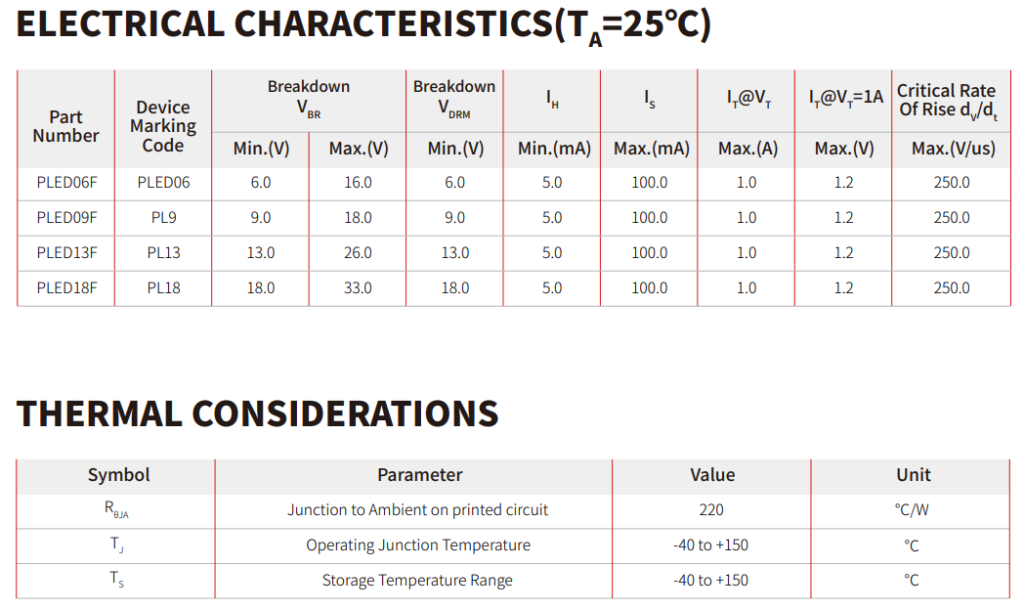
- SOD-123FL Package
Suitable for compact LED strips and low to medium power lighting
- PLED06F
- PLED09F
- PLED13F
- PLED18F
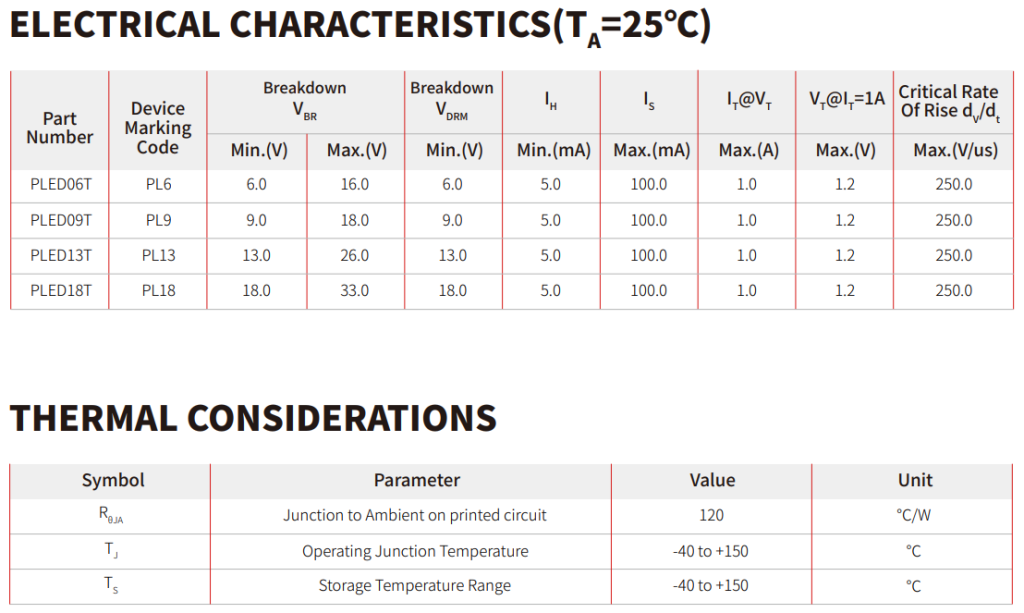
- SMA Package
Suitable for general lighting and medium power applications
- PLED06T
- PLED09T
- PLED13T
- PLED18T
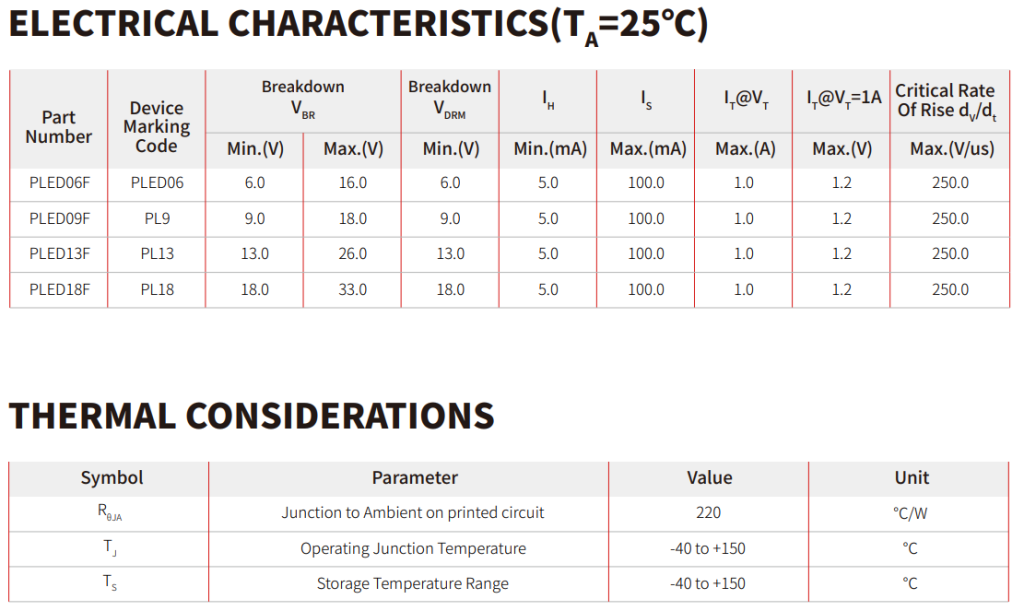
- SMB Package
Suitable for high-power LED systems and outdoor lighting
- PLED06S
- PLED09S
- PLED13S
- PLED18S
📌 Typical Applications
- Outdoor and Industrial Lighting:
- Streetlights
- Tunnel Lights
- Building Exterior Lighting
Advantages: Single-point failure does not affect overall lighting, improving maintenance efficiency and system reliability.
- Automotive Electronic Lighting:
- Headlights
- Taillights
- Turn Signals
Advantages: Meets automotive-grade reliability design requirements, improving driving safety.
- Commercial and Smart Lighting:
- LED Strips
- Panel Lights
Advantages: Avoids localized dark areas, supports PWM dimming systems, improving visual consistency.
📌 Design and Selection Guidelines
- Key Parameter Matching
Breakdown Voltage (VBR)
Recommended ≥ 1.5 × LED Normal Operating Voltage
Holding Current (IH)
Ensuring the device remains on under fault conditions
On-Circuit Current (IT)
Select based on LED string current to avoid overload
- PCB Layout Recommendations
PLEDs should be placed as close as possible to the LED pads.
Shorten the loop path to reduce parasitic inductance.
High-power applications require reserved copper foil for heat dissipation.
- Thermal Design Recommendations
On-circuit power dissipation can be estimated as:
P ≈ Vf × I
Where:
Vf: On-circuit voltage drop (approximately 1–1.5V)
I: LED string current
A reasonable heat dissipation design is required based on the luminaire structure.
Conclusion
Whether used in outdoor lighting, automotive lighting, LED displays, or industrial illumination, a single LED open-circuit failure should not cause an entire lighting string to shut down.
Semiware's PLED series provides a simple, reliable, and cost-effective bypass protection solution that helps improve system reliability, reduce maintenance costs, and keep LED strings operating even when individual LEDs fail.
To learn more about available package options, electrical specifications, and product models, visit the Semiware PLED Protectors Product Line or contact our engineering team for application support.