Transient overvoltages, power grid surges, and switching noise from inductive loads are common threats facing AC-powered electronic equipment.
The 07D221K Metal Oxide Varistor (MOV) is a general-purpose circuit protection device featuring a compact 07D-series radial lead package that provides reliable transient surge protection. Striking a balance between small size, reliable performance, and cost-efficiency, it is suitable for a wide range of low-to-medium power electronic designs.
I. 07D221K Varistor Definition and Specifications
The 07D221K is a zinc oxide varistor from the 07D radial lead series, designed for use at AC inputs and in other transient overvoltage protection applications.
The part number follows standard industry naming conventions: "07D" indicates the 7mm disc-type MOV size specification, "221" represents the 220V varistor voltage, and "K" denotes a voltage tolerance of ±10%.
Key Specifications:
- Varistor Voltage (V1mA): 220V
- Maximum AC Operating Voltage: 140V
- Maximum DC Operating Voltage: 180V
- Maximum Clamping Voltage: 360V
- Maximum Surge Current (8/20μs): 1200A
- Maximum Energy: 26.5J
- Typical Capacitance: 230pF
- Operating Temperature: -40°C to +125°C
Design Note: When a surge occurs, the actual voltage experienced by downstream components depends not only on the surge voltage itself but also on the surge current, line impedance, and PCB layout.
For the 07D221K, 360V represents the maximum clamping voltage under specified test conditions; it is a key parameter for evaluating the level of protection and the voltage withstand capability of downstream components, rather than a fixed voltage that will appear in every surge scenario.
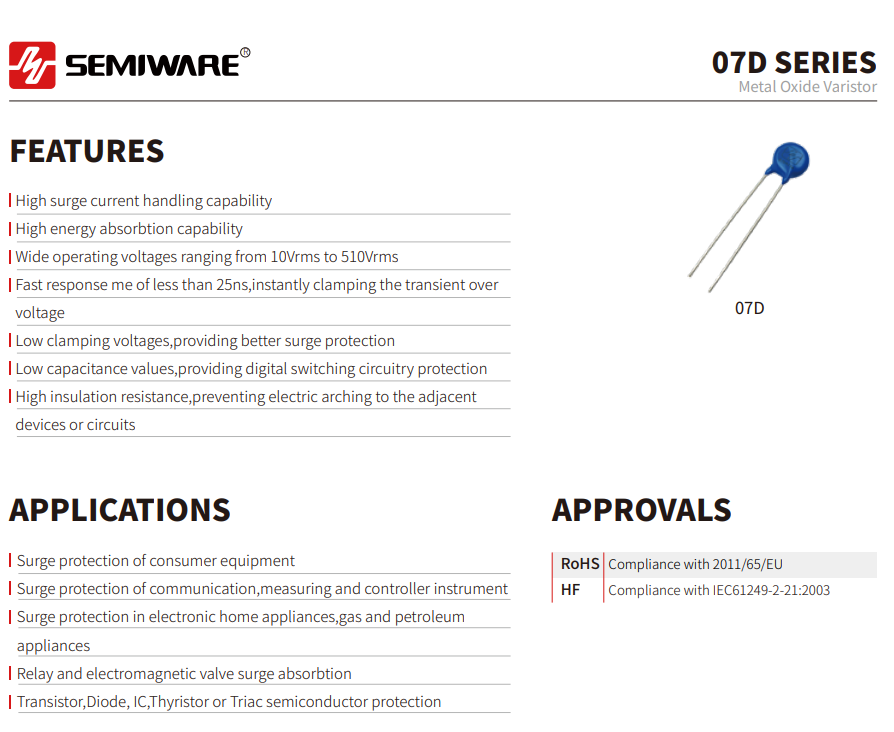
III. Typical Applications of 07D221K
The 07D221K is suitable for transient overvoltage protection in a wide range of low-to-medium power electronic devices, including:
- AC input surge protection for home appliances
- Transient suppression on the primary side of switching power supplies and power adapters
- LED drivers and outdoor lighting equipment
- Low-power industrial control modules and relay control circuits
- Smart power strips and socket protection modules
- Consumer-grade metering instruments and low-voltage power supply equipment
MOVs are typically connected in parallel across the lines requiring protection and may be used in conjunction with components such as fuses, depending on specific circuit requirements. If the MOV fails due to abnormal overvoltage or other faults, overcurrent protection devices (like fuses) help mitigate the risk associated with such failures.
IV. Selection Guidelines for the 07D221K Varistor
- Verify Continuous Operating Voltage Margin
The maximum continuous AC voltage rating for the 07D221K is 140V AC; it is not suitable for long-term, direct operation in a full-voltage 220V AC mains environment. For devices with a 220V AC input, designers must account for grid voltage fluctuations to avoid continuous overvoltage, which could lead to increased leakage current and accelerated component aging. 2. Distinguishing between Varistor Voltage and Clamping Voltage
The 220V varistor voltage is the voltage measured at a DC current of 1mA; the 360V clamping voltage is the maximum voltage across the MOV under specified 8/20μs surge test conditions. When selecting a component, consider the voltage withstand capability of the device being protected and the system's actual transient conditions to ensure sufficient voltage margin.
- Evaluating Surge Current and Energy Capacity
The 07D221K can withstand a surge current of 1200A (8/20μs) and has a maximum energy absorption of 26.5J, making it suitable for transient surge protection in consumer electronics and low-power industrial equipment. For applications requiring higher surge capabilities, the 10D, 14D, and 20D series varistors are available options.
Summary
Semiware varistors undergo rigorous reliability testing—including high/low-temperature cycling, humidity resistance, and long-term load aging—ensuring stable performance in diverse and demanding environments.
If you are evaluating the 07D221K for your circuit design, Semiware offers samples, datasheets, and technical support; please feel free to contact our technical team.
https://en.semiware.com/contact
FAQ
Q1: Can the 07D221K be used with a 220V AC mains input?
A: Direct, long-term use is not recommended. The maximum continuous AC voltage for the 07D221K is 140V AC; subjecting it to 220V mains voltage for an extended period increases component stress and may lead to aging and performance degradation. You should evaluate the voltage margin or select a varistor with higher specifications.
Q2: Should the 07D221K be connected in series or in parallel?
A: Varistors are typically connected in parallel across the lines being protected to suppress transient overvoltage. They can also be used in conjunction with overcurrent protection devices, such as fuses connected in series, depending on circuit safety requirements.
Q3: Will the 07D221K clamp the surge voltage to 220V?
A: No. For the 07D221K, 220V represents the varistor voltage measured at a 1mA DC test current, whereas 360V is the maximum clamping voltage under specified 8/20μs surge test conditions. Actual surge voltage is also influenced by factors such as surge current, line impedance, and PCB layout.
Q4: What is the difference between the 07D221K and the 07D220K?
A: The primary difference lies in their operating voltage ranges. The 07D220K has a varistor voltage of 22V and a maximum AC operating voltage of 14V, while the 07D221K has a varistor voltage of 220V and a maximum AC operating voltage of 140V. Since they are designed for different voltage levels, they cannot be directly substituted for one another.