Introduction
During the commissioning of industrial power supplies, industrial control equipment, and products with AC inputs, a common issue arises: equipment functions correctly during laboratory testing but experiences intermittent anomalies or even damage when deployed in the field.
This is often caused by transient disturbances from the power grid entering the equipment—such as surge voltages resulting from induced lightning strikes, grid switching, motor start/stop operations, and the operation of other inductive loads. For AC input stages, the MOV (Metal Oxide Varistor) is a widely used primary surge protection component.
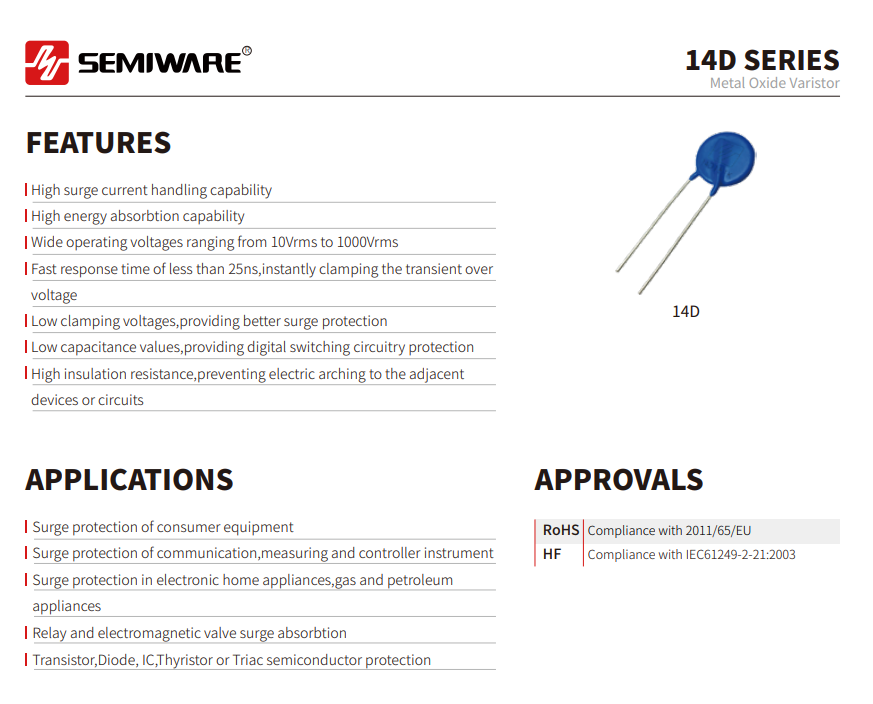
I. Key Parameters of the 14D561K
The 14D561K is a 14mm radial-lead metal oxide varistor with a nominal varistor voltage of 560V (at 1mA). It is suitable for AC power inputs, industrial equipment, and other circuits requiring high surge withstand capability. Its main parameters are as follows:
| Parameter | 14D561K |
| Diameter | 14 mm |
| Maximum AC Working Voltage | 350 VAC |
| Maximum DC Working Voltage | 460 VDC |
| Varistor Voltage | 560 V @ 1 mA |
| Varistor Voltage Tolerance | ±10% |
| Maximum Clamping Voltage | 920 V |
| Standard Surge Current | 4.5 kA (8/20 μs) |
| High Surge Current | 6 kA (8/20 μs) |
| Typical Capacitance | 360 pF |
It is important to note that 560V refers to the varistor voltage, not the continuous operating voltage that the MOV can withstand over the long term.
II. Analysis of 14D561K Application Scenarios
- Surge Protection for AC Power Inputs
For 220/230VAC single-phase inputs and other AC equipment with a maximum operating voltage not exceeding 350VAC, the MOV can be connected across the Line (L) and Neutral (N) terminals to suppress differential-mode transient overvoltages originating from the power grid.
During normal operation, the MOV remains in a high-impedance state, having minimal impact on the system. When a transient overvoltage occurs at the input, the MOV's impedance drops rapidly, providing a shunt path for the surge current and thereby limiting the transient voltage applied to downstream circuitry.
- Industrial Power Supplies and Industrial Control Equipment
The starting and stopping of motors, relays, contactors, and other inductive loads can generate transient voltages on power lines. For equipment such as industrial controllers, instrumentation, and industrial power supplies, an MOV can be added at the AC input to suppress transient surges entering the device. 3. Lightning Protection Modules and Surge Protection Components
In certain power supply surge protection modules, the MOV primarily serves to limit differential-mode surge voltage.
The 14D561K features a 14mm disc structure with radial leads, making it suitable for installation on power supply boards or within surge protection modules.
- Industrial Lighting and Power Drivers
Industrial lighting systems, power drivers, and certain outdoor electronic devices often operate in complex power grid environments over extended periods.
If significant transient surges are present at the input, an MOV can be installed at the power entry point to mitigate the impact of transient overvoltage on components such as rectifier bridges, power MOSFETs, and control ICs.
- Transient Suppression for Relay and Solenoid Valve Circuits
Relays and solenoid valves are typical inductive loads.
When the coil is de-energized, the energy stored in the inductance generates a transient voltage. Without appropriate suppression measures, these voltage spikes can propagate through power or control lines, potentially affecting MCUs, driver ICs, and other sensitive circuitry.
For AC coils, a suitable MOV can be selected and connected across the load to suppress transients, based on parameters such as the coil's rated voltage, normal operating voltage, and the energy requiring dissipation.
III. PCB Layout Recommendations
3.1 PCB Routing: Minimize the circuit path length for the varistor to reduce lead inductance; excessive inductance can degrade actual clamping performance.
3.2 Component Limitations: Devices have limits on the maximum number of surge events; for applications involving frequent, high-energy surges, it is recommended to select components based on derated specifications rather than relying solely on nominal ratings.
3.3 Fuse Integration: A varistor cannot fully replace a fuse. It is recommended to pair the input with a suitable fuse to mitigate safety risks associated with potential short-circuit failures of the MOV.
IV. 14D561K Datasheet
Conclusion
If you are developing a high-voltage port protection solution, please visit the Semiware website to download the complete MOV-14D series datasheet. You may also contact our FAE team for circuit reference designs, sample support, and solution evaluations.