I. Why Surge Protection for Streetlight Systems Is Crucial?
With the rapid rollout of smart city infrastructure, street lighting systems—particularly modern LED streetlights integrated with intelligent control modules—are facing severe surge-related risks.
These risks stem primarily from lightning activity and power grid fluctuations, potentially leading to equipment damage, increased maintenance costs, and even public safety hazards. Consequently, formulating a comprehensive risk mitigation strategy necessitates a systematic design approach that encompasses everything from risk assessment and multi-level protection to specific implementation details.
II. Primary Sources of Surge Risk
1. Lightning Surges
Direct Lightning Strikes: Lightning strikes the light pole or its immediate vicinity directly, generating immense transient energy with extremely destructive potential.
Induced Lightning Surges: Lightning discharges near the light pole or power supply lines, generating high-voltage surges within the lines through electromagnetic induction; this is the primary cause of damage to streetlights' electronic components.
Conducted Lightning Surges: Lightning strikes distant power grid infrastructure (such as transformers or transmission lines), and the surge energy is then conducted through the power supply lines to the streetlights. Statistics indicate that approximately 80% of surge-related damage originates from this type of secondary surge.
2. Power Grid Operational Surges
The startup, shutdown, switching operations, or faults involving large-scale electromechanical equipment within the power grid can trigger momentary voltage fluctuations. These fluctuations create surges that inflict either cumulative degradation or immediate damage upon the sensitive electronic components of streetlights.
III. Systematic Mitigation Strategy
An effective surge protection system should adhere to the principle of "zoned protection and staged discharge," combining external lightning protection with internal surge protection.
Protection Against Direct Lightning Strikes (External Lightning Protection)
1️⃣ Protection Against Direct Lightning Strikes (External Lightning Protection)
This constitutes the first line of defense, designed to safely channel lightning currents into the earth.
1. Air Terminals
For light poles standing 4 meters or taller, the metal luminaire housing or the metal components at the pole's apex should be utilized as air terminals to actively intercept lightning strikes.
2. Down Conductors
The metal light pole itself—or, in the case of concrete poles, internal steel reinforcement bars with a diameter of no less than 12 mm—should serve as the down conductor, providing a low-impedance pathway for the lightning current.
3. Grounding System
Establishing a reliable grounding system is critical. Typically, the steel reinforcement cage embedded within the light pole's foundation is utilized as a natural grounding electrode; the required grounding resistance for this system must not exceed 10Ω. If this requirement cannot be met, supplementary artificial grounding electrodes (such as hot-dip galvanized steel angle bars) must be installed.
2️⃣ Lightning Electromagnetic Pulse Protection (Internal Lightning Protection)
This constitutes the core mechanism for safeguarding the precision electronic equipment housed within streetlights, primarily achieved through the installation of Surge Protection Devices (SPDs).
1. Power Line Protection
Distribution Cabinet Level Protection: Within the streetlight power distribution cabinet, a voltage-limiting SPD with a nominal discharge current of no less than 40kA should be installed to discharge the majority of surge energy conducted from the power grid.
2. Luminaire Level Protection
For modern LED streetlights—particularly smart streetlights—the integrated dimming drivers, IoT modules, and other internal components are extremely sensitive to power surges.
Industry practice indicates that a 20kV surge protection rating has become a core requirement for outdoor lighting; this rating effectively withstands lightning-induced surges ranging from 15kV to 20kV in real-world environments, providing comprehensive protection for the entire luminaire system (including its smart components).
This is typically achieved by connecting an SPD in parallel or in series at the power input terminal of the luminaire.
3. Smart Control System Protection
The signal lines and communication ports (such as CAN and LIN buses) of smart control systems—including remote monitoring and energy-saving control modules—also require protection.
These components should be equipped with appropriate signal SPDs, and shielded cables should be utilized to prevent surges from intruding via signal lines and damaging the core control modules.
IV. Multi-Stage Protection Circuit Design
Within the power modules of streetlights, multi-stage protection circuits are typically employed to address surges of varying energy levels.
- First Stage (Coarse Protection): Utilizes Gas Discharge Tubes (GDTs) to discharge ultra-high-energy transient impulses (e.g., those induced by direct lightning strikes).
- Second Stage (Intermediate Protection): Utilizes Metal Oxide Varistors (MOVs) to suppress surges of moderate amplitude (e.g., those caused by power grid switching operations).
- Third Stage (Fine Protection): Utilizes TVS diodes, which feature extremely fast response times (in the nanosecond range), to clamp residual voltage spikes and protect downstream sensitive Integrated Circuits (ICs).
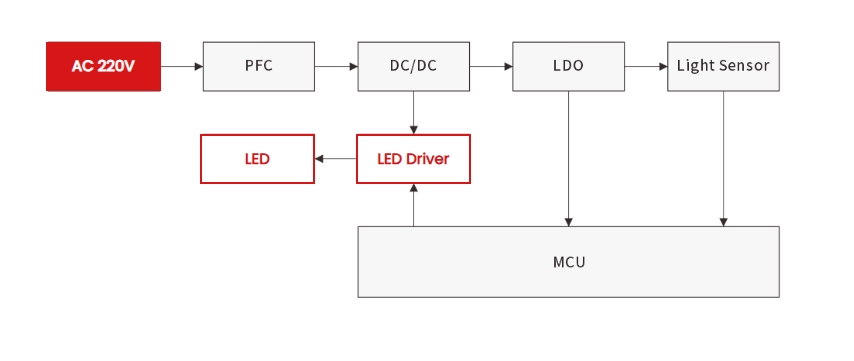
V. Circuit Application Block Diagram
👉 Looking for a customized surge protection solution for your LED street lighting system?
Semiware’s EMC experts can help you design a reliable, cost-effective protection architecture tailored to your project.
🔗 Explore solutions: https://en.semiware.com/applications/street-lamp-controller/
📩 Contact us for design support: https://en.semiware.com/contact/