Introduction
Point-of-Sale (POS) terminals have become indispensable equipment in retail stores, restaurants, supermarkets, self-service kiosks, and various payment systems.
With the widespread integration of touchscreens, USB-C ports, card readers, wireless communication modules, and network connectivity, modern POS terminals face a variety of electrical transient threats during daily operation.
Common electrical risks include:
- Electrostatic discharge (ESD) caused by frequent human-machine interaction
- Voltage surges resulting from unstable power adapters or external cables
- Transient pulses generated by the hot-plugging of USB and card reader interfaces
- Electrical Fast Transients (EFT) in industrial or commercial environments
Without proper circuit protection, these transient events can lead to:
- Damage to controller ICs
- Data communication errors
- Touchscreen malfunctions
- Card reader failure
- Reduced product reliability
This article outlines the key protection points within POS terminals and discusses how to select appropriate protection components.
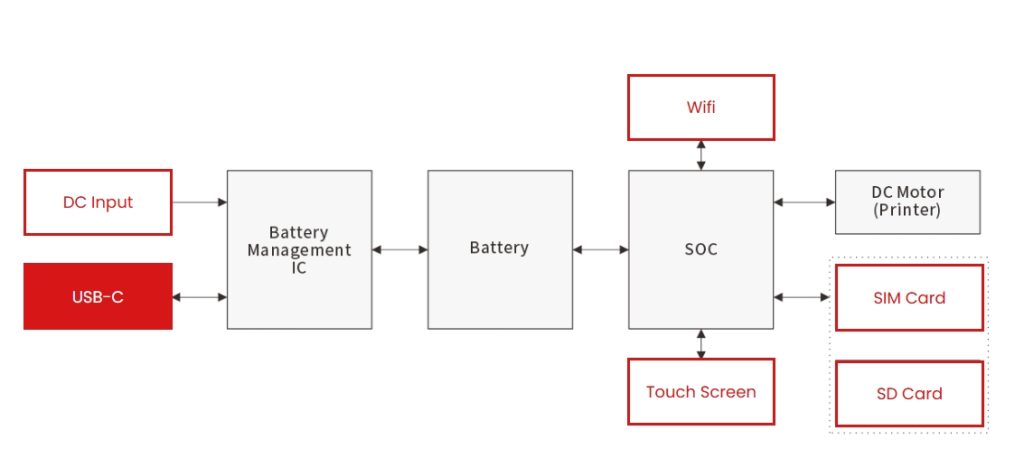
POS Terminal Interfaces and Electrical Risks
| POS Interface | Potential Risks |
| DC Input | Power surges, voltage spikes, unstable adapters |
| USB-C Port | ESD from hot-plugging, transient voltage events, EMI |
| Touch Screen Interface | Human body ESD, repeated surface contact |
| SD Card Interface | ESD during card insertion and removal |
| SIM Card Interface | ESD caused by frequent handling and replacement |
| WiFi | ESD events, RF signal integrity degradation |
The following section analyzes the protection scheme for Semiware in detail.
1️⃣ DC Input Protection
The DC input of the POS terminal is directly connected to an external power adapter, which is often affected by voltage fluctuations, plug-and-play transients and unstable power supplies.
Recommended Solution:TVS Diode Surge Protection + Zener Diode
➡️ BZT52B5V1 Zener Diode
BZT52B5V1 Key Features
- Precise voltage regulation at 5.0–5.2V for reliable overvoltage protection
- 500mW power dissipation, suitable for continuous protection at the power entry
- Compact SOD-123 package, ideal for space-constrained POS designs
👉 Learn more about BZT52B5V1 Zener Diode: https://en.semiware.com/product-zener/bzt52b5v1/
2️⃣ USB-C & Touch Screen Protection – High-Frequency and Human ESD Defense
Due to frequent human contact, hot-plugging, and environmental influences, USB-C ports and touchscreens are among the components of POS terminals most susceptible to electrostatic discharge.
Recommended Solution👇
➡️ SEULC0524PA – Multi-line ESD Protection
➡️ SE10F10B5.0MA – Single-line Precision ESD Protection
SEULC0524PA & SE10F10B5.0MA Key Features
- Ultra-low capacitance (as low as 0.4pF) to preserve USB-C and touch signal integrity
- ±15KV ESD protection compliant with IEC 61000-4-2 standards
- Compact DFN packages, optimized for high-density PCB layouts
👉 Explore SEULC0524PA ESD Diode Array: https://en.semiware.com/tvs-array/seulc0524pa/
👉 View SE10F10B5.0MA ESD Diode: https://en.semiware.com/tvs-array/se10f10b5-0ma/
3️⃣ SD Card & SIM Card Protection
SD card and SIM card interfaces are frequently inserted and removed, making them particularly susceptible to electrostatic discharge (ESD) events, which can lead to data corruption or damage to the interface controller.
Recommended Solution👇
➡️ SESRV05-4A TVS Diode Array
SESRV05-4A Key Features
- Multi-line protection for SD and SIM card signal paths
- Low capacitance (~0.4pF) to maintain stable data transmission
- ±15KV ESD capability for reliable field operation
- Compact SOT-23-6L package, reducing component count and layout complexity
👉 Check SESRV05-4A TVS Diode Array: https://en.semiware.com/tvs-array/sesrv05-4a/
4️⃣ WiFi Module Protection
The WiFi module and antenna in a POS terminal need to be electrostatic discharge protected and must not degrade the radio frequency signal. Traditional TVS diodes have large capacitance, which may affect wireless performance.
Recommended Solution👇
➡️ Polymer ESD Suppressor
Polymer ESD Suppressor Key Features:
- Ultra-low capacitance, optimized for high-frequency RF applications
- Fast ESD response to protect sensitive WiFi chipsets
- Miniaturized package suitable for compact wireless modules
👉 Discover Polymer ESD Suppressor Solutions: https://en.semiware.com/products/polymer/
Circuit Protection Scheme Diagram
Conclusion
From DC input stabilization to high-speed USB-C interfaces, touch interfaces, card readers, and wireless modules, selecting suitable protection devices for each interface ensures the stability of the POS machine.
✨ Designing or sourcing protection components for POS terminals?
We support mass production, competitive pricing, and flexible supply solutions.
Contact us to request samples or discuss your project requirements.