Introduction
Overcurrent protection is a crucial aspect of ensuring system reliability in electronic equipment, power modules, and smart hardware design.
Resettable fuses automatically resume operation after a fault is cleared. This article will introduce:
- The working principle of resettable fuses
- Key parameters of PPTC fuses
- Common application circuits
- How to select a fuse based on actual needs
1. What is a Resettable Fuse?
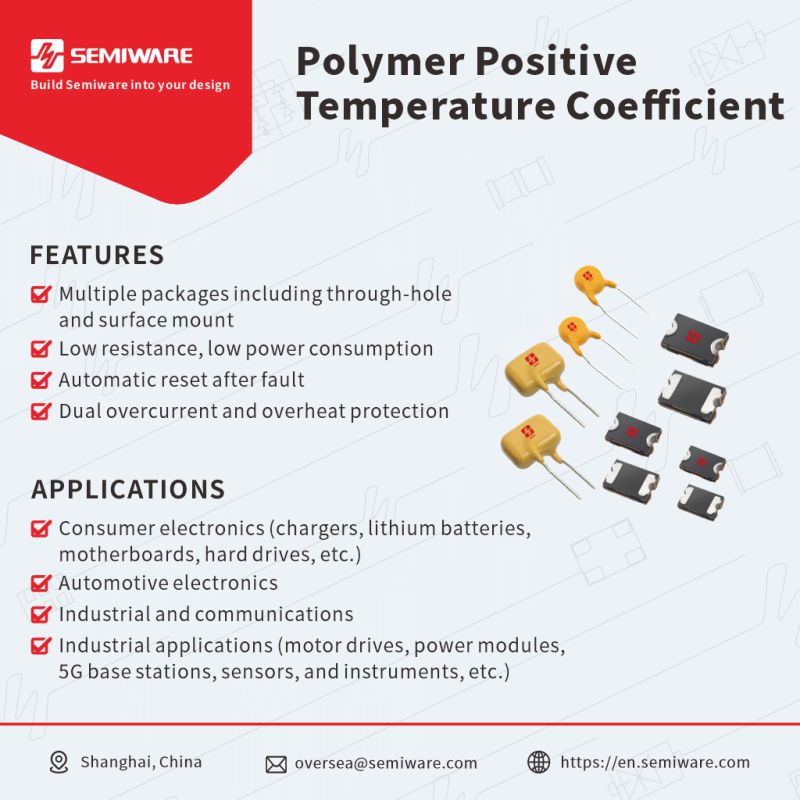
A resettable fuse, also known as a PPTC fuse, is an electronic protection device that utilizes the positive temperature coefficient (PTC) material properties of polymers to achieve overcurrent protection.
Unlike ordinary fuses, PPTC fuses do not permanently melt after an overcurrent event but return to a low-resistance state after the fault is cleared, allowing for reuse.
2. Working Principle of PPTC Resettable Fuses
Under normal operating conditions, the PPTC material maintains a low resistance value.
Typically, at 25°C, the resistance of a resettable fuse is less than 1Ω, ensuring normal power supply to the circuit.
2.1 When an abnormal condition occurs in the circuit, such as:
- Load short circuit
- Output overcurrent
- Motor stall
- Power supply malfunction
When the current flowing through the PPTC exceeds its rated value, internal heat is generated, causing the polymer material temperature to rise.
2.2 When the temperature reaches the operating point:
- The polymer structure changes;
- The distance between conductive particles increases;
- The device resistance rises rapidly;
The resistance can reach megaohm levels. At this point, the current is limited to a very small value, similar to an open circuit, thus protecting downstream circuits.
2.3 When the fault is cleared and the current decreases:
- The PPTC temperature drops;
- The material returns to its original structure;
- The resistance decreases;
The resettable fuse resumes its conducting state.
3. Main Features of Resettable Fuses
3.1 Automatic Reset Function
Compared to disposable fuses, the biggest advantage of PPTCs is their reusability. After an abnormality occurs, the equipment can resume operation without repair or fuse replacement.
3.2 Overcurrent Protection
When the load current exceeds the set range, the PPTC enters a high-impedance state, limiting the fault current and preventing damage to the PCB circuitry.
3.3 Fast Response
PPTC fuses typically operate within milliseconds to seconds.
3.4 High Reliability
Because it has no mechanical structure and eliminates the risk of fuse burnout, PPTC fuses are suitable for equipment requiring long-term reliable operation.
4. Key Parameters of Resetting Fuse
4.1 Hold Current (Ihold)
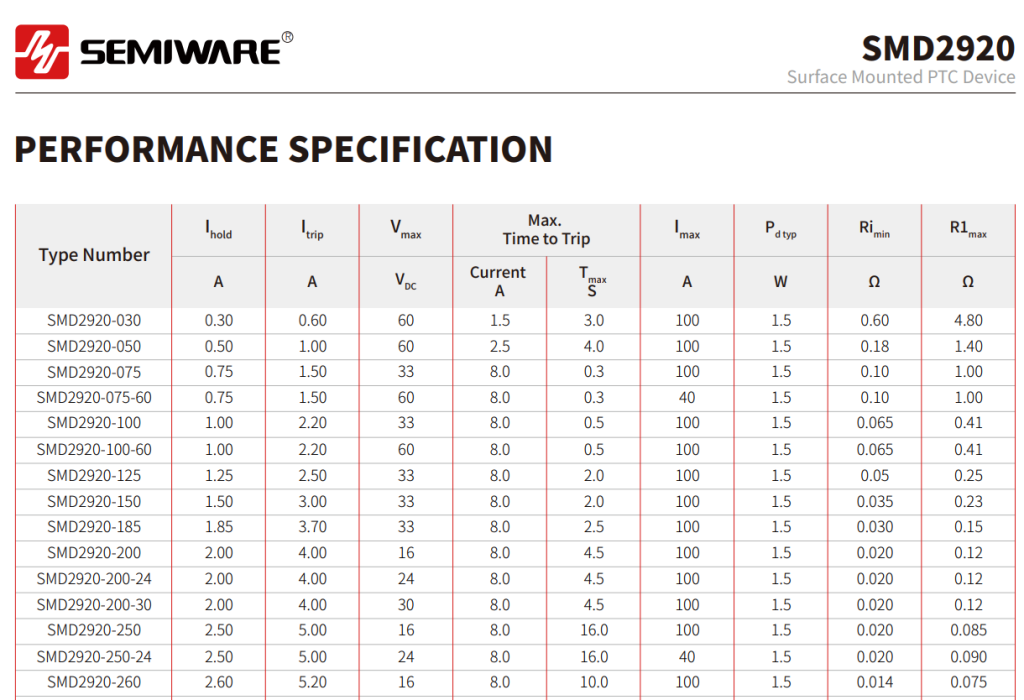
Ihold represents the maximum operating current at which the PPTC fuse can maintain a low-resistance state without tripping under conditions of 25°C.
When the actual operating current (Iload) < Ihold, the PPTC remains normally conducting.
For example, if the maximum operating current of the device is 500mA, then the selected Ihold must be greater than 500mA.
However, it should be noted that temperature affects Ihold. PPTCs are thermistors, and their holding current will change with ambient temperature.
General Rules:
Ambient Temperature Changes in Ihold: Below 25℃, Ihold increases; Above 25℃, Ihold decreases.
Therefore, in high-temperature applications, the 25℃ specification cannot be directly used for selection; derating design is required.
For example: If the equipment's maximum operating temperature is 50℃ and an actual operating current of 450mA is required, the temperature effect needs to be considered:
Ihold ≈ 450mA / 0.8 ≈ 560mA
Therefore, a model with a nominal Ihold greater than 560mA should be selected.
4.2 Trip Current (Itrip)
Itrip represents the minimum current required to bring the PPTC to a high-resistance state at 25℃.
When I > Itrip, the PPTC begins to heat up and enters protection mode.
4.3 Maximum Voltage (Vmax)
Vmax represents the maximum operating voltage that the PPTC fuse can withstand.
When selecting a model, Vmax ≥ the system's maximum operating voltage, and it is recommended to reserve a certain margin.
4.4 Trip Time
Trip time represents the time required for the PPTC to transition from a low-resistance state to a high-resistance state under specified overcurrent conditions. The higher the current, the faster the trip.
5. Self-Resetting Fuse Selection Method
Case Study:
A 24V power system requires overcurrent protection:
Step 1: Determine the rated voltage Vmax
The system voltage is 24V, so the fuse must have a Vmax ≥ 24V, with a margin.
Step 2: Calculate Ihold
The maximum operating temperature is 50℃. Based on temperature derating: Ihold ≈ 450mA / 0.8 = 560mA
Therefore, the selected Ihold needs to be greater than 560mA.
The Semiware SMD2920 series PPTC fuses SMD2920-075 and SMD2920-100 can meet the operating current requirements.
Step 3: Confirm Action Time
Requirement: Trip Time < 1s at 5A
From the datasheet above, both SMD2920-075 and SMD2920-100 meet the requirements.
However, the SMD2920-075 has a lower holding current, resulting in a faster thermal response and providing faster protection.
Therefore, the recommended solution for this application is the SMD2920-075 Resettable Fuse.
6. Common Applications of PPTC Resettable Fuse
6.1 Power Input Overcurrent Protection
When a short circuit occurs in the downstream stage or the load increases abnormally, the PPTC limits the current, protecting the power supply and PCB.
Applications:
- Industrial control equipment
- Smart terminals
- Battery-powered equipment
6.2 USB Interface Protection
USB interfaces frequently face external device malfunctions, output short circuits, and hot-plugging shocks. Therefore, a PPTC is usually connected in series in the USB VBUS line to protect the main control chip and power module.
6.3 Battery and Charging Equipment Protection
In lithium battery devices, power tools, and consumer electronics, PPTC can be used to limit abnormal currents and improve system safety.
6.4 I/O Interface Protection
Conclusion
PPTC resettable fuses, with their automatic recovery, reusability, and reliable protection features, have become important overcurrent protection devices for electronic equipment.
In practical selection, the following factors need to be considered:
- Ihold holding current;
- Itrip trigger current;
- Vmax rated voltage;
- Action time;
- Ambient temperature effect;
Semiware offers a variety of PPTC resettable fuse products, including the SMD1206, SMD1812, and SMD2920 series, to meet the application needs of consumer electronics, power modules, industrial control, and interface protection.
For PPTC selection assistance for specific applications, please contact the Semiware technical team for support.