With the advancement of artificial intelligence, automatic control, and smart manufacturing technologies, electronic robots are rapidly entering diverse fields such as industrial automation, medical assistance, logistics and distribution, and intelligent services.
However, compared to traditional electronic devices, robotic systems typically integrate a greater number of high-speed communication interfaces, precision sensors, microcontrollers, and wireless modules, making their electronic systems significantly more sensitive.
Therefore, establishing a robust ESD (Electrostatic Discharge) protection strategy during the product design phase is crucial for enhancing system reliability.
I. Key ESD Risks Faced by Electronic Robots
- Damage to Semiconductor Devices
Robots contain numerous highly integrated electronic components. As the internal structural dimensions of these chips shrink, they become increasingly sensitive to high transient voltages. When the transient voltage generated by an ESD event exceeds the device's tolerance threshold, it can lead to:
- Gate oxide breakdown
- PN junction damage
- Chip functional failure
- Control Program Errors and Data Anomalies
During robot operation, transient interference caused by ESD can affect:
- Data stored in Flash memory
- MCU operating status
- Communication data transmission
Resulting in:
- Abnormal program execution
- Parameter loss
- Control logic errors
- Sensor Misinterpretation and System Anomalies
Modern robots rely heavily on sensors for environmental perception, such as:
- Cameras
- LiDAR
- Infrared sensors
- Encoders
- Touch sensors
ESD interference can compromise sensor signal integrity, causing the robot to experience:
- Positioning errors
- Distance detection anomalies
- Motion control deviations
- ESD Impact on Communication Interfaces
Robots typically feature numerous external interfaces:
- USB
- HDMI
- Ethernet / RJ45
- CAN
- RS485
- UART
- Wi-Fi
These interfaces are directly exposed to the external environment, serving as primary pathways for static electricity to enter the device's internal circuitry.
II. ESD Protection Methods in Robot Circuit Design
While production environments can mitigate risks through anti-static measures, robots in real-world application environments cannot entirely avoid static electricity generated by human contact, equipment friction, or air discharge.
Therefore, active protection must be established through circuit design.
- Optimizing PCB Layout and Routing Design
a. Isolation of sensitive areas from interference sources
Properly partition the following areas:
| High-Interference Areas | Sensitive Areas |
| Motor drive circuits | MCU control circuits |
| Power conversion modules | Sensor interfaces |
| High-frequency communication modules | Analog acquisition circuits |
b. Shorten signal paths
Minimize the trace lengths for high-speed and sensitive signals to reduce the impact of ESD transient voltages on signal integrity caused by parasitic coupling. Examples include:
- Clock signals
- High-speed camera interfaces
- Communication lines
c. Establish low-impedance return paths
Properly plan power, ground, and signal layers in the PCB design to provide a rapid discharge path for ESD currents and limit the scope of interference.
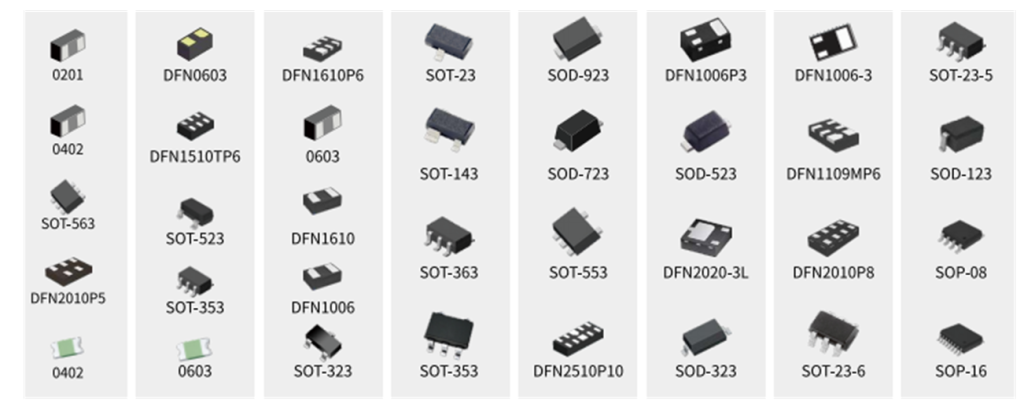
- Use TVS/ESD protection devices
TVS diodes are the most common protection solution for ESD defense in robotic interfaces.
Operating principle:
When static electricity generates a high-voltage transient, the TVS device conducts rapidly to shunt the surge current while clamping the residual voltage to a safe level, thereby protecting downstream chips.
a. Communication interface protection
Examples:
- USB interfaces
- CAN interfaces
- RS485 interfaces
- Ethernet interfaces
👉 Using low-capacitance ESD protection devices enhances the interface's ESD immunity while maintaining high-speed signal transmission.
b. Power interface protection
Robots typically utilize battery-powered systems; power inputs are susceptible to transients caused by plugging/unplugging, external static electricity, and power fluctuations.
👉 TVS devices can be used for power input protection to mitigate the impact of high-voltage transients on MCUs, motor driver ICs, and power management chips.
- ESD protection for sensors and external interfaces
Robot sensors are often mounted externally, making them more vulnerable to human contact or environmental static electricity.
Design strategies include:
- Adding ESD protection devices at sensor interfaces
- Using shielding structures to reduce external interference
- Optimizing grounding paths
Examples:
Interfaces for cameras, touchscreens, and encoders require ESD protection solutions tailored to the specific operating environment
Semiware offers comprehensive ESD protection solutions for common robotic interfaces, including:
- USB interfaces
- RJ45 network interfaces
- RS232/RS485 communication interfaces
- HDMI interfaces
- CAN interfaces
- SPI / UART
- I2C
- Analog signal interfaces
↗️ For more reference designs: https://en.semiware.com/application
- Filtering and Decoupling Design
In addition to ESD protection devices, proper filtering design can enhance a system's immunity to interference.
a. Power Supply Filtering
Utilize LC or Pi-type filters to reduce high-frequency interference on power lines and improve the stability of the robot's power supply.
b. Chip Decoupling Design
Strategically place decoupling capacitors near MCUs, communication chips, and motor driver chips to minimize power supply fluctuations caused by ESD events.
Low-capacitance capacitors: Suppress high-frequency noise
High-capacitance capacitors: Provide transient current support
- Grounding and Shielding Design
a. Optimizing Grounding Paths
A key aspect of ESD protection is designing an effective discharge path.
Ensure the following:
- Short TVS grounding paths
- Low grounding impedance
- Clearly defined return paths
b. Electromagnetic Shielding
For components such as:
- Wireless communication modules
- RF circuits
- High-precision analog circuits
Metal shielding covers can be employed—with proper grounding—to reduce static electricity and electromagnetic interference.
Conclusion
As robots become increasingly intelligent, proper PCB layout, the use of TVS/ESD protection devices, interface protection, filtering, and grounding/shielding designs are essential. These measures effectively reduce system failures caused by static electricity, thereby enhancing the stability and service life of robotic products.
Semiware specializes in circuit protection solutions, offering products such as ESD diodes, TVS diodes, TSS, GDTs, MOVs, MOSFETs, and Zener diodes to help customers build more reliable and secure intelligent electronic systems.