Overview
Within the smart home ecosystem, smart speakers serve as central hubs, integrating a diverse array of functions such as audio playback, voice interaction, network connectivity, and touch-screen display capabilities. However, their complex circuitry and highly integrated SoCs render them highly susceptible to external electrical interference.
Electrostatic discharge (ESD) and voltage surges represent two of the most prevalent electrical overstress events. Without effective protection, such incidents can—at best—trigger device restarts or functional anomalies; at worst, they can result in the permanent damage of core components.
Drawing upon the typical circuit architectures of smart speakers, this article provides an in-depth analysis of the critical risk points these devices face, and—leveraging the high-performance protection solutions offered by Semiware—proposes targeted protection strategies to address them.
I. Primary Sources of ESD and Surge Risks in Smart Speakers
Multiple external interfaces and internal modules within a smart speaker are exposed to potential electrical threats, primarily including:
1. USB Ports
As common ports for charging and data transmission, USB interfaces are highly susceptible to Human Body Model (HBM) ESD events triggered by user plug-and-unplug operations or contact with charged objects; the associated voltages can reach levels as high as ±15kV or even higher. Furthermore, the power input side may experience surges resulting from power adapter malfunctions or lightning-induced transients.
2. RJ45 Ethernet Ports
Used for wired network connections, these ports are often situated near windows or exterior walls, making them vulnerable to high-voltage surges induced by lightning or coupled through power lines. Additionally, network cables themselves can accumulate static electricity during long-distance routing.
3. Audio Output Interfaces
Used to connect external speakers or headphones, these interfaces pose a risk where, upon user contact with exposed metal contacts, static electricity may be conducted through the audio lines to the audio codec or power amplifier chip, potentially causing damage.
4. Display Interfaces
The flexible circuit board connectors for touchscreens or LCD/OLED panels are often exposed; frequent user interaction via touch operations can introduce high-frequency, high-voltage ESD events, and the display driver chips are extremely sensitive to voltage fluctuations.
5. Power Management Modules
Although the AC input is not explicitly labeled in the accompanying diagram, when the device is powered via USB or an external power supply, power components—such as the MOSFETs situated upstream of the DC/DC converters and LDOs—are susceptible to damage caused by surges at the power source or reverse-polarity connections.
II. Circuit Block Diagram
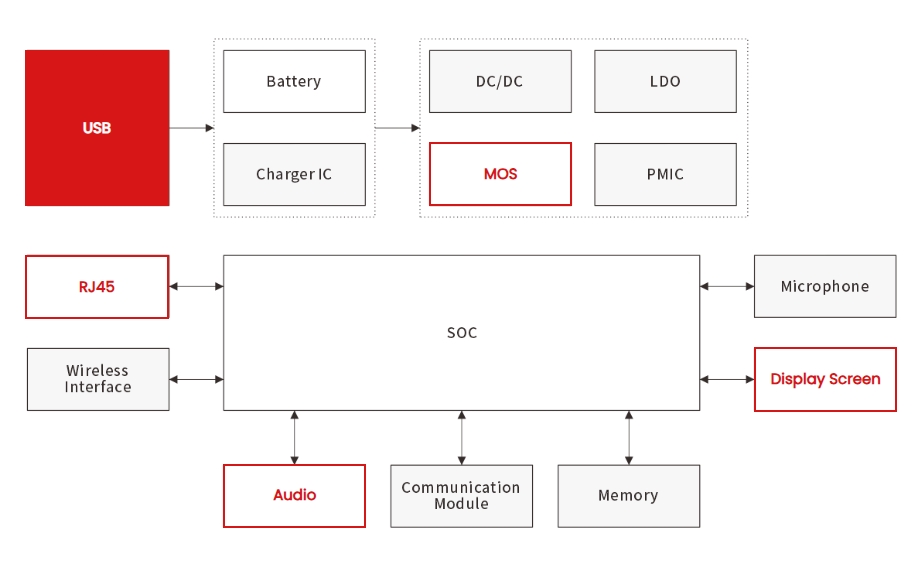
III. Semiware High-Performance Protection Solutions
To address the aforementioned risk points, Semiware offers a comprehensive range of circuit protection devices characterized by low capacitance, high immunity, and rapid response times, ensuring that smart speakers maintain stable operation even in demanding environments.
Specific details are as follows:
| Application Area | Risk Type | Recommended Product | Key Parameters | Protection Strategy |
| USB Interface | ESD, Surge | SE41T06U5.0LB | 5V, ±20kV, 2pF, SOT-143 | Protect VBUS & data lines with low-capacitance TVS, placed close to connector |
| RJ45 Port (Primary Protection) | Lightning Surge | SG3225B800 | 800V, 1kA, 0.5pF | Use GDT for high-energy surge diversion |
| RJ45 Port (Secondary Protection) | ESD | SE3D15B3.3MA | 3.3V, ±30kV, 0.6pF | Secondary fine protection for PHY side |
| RJ45 Differential Lines | ESD | SESRV05-4A | 5V, ±15kV, 0.8pF | Multi-line TVS array for Ethernet signals |
| RJ45 Power / PoE Lines | Surge | STB100B58 | 58V, 6kV, 100A | Protect low-voltage power lines |
| AC / High Voltage Lines | Surge | STB100B275 | 275V, 6kV, 100A | High-energy surge protection for AC side |
| Audio Interface | ESD | SE10F10B5.0A | 5V, ±25kV, 15pF | Balance ESD protection and audio signal integrity |
| Display Screen | ESD | SE10F10B3.3MA | 3.3V, ±30kV, 0.22pF | Ultra-low capacitance for high-speed signals |
IV. Design Insights
1. Multi-Level Protection is Essential
GDT (Primary protection) → handles high surge current
TVS (Secondary protection) → clamps residual voltage
2. Capacitance Matters
Audio & display lines require ultra-low capacitance devices
High capacitance may degrade signal integrity
3. Placement is Critical
Always place protection devices as close to the connector as possible
Minimize trace inductance for fast transient response
4. System-Level Coordination
Combine TVS + Thyristor + GDT where needed
Ensure proper grounding and return path design
V. Summary
The protection solutions provided by Semiware cover the key risk interfaces of smart speakers. Through appropriate component selection and layout, these solutions effectively withstand the impact of ESD and surges, thereby enhancing product reliability and user experience.
Interested in delving into the circuit diagram details of this smart speaker protection solution, or looking to obtain relevant technical documentation?
👉 Click the link to visit Semiware’s official application page and explore more reference designs for building reliable application circuits. https://en.semiware.com/applications/smart-speaker/