⚡ Why Resettable Overcurrent Protection Matters?
Overcurrent events are frequent in electronic systems. Hot-swapping, short circuits, surges, and unexpected load changes can all damage sensitive components. Without proper protection, this can lead to damage to electronic equipment, shortened product lifespan, and even safety hazards.
Resettable PTC fuses are indispensable for designers seeking reliable protection solutions. The SMD1812P010TF resettable PTC fuse combines current capacity, compact size, and long-term reliability, making it widely used in consumer electronics and industrial applications.
🚀 What is the SMD1812P010TF Resettable PTC Fuse?
The SMD1812P010TF belongs to the SMD1812 series of PPTC (Polymer Positive Temperature Coefficient) resettable fuses. Unlike traditional one-time fuses, PPTC devices do not require replacement even after a failure.
⚙️ How the SMD1812P010TF Resettable PTC Fuse Works?
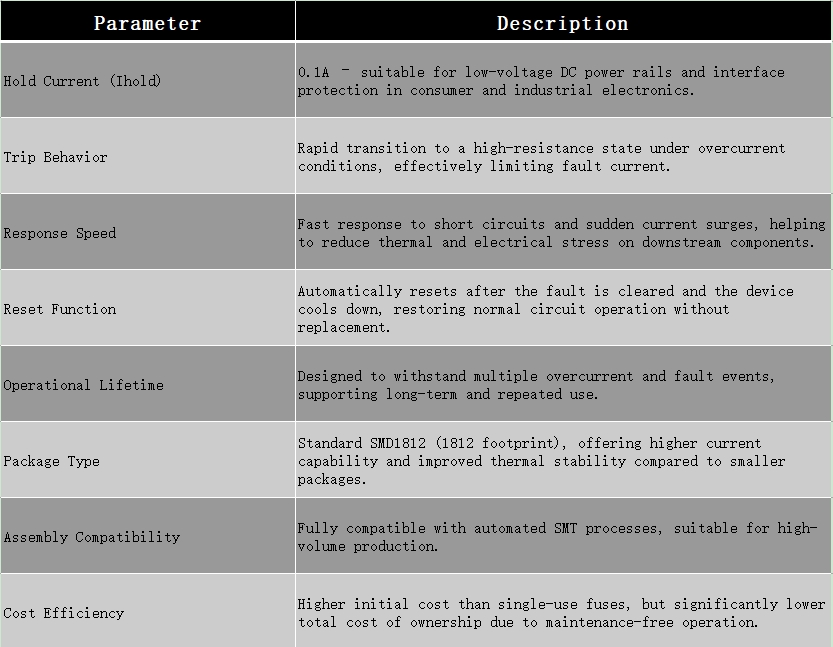
When the current exceeds its specified limit, the polymer material inside the fuse heats up and enters a high-resistance state. This rapid increase in resistance effectively limits the fault current, thus protecting downstream circuits. Once the abnormal situation is resolved and the device cools down, it automatically returns to a low-resistance state, resuming normal operation.
The self-resetting characteristic of the SMD1812P010TF PTC greatly improves the operating efficiency of electronic equipment and saves maintenance costs.
✔️ Key Electrical Characteristics and Design Benefits
🔋 Typical Applications of the SMD1812P010TF
- Charging Interface ➡️ USB port, internal charging circuitry, and power input short-circuit and overload protection.
- Consumer Electronics ➡️ Laptops, tablets, smart devices, and other portable electronic products requiring reliable power protection.
- Industrial Control Systems ➡️ Applications requiring stable and reliable protection, such as PLC modules, sensors, and control boards.
- Communication Equipment ➡️ Routers, switches, and network interface circuits susceptible to transient failures.
- Power Modules ➡️ Provide output protection for DC-DC converters, adapters, and auxiliary power supplies.
In circuit protection design, the SMD1812P010TF resettable fuse provides a more intelligent and worry-free option. It combines protection and self-healing, making your products more durable and reliable. For engineers who prioritize product stability and user experience, this is undoubtedly a high-quality component worth adding to their consideration list.
Find the right SMD1812 PPTC fuse for your design👇
If you are developing new products or upgrading existing protection designs, we offer a full range of SMD1812 PPTC fuses. They are of stable quality, have flexible delivery times, and come with technical support.
👉 Contact us for product specifications, samples, or cross-reference recommendations.
📩 sales29@semiware.com
❓ FAQs
1.What is a PPTC fuse?
A PPTC fuse is a resettable overcurrent protection device that increases its resistance when excessive current flows and automatically resets after the fault is removed.
2.How does it compare to traditional fuses?
Traditional fuses are single-use and must be replaced after tripping, while PPTC fuses reset automatically and require no maintenance—ideal for consumer and portable electronics.
3.How does a PPTC fuse work?
During overcurrent, the polymer material heats up and expands, sharply increasing resistance to limit current. After cooling, it returns to its low-resistance state, restoring normal operation.
4.What is the difference between PPTC and PTC?
PPTC is a polymer-based PTC device designed specifically for resettable overcurrent protection, while standard PTC components are typically used for temperature sensing or inrush current limiting.
5.What is the difference between NTC and PTC?
NTC resistance decreases as temperature rises (used for sensing and inrush limiting), while PTC resistance increases with temperature (used for protection or heating functions).



Comments (0)