Most engineers have faced this frustration: your product passes every functional test, but then fails again and again at the final ESD (electrostatic discharge) test. Or worse, a customer returns a device, and after investigation you realize the I/O chip was killed by a hot-plug surge or a random static zap. In many cases, the missing link is simply a solid TVS diode array—like SRV05-4.
📌SRV05-4: The “Invisible Bodyguard” for Your Design
Picture this: you’re designing a charging case for premium Bluetooth earbuds. That small USB-C port isn’t just a power input—it also handles firmware updates and data sync. But it’s fully exposed, making it the weakest entry point for ESD.
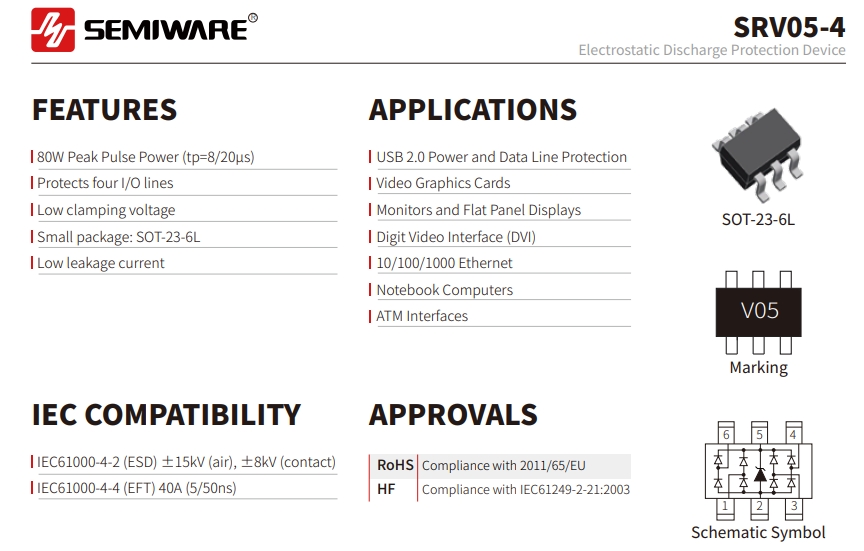
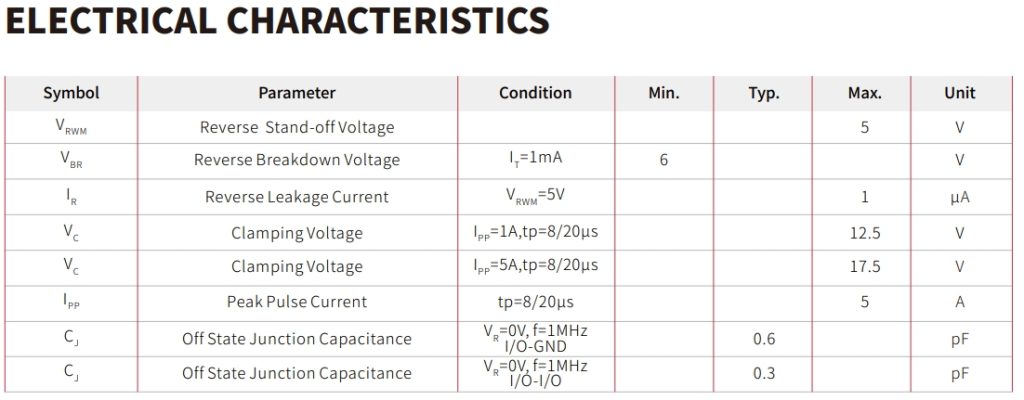
Here’s where SRV05-4 steps in. With response times in the nanosecond range, it clamps those surges to a safe level—around 12.5V at 1A or 17.5V at 5A.
Why does the 0.3pF junction capacitance is important? Because when you’re protecting high-speed signals like USB D+/D-, If the junction capacitance is too large, it will have a greater impact on the device data.Semiware's SRV05-4, the capacitance is so low you’ll barely notice it.
📌SRV05-4 can be used not only in consumer electronics, but also in industrial
Don’t think SRV05-4 is only for consumer gadgets. With an operating range from -55°C to +150°C, it’s also built for tougher environments.
Consider a factory floor, where PLC controllers connect to dozens of sensors and switches. Every time a motor starts or a relay clicks, strong transients and EMI ripple through the lines. Temperatures can spike too. In this setting, SRV05-4 can preventing system glitches or shutdowns. It’s the kind of invisible protection that ensures continuous, stable production.
📌Semiware's SRV05-4 can be used as a cost-effective alternative to Onsemi and Semtech
In recent years, many engineers learned the hard way that relying on a single supplier can stall a project when shortages hit. That’s why second-source compatibility is crucial.
Semiware's SRV05-4 is pin-compatible with Onsemi and Semtech, and the electrical characteristics are nearly identical:
- Reverse stand-off voltage (VRWM): 5V → Perfect for 3.3V and 5V systems
- Breakdown voltage (VBR): ~6V → Ensures solid blocking in normal operation
- Clamping voltage (VC): ~12.5V @1A, 17.5V @5A → Practically the same protection level
This means you can drop Semiware‘s SRV05-4 into the same SOT-23-6 footprint without redesigning your PCB. On your BOM, it works as both a cost-effective replacement and a secure second-source option.
🌈 In general, whether it's consumer electronics, networking equipment, or industrial equipment, Semiware's SRV05-4 can provide reliable circuit protection while controlling your BOM costs.
Product Line👉https://en.semiware.com/tvs-array/srv05-4/
📌 Design Tips: Maximizing the Protection of the SRV05-4
Place it close to the interface
- Place the TVS diode as close as possible to USB, I/O, or other sensitive interfaces to quickly absorb transient voltages and prevent damage to the chip.
- This is especially important for high-speed signals (such as USB D+/D-). Close placement reduces voltage spikes induced by PCB traces.
Optimize grounding
- The GND pin of the TVS should be directly connected to the PCB ground plane to avoid introducing additional inductive reactance through long traces.
- If the ground line is too long, surges may cause voltage drops along the trace, reducing the protection effect.
Series/Parallel Considerations
- One TVS is usually sufficient for a single interface. For multiple interfaces, place them independently for each interface.
- Avoid connecting multiple TVS in parallel on the same signal line. Unless designed and verified, this may lead to uneven clamping voltage or abnormal triggering.
PCB Routing Recommendations
- Keep signal lines as short and straight as possible to reduce loop area and improve ESD immunity.
- For high-speed signals, a low-capacitance layout is maintained; the 0.3pF capacitor in the SRV05-4 maximizes signal integrity.
Considering temperature and environment
- The SRV05-4 supports temperatures from -55°C to +150°C, making it suitable for industrial environments.
- In high-temperature scenarios, ensuring no additional thermal resistance at both ends of the TVS is crucial for optimal clamping performance.
💡 FAQs
Q1: Will the SRV05-4 affect high-speed USB signals?
A: Almost not. With an ultra-low 0.3pF junction capacitance, the SRV05-4 ensures high-speed USB D+/D- or other data lines transmit signals without degradation or errors.
Q2: Can the SRV05-4 withstand high temperatures in industrial environments?
A: Yes. It has a wide operating temperature range of -55°C to +150°C, making it suitable for industrial equipment, PLC controllers, and outdoor devices.
Q3: Can it replace Onsemi or Semtech TVS diodes?
A: Absolutely. The SRV05-4 is pin-compatible with Onsemi and Semtech devices, with nearly identical electrical characteristics, so you can drop it into the same SOT-23-6 footprint without redesigning your PCB.
Q4: How do I choose the right TVS for my system?
A: Consider the system’s operating voltage (VRWM), maximum surge current, signal speed, and interface type. The SRV05-4 is ideal for 3.3V or 5V systems, providing robust protection without affecting high-speed signals.
Q5: Do I need multiple TVS diodes for multiple interfaces?
A: It is recommended to place one TVS per sensitive interface. Sharing a TVS across multiple interfaces may cause uneven clamping and reduce overall protection effectiveness.
Whether you’re designing consumer electronics, industrial controllers, or high-speed USB devices, SRV05-4 keeps your circuits safe—without compromising performance.
Whether it’s technical support, datasheets, or sample requests, Semiware is here to help you protect your designs.
👉 https://en.semiware.com/contact/