Overview
When designing surge protection for AC power supplies, the selection of a Metal Oxide Varistor (MOV) should not be based solely on the nominal mains voltage. It is essential to also consider the maximum continuous operating voltage across the device, its surge clamping capability, and the specific conditions of the power supply.
The Semiware 10D511K is a 10mm-diameter (Φ10mm) zinc oxide varistor with a nominal varistor voltage of 510V and a maximum continuous AC operating voltage of 320VAC. Compared to the 10D471K and 10D621K models, it offers a different continuous operating voltage rating, making it suitable for AC input circuits that align with its specifications—such as certain 277VAC commercial lighting systems, industrial auxiliary power supplies, and power units for telecommunications equipment.
This article outlines the key parameters, typical applications, and design considerations for the 10D511K, assisting engineers in selecting the appropriate component based on actual operating voltages and specific protection requirements.
I. Key Electrical Parameters of the 10D511K
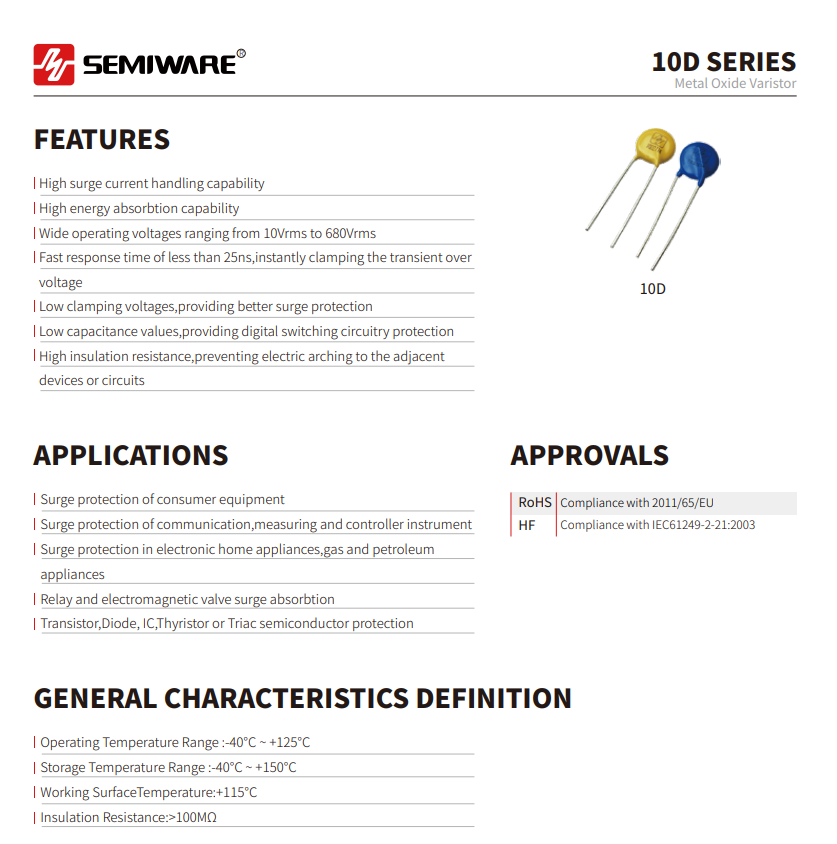
According to the datasheet for the Semiware MOV-10D series, the primary specifications for the 10D511K are as follows:
- Nominal Varistor Voltage (V₁mA): 510V
- Maximum Continuous AC Operating Voltage (VAC): 320VAC
- Maximum Continuous DC Operating Voltage (VDC): 415VDC
- Maximum Clamping Voltage: 845V
- Standard Surge Current Capacity (8/20μs): 2500A
- High Surge Current Capacity (8/20μs): 3500A
- Energy Absorption Capability: 98J (standard conditions) / 102J (high-surge conditions)
- Rated Power: 0.4W
- Typical Capacitance: 200pF
- Operating Temperature: -40°C to +125°C
- Encapsulation Material: Epoxy Resin
The 10D511K features a maximum continuous AC operating voltage of 320VAC. This means it is suitable for AC circuits where the continuous operating voltage across the MOV does not exceed its rated range; however, it is not appropriate for direct use in 400 VAC line-to-line circuits or in main circuits subject to a sustained 380 VAC line-to-line voltage.
In a 230/400 V three-phase system, the line-to-neutral (L-N) voltage is typically around 230 V, while the line-to-line (L-L) voltage is approximately 400 V. Since the operating voltages differ depending on the connection point, each case must be evaluated individually; the appropriate MOV model cannot be determined solely based on a device’s “three-phase 400 V” or “three-phase 380 V” rating.
III. Main Application Scenarios
3.1 277VAC Commercial Lighting and LED Driver Power Supplies
In some commercial buildings in North America, lighting equipment is powered by 277VAC. For designs where an MOV is connected directly across a 277VAC input circuit (within rated conditions), the 10D511K—with its maximum continuous operating voltage of 320VAC—provides an adequate voltage margin.
It can be used at the input of commercial LED lighting drivers and other lighting power supplies (provided they meet the voltage criteria) to absorb transient overvoltages caused by events such as lightning-induced surges or switching operations.
3.2 Industrial Auxiliary Power Supplies and Control Equipment
Auxiliary AC power supplies within industrial control cabinets, automation equipment, and measurement/control instruments may be subject to surges resulting from power grid switching, the starting or stopping of inductive loads, or coupling from external lines.
3.3 Communication Equipment and Outdoor Industrial Gateways
The AC auxiliary power inputs for communication equipment, industrial gateways, RTUs (Remote Terminal Units), and measurement/control terminals may be exposed to surges induced on the lines or transients caused by power switching.
3.4 Auxiliary AC Circuits in Photovoltaic (PV) and Energy Storage Systems
In photovoltaic inverters and energy storage systems, it is necessary to distinguish between the DC power circuit, the AC grid-connection point, and the internal auxiliary power supply circuit.
3.5 Home Appliances and Electronic Control Circuits
MOVs can be used to absorb power surges in home appliances, control instruments, and electronic equipment. Depending on specific circuit conditions, they may also be used to suppress transient overvoltages generated by inductive loads, such as relays or solenoid valves.
However, the 10D511K—with its nominal varistor voltage of 510V and maximum clamping voltage of 845V—is not suitable for all low-voltage control circuits. For inductive loads such as coils, the appropriate MOV specification should be selected based on the actual operating voltage, switching transients, and the voltage withstand rating of the device being protected.
IV. Common Pitfalls in Selection
❌ Misconception: Using a 10D511K in a 380V three-phase line-to-line main circuit.
A 380VAC supply exceeds the 10D511K’s maximum continuous operating voltage (MCOV) of 320VAC. Prolonged overvoltage can lead to increased leakage current, temperature rise, and performance degradation of the MOV. In such applications, a device with a higher MCOV rating must be chosen based on the actual maximum continuous voltage; one cannot simply assume that a 10D621K is appropriate just because the nominal voltage is 380V.
❌ Misconception: Selecting a 10D511K for standard 220V mains-powered equipment.
For typical 220/230VAC input circuits, if the 10D471K—with its 300VAC maximum continuous operating voltage—meets the design requirements, it is generally the preferred choice. While the 10D511K offers a greater operating voltage margin, its maximum clamping voltage (845V) is higher than that of the 10D471K (775V), which may increase the voltage stress on downstream circuitry.
✅ When should you consider the 10D511K?
The 10D511K may be considered when the equipment's actual AC input voltage exceeds the operating range of the 10D471K, yet the maximum continuous operating voltage across the MOV remains within 320VAC. Examples include certain 277VAC commercial lighting power supplies, as well as industrial auxiliary power supplies, auxiliary AC circuits for telecommunications equipment, and auxiliary AC inputs for energy storage systems.
Final component selection should take into account factors such as grid voltage fluctuations, the MOV's installation location, surge rating requirements, and the voltage withstand capabilities of the downstream circuitry.
For detailed specifications on the Semiware 10D series varistors, please visit: 👉 https://en.semiware.com/varistors/10d511k/
If you are evaluating MOVs for your application, feel free to contact Semiware for product information and technical support.