Introduction
Transient overvoltages in circuits—caused by events such as lightning-induced surges, power grid switching, relay operation, or the disconnection of inductive loads—can damage power modules, semiconductor devices, and control circuitry.
For consumer electronics and industrial control equipment, engineers must select appropriate overvoltage protection devices capable of rapidly suppressing transient voltage spikes without interfering with the normal operation of the circuit.
The 10D221K is a 10mm disc-type Metal Oxide Varistor (MOV) with a radial leaded package. It features a nominal varistor voltage of 220V, a maximum continuous operating voltage of 140VAC, and a surge current handling capability of 2500A (based on an 8/20μs waveform).
This article explores the performance characteristics and practical selection criteria for the MOV-10D221K, covering its operating principle, part number identification, key parameters, typical applications, and hardware design considerations.
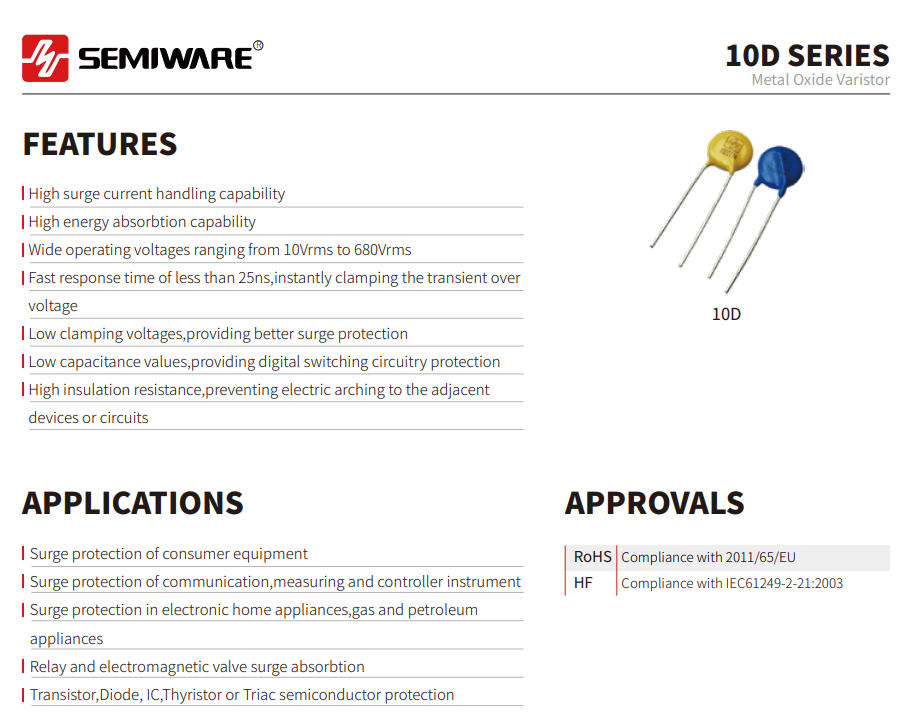
I. 10D221K Varistor Working Principle
The MOV-10D221K is based on zinc oxide (ZnO) ceramic material, which provides transient overvoltage protection through its inherent non-linear resistance characteristics.
Unlike a standard resistor, the resistance value of an MOV changes in response to the voltage applied across its terminals.
- Normal Operating State: When the voltage across the terminals remains within the normal operating range, the MOV exhibits high impedance. Only a negligible leakage current flows through it, ensuring it does not significantly affect the circuit's normal operation.
- Surge Protection State: When a rapid rise in voltage occurs—due to a lightning-induced surge or a switching transient—the MOV’s impedance drops sharply. This creates a low-impedance path for the surge current, thereby clamping the voltage and reducing the electrical stress on downstream electronic components.
- Post-Surge State: Once the transient voltage returns to normal levels, the MOV reverts to its high-impedance state, allowing the circuit to resume normal operation.
It should be noted that an MOV cannot absorb an infinite amount of surge energy. Repeated exposure to high-energy surges can lead to a gradual degradation in performance, or in severe cases, even trigger thermal runaway; therefore, it is essential to account for surge energy and incorporate appropriate safety protection measures.
II. 10D221K Key Electrical Parameters
| Parameter | Specs |
| Varistor Voltage | 220V ±10% |
| Max. AC Voltage | 140VAC |
| Max. DC Voltage | 180VDC |
| Max. Clamping Voltage | 360V |
| Max. Surge Current | 2500A (8/20μs) |
| Max. Energy | 46.2J |
| Capacitance | 450pF |
| Operating Temperature | -40°C to +125°C |
| Storage Temperature | -40°C to +150°C |
| Package | 10mm Radial Leaded |
The 10D221KJ is a high-surge variant, featuring a surge current capacity of 3500A and a maximum energy absorption of 46.5J. For detailed specifications, please refer to the official Semiware website.
https://en.semiware.com/varistors/10d221kj
III. Understanding the Three Voltage Ratings for the 10D221K: 220V, 140VAC, and 360V
When selecting a Metal Oxide Varistor (MOV), it is easy to confuse three specific parameters: varistor voltage, maximum continuous operating voltage, and maximum clamping voltage.
- 220V Varistor Voltage: The nominal voltage measured at a 1mA DC test current. This value characterizes the MOV’s V-I (voltage-current) curve and does not indicate that the device can operate continuously at 220V.
- 140VAC Maximum Continuous Operating Voltage: The maximum RMS AC voltage that the MOV can withstand over a long period. The normal operating voltage—including any fluctuations—must remain within this rated limit.
- 360V Maximum Clamping Voltage: The peak voltage across the MOV under a specified 25A surge test condition. This parameter is used to evaluate the residual voltage to which downstream components will be exposed during a surge event.
Consequently, when selecting an MOV, one should not rely solely on the 220V varistor voltage; it is equally important to consider the actual operating voltage and the voltage tolerance of the downstream components.
Important Note: The MOV-10D221K has a maximum continuous AC operating voltage of 140VAC; therefore, it is not suitable for direct connection to a 220–240VAC mains power input circuit.
IV. 10D221K Varistor Applications
The MOV-10D221K is primarily intended for circuits where the maximum continuous AC operating voltage does not exceed 140VAC, as well as for applications that meet its specified DC voltage ratings.
4.1 Power Circuit Protection
Used at the input of low-voltage AC power supplies or within power conversion circuits that meet specified rated voltage requirements, to suppress the impact of grid switching and external transient surges on downstream circuitry.
4.2 Relay and Inductive Load Protection
Used in drive circuits for relays, coils, and solenoid valves with appropriate voltage ratings, to suppress transient overvoltages generated during switching operations. The specific model should be selected based on the load's normal operating voltage and its transient characteristics.
4.3 Consumer Electronics and Home Appliance Control Equipment
Used in home appliance control boards, lighting control modules, and other electronic control equipment that meet specified rated operating voltage requirements, to mitigate the impact of transient voltages on sensitive electronic components.
4.4 Industrial Control and Instrumentation
Suitable for transient overvoltage protection in low-voltage control circuits, auxiliary power supplies, and measuring equipment.
V. Key Considerations for Using the 10D221K Varistor in Hardware Design
✅ Strictly Match the Maximum Continuous Operating Voltage
The 10D221K has a maximum continuous operating voltage of 140VAC; it must not be used directly in 220VAC mains circuits.
✅ Optimize PCB Layout
Traces between the varistor and the node being protected should be as short and wide as possible. Excessively long or narrow traces introduce parasitic inductance, which increases the effective clamping voltage and diminishes surge suppression performance.
✅ Account for Parasitic Capacitance
The MOV-10D221K has a typical capacitance of approximately 450pF (at 1kHz). While generally suitable for power supply protection, it is not recommended for high-speed signal lines, as it may compromise signal integrity.
✅ Understand Varistor Lifespan Characteristics
The performance of an MOV may gradually degrade after repeated exposure to high-energy surges. In environments prone to frequent high-energy surges, consider using a larger-sized MOV (e.g., 14D or 20D series) or evaluate a multi-stage protection scheme, such as an MOV combined with a Gas Discharge Tube (GDT).
Contact Us
Semiware offers a wide range of Metal Oxide Varistors (MOVs) to accommodate various voltage ratings and surge protection requirements.
For detailed specifications, sample requests, or assistance with component selection, please contact Semiware.
Download 10D221K datasheet (PDF) 👉 https://en.semiware.com/varistors/10d221k/
Contact Semiware 👉 https://en.semiware.com/contact