Overview
In DC 12V power supply systems, the risk of electrostatic discharge (ESD) and surge increases significantly when the withstand voltage is increased to 4KV. This is common in complex environments such as outdoor communication base stations, industrial automation equipment, and automotive electronics.
This article will explore the risks associated with DC 12V-4KV and analyze Semiware's recommended combination of a gas discharge tube and a TVS diode.
I. Electrostatic Discharge and Surge Risks in DC 12V-4KV Circuits
1️⃣ Lightning Surges: Outdoor equipment (such as surveillance cameras and base station power supplies) is susceptible to direct or induced lightning strikes, generating transient high voltages up to 4KV. These voltages, coupled to the circuit through the power line, can potentially break down insulation or burn out PCB traces.
2️⃣ Electrical Fast Transient (EFT): In industrial environments, operations such as motor starting/stopping and relay switching generate high-frequency high-voltage pulses (e.g., the 4KV level in the IEC 61000-4-4 standard), leading to signal interference or equipment malfunction.
3️⃣ Electrostatic Discharge (ESD): When a human body comes into contact with the device interface, static electricity can reach 15KV in a dry environment. Instantaneous discharge can damage sensitive components such as ICs and MOSFETs, causing permanent failure.
4️⃣ Power Fluctuations and Overloads: When a car starts, the battery voltage may suddenly drop below 6V, or when the alternator fails, the voltage may surge to above 24V. These surges, combined, pose a double threat to the circuit.
II. Semiware Protection Solution: GDT and TVS Working Together
To effectively cope with the 4KV high-voltage challenge, Semiware adopts a classic two-stage protection architecture. As shown in the circuit diagram, this solution uses a gas discharge tube (GDT) as the first stage of "coarse" protection to dissipate large currents; and a TVS diode as the second stage of "fine" protection to precisely lock the voltage.
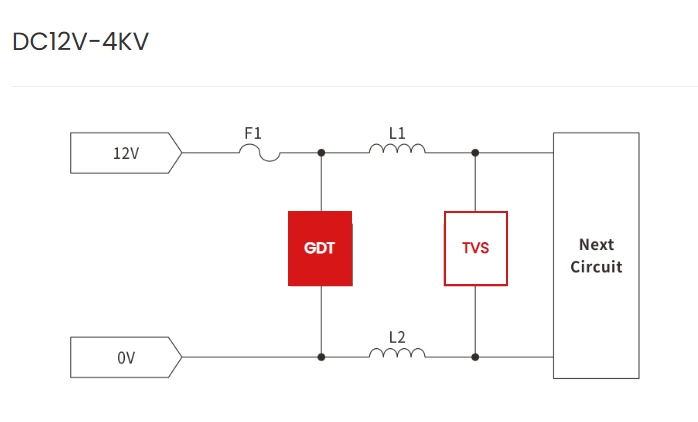
1. First Stage of Protection: SG4532B300 (GDT)
Location: Near the power input terminal
Function: The GDT has extremely high insulation resistance and extremely low capacitance. When a 4KV surge occurs, the GDT (Gas Transmission Device) quickly breaks down and conducts, discharging most of the surge current (up to 2KA) to the ground, limiting the voltage to around 300V. It acts like a "dam," blocking the flood peak.
2. Second line of defense: SVB100B15 (TVS)
Location: Immediately adjacent to the downstream sensitive circuit.
Function: The TVS has an extremely fast response speed (nanosecond level). After the GDT activates, the residual voltage or rapidly rising pulse will be instantly clamped below 18.5V by the TVS, ensuring the absolute safety of the downstream 12V equipment.
III. Core Component Parameters and Advantages Analysis
| Parameter | SG4532B300 (GDT) | SVB100B15 (TVS) | Synergistic Advantage |
| Core Function | DC Breakdown Voltage: 300V (±20%) | Clamping Voltage: 16.7–18.5V | High–Low Coordination: The GDT remains non-conductive under normal conditions (ultra-low standby leakage), while the TVS provides precise clamping within the 12V safety window, ensuring full protection coverage. |
| Energy Handling | Peak Surge Current: 2kA (8/20μs) | Peak Pulse Power: 1000W | Energy Coordination: The GDT acts as the primary surge path, dissipating most of the lightning energy; the TVS suppresses residual transients, preventing overstress of downstream components. |
| Response Characteristics | Capacitance: ~1pF | Response Time: <1ns | Speed Complementarity: The GDT offers ultra-low capacitance with minimal signal impact, while the TVS responds in nanoseconds to clamp fast transients and compensate for the GDT’s slower turn-on (μs level). |
| Package | 4.5 × 3.2 × 2.7 mm | SMB | Design Flexibility: Both devices use compact SMD packages suitable for high-density PCB layouts. The GDT’s high insulation resistance minimizes leakage current in normal operation. |
IV. Solution Advantages and Application Scenarios
1️⃣ High Voltage Withstand Capability: Two-stage protection can withstand 4KV surges (IEC 61000-4-5 standard), meeting the lightning protection requirements for outdoor equipment.
2️⃣ Low Residual Voltage Protection: The TVS clamps the voltage to below 18.5V, far below the withstand voltage limit of 12V system components (typically 24V), ensuring the safety of downstream circuits.
3️⃣ Miniaturized Design: The GDT uses a 4.5x3.2mm package with an SMB surface mount TVS, saving PCB space and making it suitable for compact devices.
4️⃣ Application Scenarios:
- Automotive Electronics: ECUs, on-board chargers (protection against startup surges and ESD).
- Industrial Control: PLCs, sensors (protection against EFT and lightning strikes).
- Communication Equipment: Base station power supplies, routers (protection against lightning and ESD).
V. Summary
Protection of DC12V-4KV circuits requires a balance between high-energy discharge and fast voltage clamping. Semiware, through the collaborative design of the SG4532B300 Gas Discharge Tube and the SVB100B15 TVS diode, achieves full-scenario protection from lightning surges to ESD, providing reliable assurance for industrial, automotive, and communication fields.
📢 Looking to optimize surge protection for your 12V or high-reliability circuits?
Contact Semiware today to get customized circuit protection solutions, expert design support, and cost-effective component recommendations tailored to your application.