Outdoor lines connected to telecommunications access equipment are frequently exposed to environments prone to lightning strikes and transient surge interference. As a core component of line cards, the Subscriber Line Interface Circuit (SLIC) is highly susceptible to damage from transient overvoltage events.
When designing multi-port voice and xDSL broadband equipment, engineers require port protection solutions that balance multi-channel integration, low signal loss, and high surge tolerance. The Semiware STP61089Q is a highly adaptable, programmable thyristor-based overvoltage protection chip designed specifically to address these challenges.
I. STP61089Q Core Principles
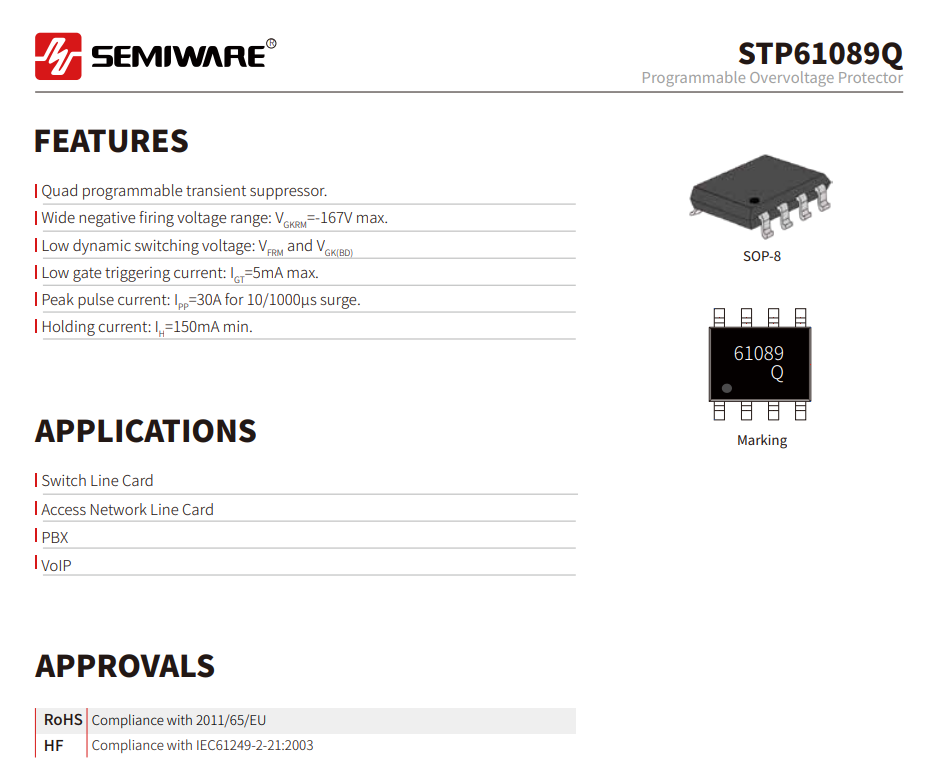
The STP61089Q is a 4-channel, buffered-gate overvoltage protection device housed in a standard SOP-8 surface-mount package, making it ideal for compact PCB designs.
Internally, the device integrates an array of four buffered thyristors sharing a common gate and anode architecture, while each thyristor features an independently accessible cathode pin. This allows for independent protection of four signal lines simultaneously; a single chip replaces multiple discrete protection components, effectively streamlining the Bill of Materials (BOM) and reducing PCB layout space.
Unlike conventional surge suppression devices with fixed thresholds, this chip features programmable triggering characteristics. It is compatible with the typical negative-bias operating conditions of telecommunications equipment, maintaining a high-impedance state during normal operation without interfering with signal transmission.
Upon encountering lightning-induced transient overvoltage, the device rapidly switches to a low-impedance state to shunt surge energy. It automatically reverts to its normal state once the surge subsides—eliminating the risk of latch-up—thereby ensuring the equipment's continuous and stable operation.
II. Key Features and Core Parameters
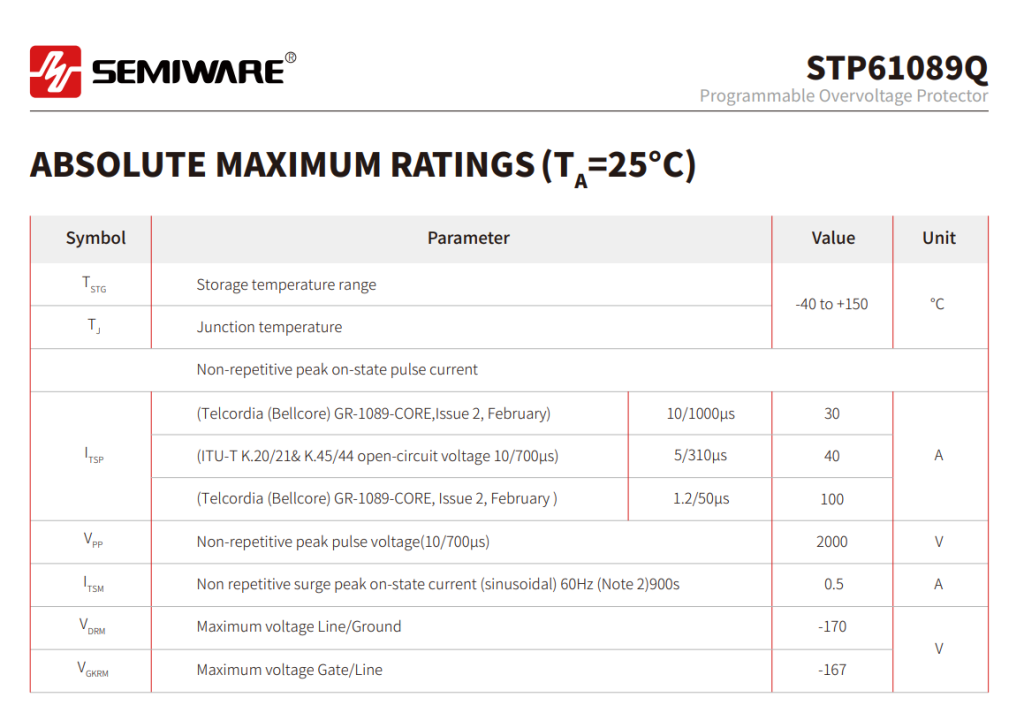
Surge Robustness: Peak current of 40A for the 5/310μs surge waveform and 30A peak pulse current for the 10/1000μs condition; capable of withstanding standard lightning surge impacts on lines.
Voltage Ratings: Maximum off-state reverse voltage of -170V, gate reverse voltage rating of -167V, and maximum breakdown voltage of 64V; suitable for the negative-voltage operating environments of telecommunications lines.
Low-Loss Design: Maximum junction capacitance of 70pF significantly reduces high-frequency signal attenuation, ensuring xDSL broadband signal integrity; maximum trigger current of only -5μA offers high trigger sensitivity and extremely low drive power consumption.
Stable Reset Performance: Minimum holding current of 150mA ensures reliable turn-off after surge dissipation, preventing continuous abnormal conduction at the port.
Overall advantages include a wide negative trigger voltage range, low dynamic switching voltage, and excellent channel consistency, making it ideal for the mass design of multi-port line cards.
III. Key Application Scenarios
The STP61089Q focuses on interface protection for wired telecommunications copper lines and is widely compatible with various subscriber-side and terminal communication equipment:
- User interface equipment utilizing SLIC chips—such as telecom line cards, PBXs, and VoIP gateways—requiring protection against transient overvoltage damage caused by lightning strikes;
- Copper-based access terminal products, including xDSL broadband access equipment, home gateways, and set-top boxes.
In practical hardware designs, it is typically paired with a PTC resettable fuse to form a comprehensive port protection system combining "overvoltage dissipation" and "overcurrent protection," thereby significantly enhancing the line port's immunity to interference and lightning strikes.
IV. Summary of Design Advantages
Traditional multi-channel line protection often relies on discrete TSS components, resulting in high component counts, complex PCB routing, poor channel consistency, and higher costs.
The STP61089Q employs a single-chip, four-channel integrated solution to effectively resolve these issues. Furthermore, its programmable thresholds, low signal loss, and high surge withstand capability allow it to precisely meet the protection requirements of SLIC line interfaces. The device complies with RoHS and REACH environmental standards and offers stable mass-production performance, making it a preferred integrated solution for overvoltage protection of ports in telecommunications access equipment.
Download the official datasheet and compliance documents to verify its performance for your next telecom hardware project.