Compared to traditional mechanical doors, automatic doors require not only stable motor drives but also the coordinated operation of multiple components, including wireless communication, sensor detection, control systems, and auxiliary power supplies.
Therefore, automatic doors face numerous electrical risks in their complex operating environment, such as:
- Surge impacts from lightning strikes or power grid fluctuations
- Electrostatic discharge (ESD) caused by user touch or environmental factors
- Power supply noise generated by the motor drive
- Temperature variations due to prolonged operation
Semiware has designed a reliable device protection solution to address these challenges.
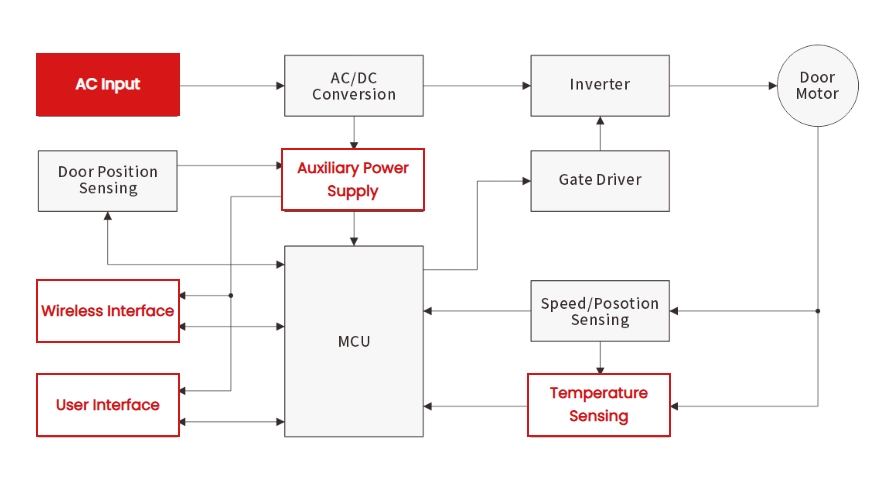
An automatic door system typically consists of the following key components:
- AC Input: The main power input for the device.
- AC/DC Conversion: Converts AC power to DC power for the system.
- Auxiliary Power Supply: Powers the control system.
- MCU (Microcontroller Unit): Responsible for logic control.
- Wireless Interface: For example, WiFi/Bluetooth/RF modules.
- User Interface: Buttons, touchscreen, or display modules.
- Temperature Sensing: Monitors system or motor temperature.
- Door Motor: Performs the opening and closing action of the door.
As you can see, an automatic door system is quite complex. So, what specific protective devices are needed?
1️⃣ AC Input Protection
Automatic door systems are directly connected to AC mains power, therefore the surge risk at the AC input is relatively high. We recommend using a combination of Varistor and Gas Discharge Tube for protection.
🔹 The Gas Discharge Tube (GDT) can absorb high-energy lightning surges and withstand high inrush currents (kA level).
🔹 Varistor offers fast response, quickly clamping the voltage to a safe range. It is also cost-effective, making it suitable for power supply protection.
2️⃣ Wireless Communication Interface Protection
Modern automatic doors increasingly support mobile phone control and wireless remote control, typically implemented through RF/WiFi/Bluetooth modules. These interfaces are highly susceptible to electrostatic discharge (ESD), such as:
- User touching the device casing
- Static electricity generated in dry environments
- Connector plugging/unplugging
Therefore, low-capacitance ESD diodes need to be placed at the communication interface to quickly discharge electrostatic current, protecting RF/MCU I/O pins without affecting signal quality.
3️⃣ User Interface Protection
The user interface of an automatic door typically includes: buttons, touch panels, and a display module.
These areas are the most frequently touched by users, so they have a higher risk of ESD and need to be fitted with ESD diodes to prevent electrostatic discharge from entering the MCU.
4️⃣ Auxiliary Power Supply Protection
The auxiliary power supply provides a stable voltage for the MCU, sensors, and communication modules.
In the auxiliary power supply section, MOSFETs are commonly used to control the power switch and manage the power path, thereby improving power efficiency and reducing conduction losses.
5️⃣ Temperature Monitoring
Motors and power modules generate heat during prolonged operation, therefore temperature monitoring is required for the automatic door system. NTC thermometer can achieve this function, with the following main features:
- Motor temperature detection
- Power supply temperature monitoring
- Over-temperature protection
When the temperature rises: the NTC resistance decreases, and the MCU can detect the temperature change in real time, triggering the protection mechanism if necessary, thus preventing system failures caused by overheating.
In summary, this solution improves system surge protection, reduces ESD failure rate, and enhances product reliability. Furthermore, Semiware's components are mature, readily available, and can replace multiple brands, offering cost-effectiveness.
If you are designing or procuring circuit protection devices for automatic door control systems, please learn more about our complete solutions. 👉 https://en.semiware.com/applications/automatic-gate/
We can provide suitable component selection and technical support for different application scenarios.
❓ FAQs: Automatic Door Circuit Protection
Q: What electronic components are used in an automatic door system?
Automatic door systems typically use varistors (MOVs) and gas discharge tubes (GDTs) for surge protection at the AC input, electrostatic discharge diodes (ESD diodes) for wireless and user interface protection, MOSFETs for auxiliary power supply management, and NTC thermistors for temperature sensing and overheat protection.
Q: Why are varistors and GDTs used together?
GDTs can withstand very high surge currents, making them ideal for absorbing large lightning surges. Varistors have a faster response time, helping to clamp voltage within safe ranges.
Q: Why is ESD protection important for wireless and user interfaces?
Using low-capacitance ESD diodes helps protect sensitive integrated circuits and communication interfaces from damage while maintaining signal integrity.
Q: What is the role of NTC thermistors in automatic door systems?
As temperature increases, the resistance of NTC thermistors decreases, preventing overheating of the motor or power supply circuitry.
Q: What factors should engineers consider when designing protective devices for automatic door controllers?
- Surge protection at the AC power input
- Electrostatic discharge (ESD) protection for external interfaces
- Reliable power management
- Appropriate temperature monitoring
- Long-term reliability in harsh electrical environments