In today's era of widespread Fiber-to-the-Home (FTTH) adoption, the Optical Network Unit (ONU)—or "optical modem"—has long since become the central hub connecting the home to the digital world.
However, residing within the ONU is a critical component—the Subscriber Line Interface Card (SLIC)—which plays a pivotal role in this connectivity.
What is a SLIC?
The SLIC serves as the essential bridge within communication devices (such as optical modems, ONUs, and xDSL terminals) that facilitates the conversion between analog telephone signals and digital network signals.
Yet, as an interface directly exposed to the user side, the SLIC constantly faces threats from lightning-induced surges and power supply anomalies.
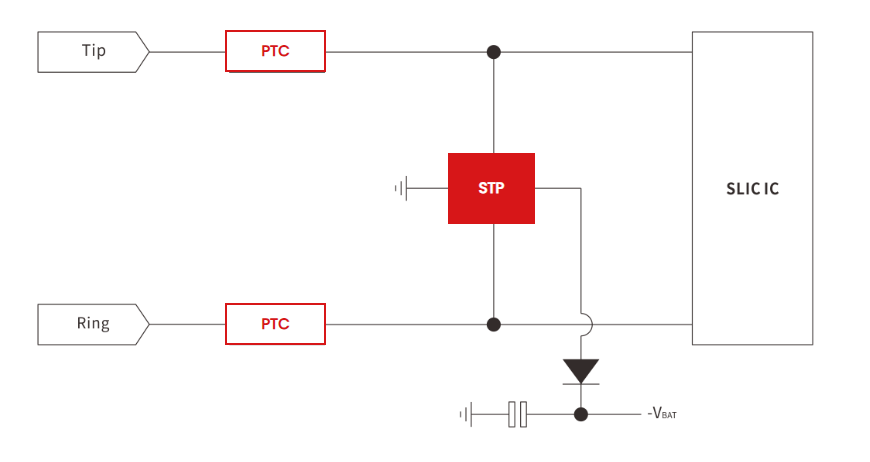
I. Why is the SLIC So Vulnerable?
Because the SLIC connects directly to external lines, it must contend with an uncontrollable external environment; communication lines are highly susceptible to the following events:
- Lightning-induced surges
- Transient overvoltages caused by power supply failures
- Induced noise and interference over long-distance lines
- ESD (Electrostatic Discharge) shocks resulting from hot-plugging or external contact
⚡ Without effective protection, these events can lead to damage to communication chips and result in system failure.
In response to this challenge, we are pleased to introduce the STP61089BL—a high-performance, programmable circuit protection device specifically designed for the protection of dual SLIC interfaces.
II. What is the STP61089BL?
The STP61089BL is a dual-channel Programmable Surge Protection Device capable of independently tracking the voltage on each positive/negative line pair, thereby enabling precise protection for dual SLIC interfaces.
It is particularly well-suited for front-end protection designs within optical communication and broadband access equipment.
III. Why Choose the STP61089BL?
Compared to traditional discrete components, the STP61089BL programmable protector offers the following key advantages:
1. Dual-channel, independently programmable protection architecture.
2. Wide negative trigger voltage range (VGKRM ≤ -167V), allowing it to adapt to complex communication line environments.
3. Low dynamic on-state voltage, which reduces conduction losses and enhances overall reliability.
4. Low trigger current (IGT ≤ 5mA), which boosts response sensitivity and enables rapid surge suppression. 5. High Surge Withstand Capability (IPP = 30A @ 10/1000μs), effectively mitigating transient overvoltages caused by lightning strikes and power anomalies.
IV. Key Electrical Parameters of the STP61089BL
| Parameter | Value | Engineering Benefit |
| 10/1000μs Peak Pulse Current | 30A | Handles standard lightning-induced surge energy, effectively protecting telecom ports from breakdown |
| 5/310μs Peak Pulse Current | 50A | Withstands steeper and higher-energy transient events, increasing system robustness margin |
| 10/700μs Peak Pulse Voltage | 2000V | Meets telecom lightning surge test standards |
| VGKRM (Max Negative Trigger Voltage) | -167V | Provides wide negative voltage tolerance, suitable for long-line and harsh field environments |
| VBO (Breakover Voltage) | -112V | Ensures precise and controlled triggering within a safe operating window, preventing false activation |
| IGT (Gate Trigger Current) | ≤ 5mA | Extremely high sensitivity, enabling fast response to small abnormal signal disturbances |
| IH (Holding Current) | ≥ 150mA | Maintains stable conduction during surge events without accidental turn-off |
| Package | SOP-8 (4.70mm × 3.80mm ) | High integration dual-channel design, saving PCB space for compact ONU/Modem layouts |
V. Wide Range of Application Scenarios
While the STP61089BL was originally designed for demanding communication environments, its exceptional performance extends its application scope far beyond just Optical Network Terminals (ONTs).
1. Optical Network Units (ONU/ONT): Protects POTS ports against damage caused by lightning strikes and power line cross-connects.
2. VoIP Gateways and Adapters: Ensures the operational resilience of IP telephony systems in harsh power grid environments.
3. Private Branch Exchanges (PBX): Provides high-density line protection for enterprise-grade communication equipment.
4. Access Network Line Cards: Serves as the primary line of defense within central office equipment.
Many of our customers have successfully deployed the STP61089BL for circuit protection in optical modems; its exceptional protection performance and stable operational reliability have garnered unanimous acclaim from our clientele.
👉 If you are currently designing interface protection for optical modems or ONUs, the STP61089BL offers a highly integrated and engineering-friendly protection solution.
➡️ STP61089BL datasheet: https://en.semiware.com/programmable-protectors/stp61089bl/
📩 If you are currently designing ONTs, ONUs, or communication gateways, please feel free to contact us for samples or design support.
➡️ https://en.semiware.com/contact/
🔎 Related Products