Introduction
Today’s next-generation smart coffee machines are far more than simple hot-water brewing devices. Human-Machine Interfaces (HMIs) with integrated displays have become standard features. Thanks to wireless connectivity, these machines can link with other smart kitchen appliances, truly bringing the smart kitchen concept to life.
However, as functionality expands and electronic modules become more complex, the hardware faces increased risks from electrical stress.
Power ports, HMI touch interfaces, sensor signal paths, and wireless communication interfaces are all vulnerable to electrical anomalies. This article outlines the common electrical risks associated with smart coffee machines and discusses corresponding protection design strategies.

I. Key Electrical Risks Facing Smart Coffee Machines
1.1 Electrostatic Discharge (ESD) Risks
- Components such as metal touch panels, display housings, and physical touch buttons are highly susceptible to electrostatic discharge from the user's body during daily operation.
- If electrostatic charges enter through touch pins—traveling along capacitive or inductive touch traces connected directly to the main control chip—they can cause erratic touch behavior or unresponsive buttons. In severe cases, they can damage the touch IC or MCU, causing the entire machine to crash.
- Display ribbon cables and exposed wireless module interfaces are also vulnerable to ESD, which can lead to display artifacts or unstable wireless connections.
Pain Point: Many engineers focus solely on power supply protection while overlooking ESD protection for HMI touch signal lines. Consequently, while prototypes may pass testing, intermittent failures frequently occur once mass-produced units reach end-users.
1.2 Power Port Surges and Transient Overvoltage
- The household AC power environment is complex; grid switching and the startup or shutdown of nearby high-power appliances can generate voltage surges at the AC-DC power input.
- Surges entering the power circuit can damage power management chips and DC-DC conversion units, preventing the coffee machine from powering on or causing the power supply section to burn out.
- Smart coffee machines contain inductive loads—such as water pumps and heating relays—that generate back-electromotive force (back-EMF) during switching. This creates internal electrical overstress (EOS), potentially interfering with the main control and sensor circuits.
1.3 Overvoltage Damage to Signal Interfaces
The unit contains numerous sensor signal lines; accidental contact during wiring, voltage crosstalk, or cable-induced interference can introduce abnormally high voltages onto these lines, damaging the sensor chips.
1.4 Risks of Overcurrent and Short Circuits
The heating module and water pump motor are high-power loads. Component aging, moisture ingress, or internal short circuits can lead to overcurrent conditions.
1.5 Electromagnetic Interference and Immunity Issues with Wireless Modules
The wireless connectivity module must communicate with other home appliances. On one hand, external electromagnetic noise can interfere with wireless signals, causing disconnections; on the other, switching noise generated by internal relays and heating units can cause reciprocal interference with the wireless module.
II. Protection Design Strategy for Coffee Machines
2.1 ESD protection for HMI (touch controls and display screens)
- Place high-speed TVS devices near the interface points for touch buttons, capacitive sensing elements, and display signal lines;
- For touch interfaces on metal panels, prioritize the design of ESD discharge paths to shunt electrostatic energy to ground and prevent it from entering the main control chip;
- Avoid using slow-response components on high-speed signal lines, as this can reduce touch sensitivity.
2.2 Surge protection at the power input
- At the AC power inlet, use a varistor (MOV) to absorb high-energy surges from the grid, paired with a fuse for short-circuit and overcurrent protection;
- In the downstream DC-DC circuit, add a TVS device to suppress transient high voltages caused by internal load switching and protect the power IC;
- For inductive loads (relays, water pumps), add flyback suppression components to suppress back-EMF and reduce internal electrical noise.
2.3 Protection for sensors and communication interfaces
- For sensor signal lines (temperature, liquid level, lid detection, etc.) and communication interfaces (SPI/UART/USB), add appropriately rated signal-level protection devices to suppress coupled transient high voltages, ensuring stable sensor data and preventing false detections;
- Regarding PCB layout, place protection devices as close as possible to connector pins to minimize the discharge path length.
2.4 Coordinated overcurrent and overheat protection for the entire unit
- In addition to electronic circuit protection, retain traditional thermal fuses and thermostats to establish a dual hardware-software protection scheme;
- Add overcurrent protection components to load circuits to rapidly cut off power during short circuits or overloads, ensuring compliance with safety certification requirements for small home appliances.
2.5 Interference immunity design for wireless connectivity
- Implement effective power supply filtering, isolate high-power heating circuits from low-power wireless signal circuits, and optimize grounding layout to minimize internal noise interference with the wireless module.
III. Semiware Coffee Machine Design Reference
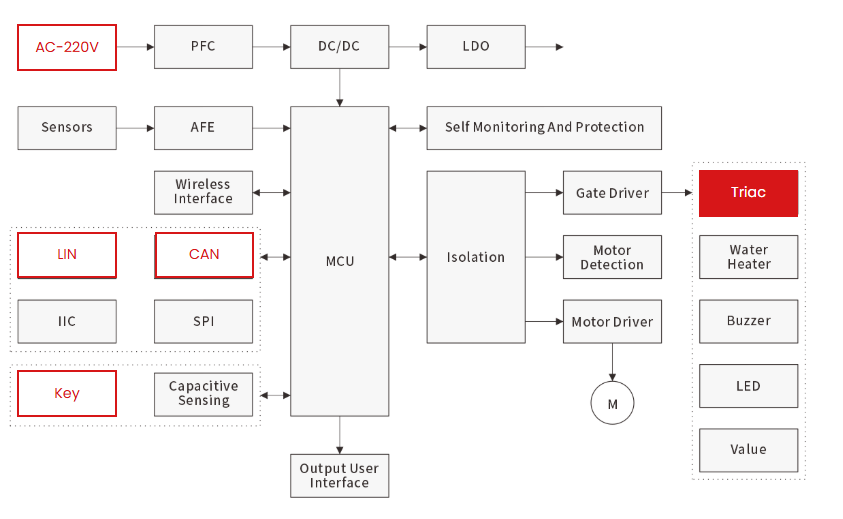
For solution details, please visit: https://en.semiware.com/applications/coffee-maker
Conclusion
Smart coffee machines integrate precision sensors, metal-touch HMIs, wireless connectivity, and high-power heating units into a compact housing; consequently, hardware design cannot focus solely on functionality—electrical protection measures must be incorporated concurrently.
To address diverse interface and circuit protection requirements, Semiware offers TVS diodes, ESD protection diodes, GDTs, and thyristor-based surge protection devices. Please contact us to discuss your specific design solutions.