I. Why Is Protection Design Essential for SSDs?
Compared to traditional mechanical hard drives (HDDs), Solid State Drives (SSDs) are characterized by high speed and high integration; however, this also introduces a specific challenge:
👉 The controller and NAND Flash components are extremely sensitive to transient voltages.
In practical applications, SSDs face two primary types of threats:
- ESD (Electrostatic Discharge) → Damages signal ports
- Surge (Voltage Surge) → Damages the power supply system
The risk is particularly elevated in the following scenarios:
- Frequent plugging and unplugging of external USB SSDs
- NVMe M.2 hot-plugging (during debugging or in industrial control systems)
- Plugging and unplugging within server backplanes
- Industrial or automotive power supply environments
II. System-Level Protection Architecture
SSD protection design primarily comprises three key components: Interface (I/F) Protection, the Power Management Unit (PMU), and NAND Protection.
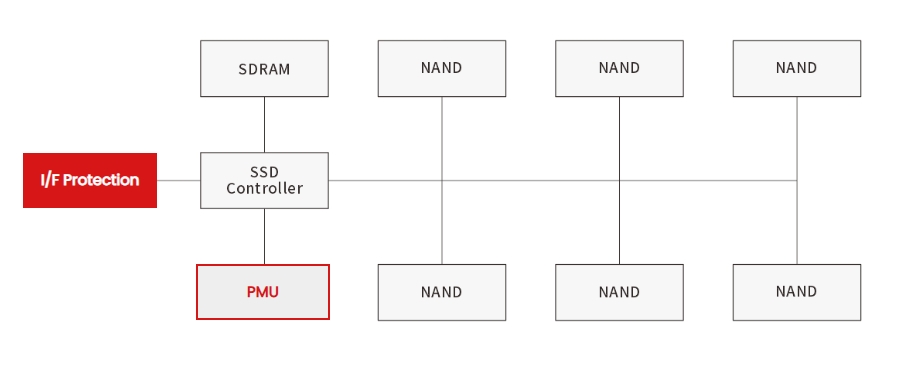
1️⃣ I/F Protection (ESD Protection Layer)
Function:Protect high-speed signal interfaces from electrostatic discharge.
Interfaces:
- USB 2.0 / 3.x
- PCIe / NVMe lanes
- SATA differential pairs
Device Type:
- Low-capacitance ESD diode (<1pF)
- TVS array for multi-line protection
Design Rule:
- Place as close as possible to connector
- Symmetrical layout for differential pairs
2️⃣ PMU Protection (Power Management Layer)
Function: Control power sequencing and protect against inrush / reverse polarity / surge.
Device Type:
- MOSFET (load switch / ideal diode)
- TVS diode (input surge clamp)
Why MOSFET instead of diode?
- Lower voltage drop
- Bidirectional control capability
- Better inrush current control
| Feature | MOSFET | Diode |
| Voltage drop | Low | High |
| Efficiency | High | Lower |
| Control | Active | Passive |
3️⃣ NAND & Core Power Protection
Key rails:
- 3.3V main power
- 1.2V core voltage
- Vcore / DRAM supply
Protection strategy:
- PMIC-based regulation
- TVS at input stage
- Decoupling capacitors for transient suppression
III. Tips for PCB Layout
As illustrated by the architecture above, circuit protection for SSDs is a comprehensive system engineering task that requires a coordinated design approach across multiple levels—specifically the interface, power supply, and signal paths.
1. Layered Protection: A first line of defense is established at the interface to absorb the majority of external transient energy; a second line of defense is positioned at the Power Management Unit to handle both internal and external power disturbances; additionally, a third layer of fine-grained protection can be implemented directly at the pins of critical ICs.
2. Component Selection: Based on the specific application scenario of the SSD (e.g., consumer-grade, industrial-grade, or automotive-grade), protection components with appropriate ratings and characteristics—such as TVS diodes, varistors, and ESD suppressors—must be selected.
3. PCB Layout: A well-planned PCB layout is critical for maximizing the performance of protection components. These components should be placed as close as possible to the interface connectors, and the grounding paths should be kept short and wide to minimize parasitic inductance and ensure that transient energy can be rapidly dissipated.
👉 If you are designing an SSD system and require optimized ESD and surge protection solutions, please feel free to contact us for a discussion.
https://en.semiware.com/contact
❓ FAQ
Q1: Do SATA and NVMe SSDs need ESD protection?
Yes. All SSD interfaces can be exposed to ESD.
NVMe requires lower-capacitance ESD protection due to higher speed, but SATA also needs basic protection.
Q2: Do consumer SSDs need protection circuits?
Yes. Consumer SSDs often face higher ESD risk due to user handling and uncontrolled environments.
Protection helps prevent data loss and device failure.
Q3: Will ESD protection affect SSD performance?
No, if designed properly.
Use low-capacitance ESD diodes (<1pF) to maintain PCIe / NVMe signal integrity.
Q4: Is surge protection only for lightning?
No. Most surge events come from power-on, hot-plug, and system noise.
PMU protection ensures stable operation under these conditions.