Introduction
With the rapid deployment of additive manufacturing technology, 3D printers are no longer limited to the desktop consumer market; a large number of these devices are entering industrial manufacturing, medical, and automotive parts industries.
Unlike short-duration desktop printing, industrial 3D printing often requires long-term continuous operation, with some large-sized workpieces having printing cycles of tens or even hundreds of hours.
Many R&D teams tend to overlook basic protection designs on the power supply and signal sides. Seemingly insignificant discrete semiconductor devices are precisely the underlying foundation for ensuring the long-term stable operation of the entire machine.
This article, based on the overall circuit architecture of a 3D printer, outlines common electrical risks and corresponding protection device selection strategies.
I. Electrical Challenges Faced by Industrial 3D Printers
Industrial 3D printer circuit systems face multiple electrical threats simultaneously. These problems are not easily exposed during short printing sessions, but they are amplified under 24/7 continuous operation:
1.1 Power Supply Surges and Voltage Fluctuations
Industrial power grids experience voltage disturbances, including surge pulses upon power-on. Frequent start-ups and shutdowns of high-power loads such as heated beds and heated nozzles generate reverse voltage surges in the power circuit, easily damaging rectifiers and power switching devices, causing power instability, and indirectly affecting temperature control accuracy.
1.2 ESD Damage Risk
Equipped with USB, SD card, and touch interfaces, engineers and operators frequently plug and unplug data cables and memory cards, making it easy for static electricity from their bodies to directly enter the main control chip pins.
1.3 Continuous Heat Dissipation from Power Devices
Nozzles and heated beds are high-current loads. Bridge rectifiers and MOSFETs continuously carry high currents. If these devices have high power consumption and generate continuous heat, it will accelerate aging, shorten the overall lifespan of the machine, and even pose overheating safety hazards.
1.4 Surge Impact and Overvoltage Damage
The factory environment contains various motors and frequency converters that can interfere with and introduce surge and overvoltage signals. These can range from minor system restarts to severe damage to the main control IC.
These risks are not all apparent during prototype testing; they are more likely to surface after mass production and deployment at customer sites, significantly increasing after-sales maintenance pressure. Therefore, surge protection, electrostatic discharge (ESD) protection, and power circuit efficiency must be incorporated into the hardware design phase.
II. Application Strategies of Key Semiconductor Devices in 3D Printing Machines
For different circuit locations in a 3D printer, such as power rectification, power drive, ESD protection, and surge absorption, corresponding discrete components can be selected to achieve low-power, high-reliability hardware protection solutions.
2.1 Schottky Diode
Schottky diodes have low forward voltage drop and fast switching speed, making them suitable for low-voltage, high-current circuits. In 3D printers, they are often used in secondary power supply rectification and freewheeling circuits.
Advantages: Lower power loss, reduced device heat generation during prolonged operation, improved power efficiency, stable power supply to the heating module, and suitability for continuous operation of equipment.
Key selection considerations: current margin, reverse voltage withstand capability, and package heat dissipation capability.
2.2 Bridge Rectifier
The core component for rectifying the power input of the entire machine, crucial for AC to DC conversion.
Industrial models continuously output high current, so the reliability of the bridge rectifier directly determines the foundation of the entire power supply. A low-power, high-reliability bridge rectifier can reduce rectification losses, reduce temperature rise, and prevent overheating failure during prolonged full-load operation.
2.3 MOSFET Power Transistors
Nozzle heating, heated bed heating, and stepper motor drives all rely on MOSFETs for switching control.
Equipment requires frequent high-speed switching of high-power loads, making the voltage withstand capability, on-resistance, and heat dissipation capability of the MOSFETs crucial. High-reliability MOSFETs can reduce conduction losses, reduce heat generation, prevent overheating and burnout, and ensure stable output of the temperature control system.
2.4. ESD Diode
Primarily located at external signal interfaces such as USB, SD card, and touchpad.
Key specifications: Strong electrostatic discharge suppression capability, low capacitance. The low capacitance ensures high-speed signal transmission is unaffected by interference, while simultaneously discharging static electricity from the human body, protecting the backend control chip, preventing electrostatic damage from insertion and removal, and resolving occasional system crashes and interface damage issues in the field.
2.5. Gas Discharge Tube (GDT)
Used for high-energy surge protection at the power input.
Features high surge absorption capability and extremely low capacitance. Facing high-energy surge impacts from industrial power grids, it can quickly discharge high-voltage pulses, protecting the backend power circuitry, suitable for anti-interference design of equipment in industrial environments.
2.6. Varistor
A classic protection device at the power input, with strong surge absorption capability and controllable overall cost.
It can be used in conjunction with a gas discharge tube to absorb instantaneous overvoltage surges on the power supply side, serving as the first line of defense for the entire device and reducing the probability of abnormal voltage entering the internal circuitry of the equipment.
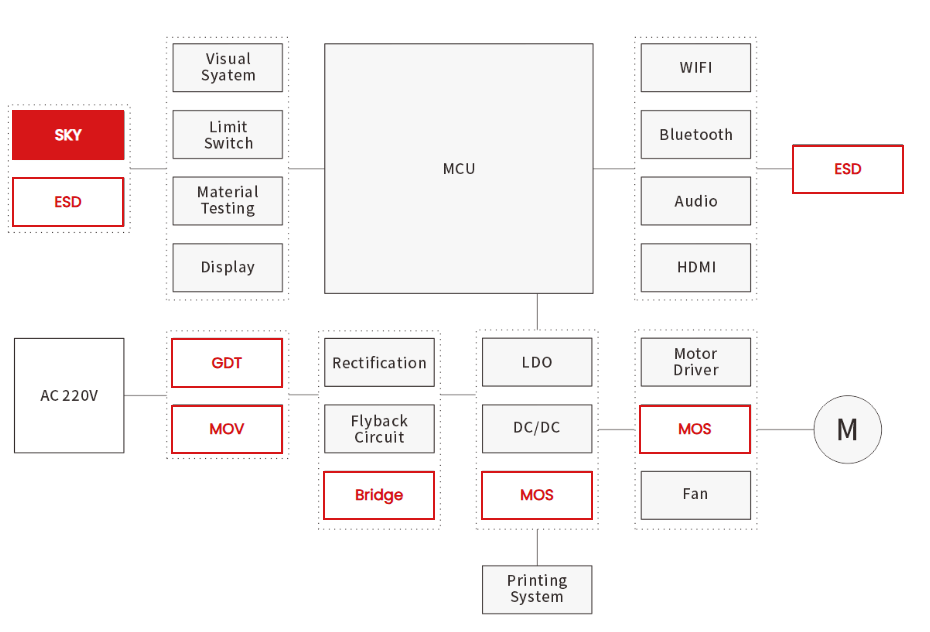
III. Design Practice Recommendations: How to Improve the Overall Reliability of a 3D Printer
3.1. Reserve Power Margin
Industrial equipment should not operate components at full rated value. For power devices such as rectifiers and MOSFETs, sufficient current and voltage margins should be reserved to cope with load impacts and environmental temperature rises, preventing accelerated aging during long-term operation.
3.2. Layered Protection Approach
Power Input Terminal: Varistor + Gas Discharge Tube for primary surge discharge;
Power Circuit: Use low-loss Schottky diodes, bridge rectifiers, and MOSFETs to reduce heat generation;
Signal Interface: ESD diodes for electrostatic discharge protection while ensuring signal integrity.
3.3 Pay Attention to High-Temperature Operating Conditions
The 3D printer itself contains numerous heat sources, and the ambient temperature of components on the board is relatively high. When selecting components, it is necessary to pay attention to parameter degradation at high temperatures, and not just consider parameters at room temperature (25℃).
3.4. EMC Field Simulation Testing
After the prototype is completed, perform electrostatic discharge and surge pulse simulation tests to reproduce interference scenarios that may be encountered in industrial settings. This verifies whether the protection circuitry is truly effective, rather than relying solely on short-term desktop printing tests in a laboratory.
Summary
As 3D printers move from consumer-grade applications to industrial and medical settings, many field failures originate from power disturbances, static electricity, and surge impacts. A comprehensive discrete semiconductor protection solution can significantly reduce the probability of equipment failure, decrease subsequent maintenance costs, and ensure print yield with relatively controllable hardware costs.
If you are developing power supply, control board, or interface circuits for a 3D printer, Semiware provides component selection and circuit protection references, including rectifier bridges, Schottky diodes, MOSFETs, TVS diodes, ESD protection devices, GDTs, and varistors.
For information on protection solutions for different circuit nodes in a 3D printer, visit the Semiware 3D Printer application page to view relevant circuit diagrams and component selection information.