Introduction
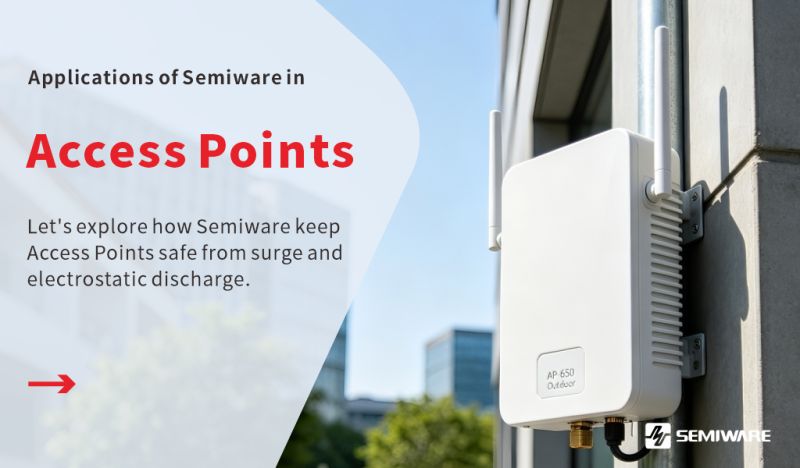
As wireless networks continue to extend outdoors, Outdoor APs (outdoor wireless access points) have become crucial infrastructure in smart cities, industrial parks, campus networks, and public Wi-Fi environments.
I. Why Do Outdoor APs Need Electrostatic Discharge (ESD) Surge Protection?
Unlike network equipment deployed in server rooms or indoor environments, Outdoor APs operate in more complex environments:
- Their installation locations are typically higher, making them more susceptible to lightning strikes;
- Outdoor power lines are more prone to transient voltage fluctuations;
- Ethernet, control interfaces, and antenna interfaces are directly exposed to the external environment, making them vulnerable to ESD (electrostatic discharge) shocks.
A single lightning surge or transient overvoltage can damage the power module, cause PHY chip failure, or even take the entire wireless coverage node offline.
II. Major Transient Threats Faced by Outdoor APs
2.1 Lightning Strike and Power Surge
Outdoor APs typically use 48V DC or PoE power. When lightning strikes, power grid switching, or high-power equipment starts or stops nearby, transient high voltages may enter the equipment through the power line.
Main Impacts:
- DC/DC power module damage
- Main control chip malfunction
- Equipment fails to start
2.2 Ethernet Interface Surge and ESD
The network interface connects to the external network cable, making it susceptible to surges induced by lightning strikes and transient pulses from hot-plugging, affecting the PHY chip and the stability of high-speed communication.
2.3 RF Interface Electrostatic Interference
The antenna interface of an outdoor AP is directly connected to the external environment. Static electricity from the human body and discharge during equipment installation can enter the RF transceiver.
Therefore, it is essential to incorporate appropriate surge and ESD protection into the design phase of Outdoor APs.
III. Semiware Outdoor AP Surge and ESD Protection Solution
To meet the protection needs of different functional modules of the Outdoor AP, a graded protection design is recommended.
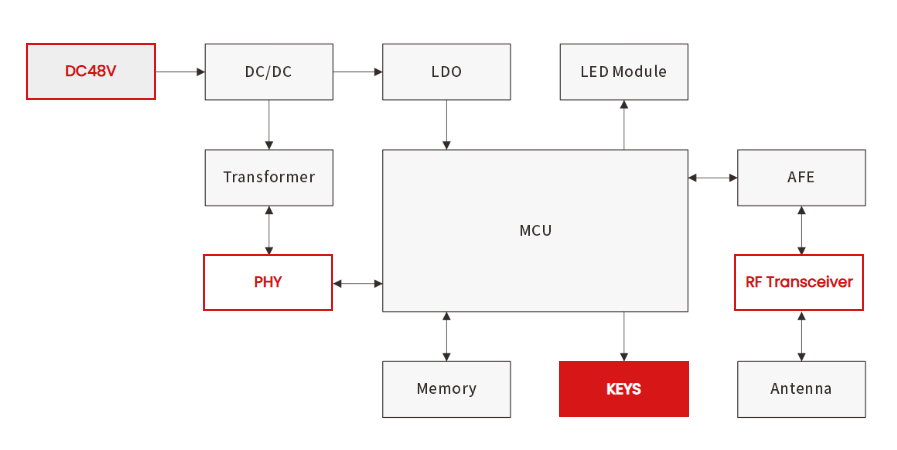
3.1 DC 48V Power Input Surge Protection
Outdoor APs are typically powered by a 48V DC or PoE system. The power input is the first line of defense against lightning surges and power transients.
Surge voltages from lightning strikes, grid fluctuations, or equipment start-up and shutdown can enter the AP through the power line, causing:
Damage to the DC/DC power module;
Main control chip malfunction;
Complete system disconnection or inability to start.
Therefore, the power supply section typically employs a multi-stage surge protection design, utilizing GDT, Varistor, and TVS Diode working in tandem to achieve protection from large-energy discharge to fine voltage clamping.
Recommended Devices:
| Protection Device | Type | Key Parameters | Protection Function |
| SG5042B090 | Gas Discharge Tube (GDT) | Breakdown Voltage: 90V ±20% Surge Current: 5KA Size: 5.0 × 5.0 × 4.2mm | Provides primary surge protection by handling high-energy lightning surges |
| 10D820K | Varistor (MOV) | V1mA: 82V Imax: 2500A (8/20μs) | Absorbs high-energy transient pulses |
| SMDJ58CA | TVS Diode | VRWM≥58V VBR: 64.4~71.2V Peak Pulse Power: ≥3000W Package: SMC | Provides fast voltage clamping |
3.2 Ethernet PHY Interface ESD and Surge Protection
As a core component of network communication, the PHY chip is highly sensitive to overvoltage, therefore requiring low-capacitance, high-speed response protection devices.
Recommended Devices:
| Protection Device | Type | Key Parameters | Protection Function |
| SESRV05-4A | TVS Diode Array | Working Voltage: 5V Capacitance: 0.8pF ESD Protection: ±15kV Package: SOT-23-6L | Provides ESD and transient protection for Ethernet PHY interfaces while minimizing impact on high-speed signal transmission |
3.3 Control Interface ESD Protection
Reset buttons, debug interfaces, or other exposed control ports on outdoor APs are susceptible to electrostatic discharge (ESD) from the human body during installation, maintenance, or use.
Although ESD duration is very short, a momentary high voltage can damage MCU GPIO or control circuitry.
Recommended Devices:
| Protection Device | Type | Key Parameters | Protection Function |
| SE5D10B5.0A | ESD Protection Diode | Working Voltage: 5V Capacitance: 15pF ESD Protection: ±15kV Package: SOD-523 | Quickly diverts ESD current away from sensitive circuits and protects MCU and control signal lines |
3.4 RF Transceiver Module ESD Protection
The RF transceiver and antenna interface of an outdoor AP are directly connected to the external environment. Due to the high-frequency characteristics of RF signals, protection devices not only need high ESD protection capabilities but must also maintain extremely low parasitic capacitance.
Recommended Devices:
| Protection Device | Type | Key Parameters | Protection Function |
| SE10F10B5.0UA | Low Capacitance ESD Diode | Working Voltage: 5V Capacitance: 0.25pF ESD Protection: ±20kV Package: DFN1006-2L | Provides high-level ESD protection with ultra-low capacitance, minimizing signal loss in RF applications |
A combination of components with multi-level protection helps Outdoor APs maintain stable operation in complex outdoor environments, reducing maintenance costs caused by surges and electrostatic discharge.
V. Outdoor AP Circuit Protection Reference Design Block Diagram
Conclusion
As wireless network infrastructure continues to expand outdoors, outdoor APs not only require stable wireless performance but also need to withstand more demanding electrical environments.
By properly configuring TVS Diode, GDT, Varistor, and low-capacitance ESD Protection Device, the device's resistance to lightning strikes, power failures, and electrostatic interference can be effectively improved.
Semiware provides complete circuit protection solutions covering power supply, network interface, and RF modules, helping wireless communication devices achieve higher reliability and longer lifespan.
For more information on Outdoor AP Surge Protection solutions, please contact Semiware for professional component selection support.