I. Background of DDR and High-Performance Memory Development
DDR (Double Data Rate) memory is widely used in computers, AI servers, network equipment, and embedded systems, and is a core component of modern high-speed data processing architectures.
With the rapid growth in demand for AI training, big data analysis, and real-time computing, DDR5 R-DIMM (Registered DIMM), with its higher bandwidth (e.g., 4800–5600 MT/s and above) and larger capacity (32GB/64GB and above), is becoming a key memory solution for data centers and high-performance computing platforms.
At the same time, higher data rates and more complex PCB designs also subject DDR memory modules to more stringent requirements for electrostatic discharge (ESD) and transient surge risks.
II. JEDEC Requirements for DDR Memory ESD/Reliability
In the design and manufacturing process of DDR memory, JEDEC has established a series of reliability and ESD-related standards to regulate device and system-level risk control.
JESD625C defines the control system requirements for ESD-sensitive devices (ESDS), applicable to semiconductor device, PCB assembly, and module-level production environments.
Key features include:
- Electrostatic Discharge Area (EPA) establishment
- Electrostatic Packaging and Transportation Specifications
- Personnel Protective Equipment (Wristbands, Anti-static Shoes, etc.)
- ESD Management Processes and Monitoring Systems
- DDR memory and DRAM-related devices typically need to meet the following testing standards:
- JESD22-A114: HBM (Human Body Model) ESD Testing
- JESD22-A115: MM (Machine Model) Testing
- JESD22-C101 Series: CDM (Civil Discharge Model) ESD Testing
These standards evaluate the ESD tolerance of DRAM and memory modules from different perspectives, including the human body, equipment, and the device's own charged state.
- PCB and System-Level Design Requirements Trends
In DDR5 R-DIMM designs, the industry is gradually introducing higher-level system-level protection solutions, such as:
- TVS transient voltage suppressors
- SMT fuses (overcurrent protection)
- Separate grounding and low-impedance return path design
These measures are becoming important design trends for high-end DDR5 modules.
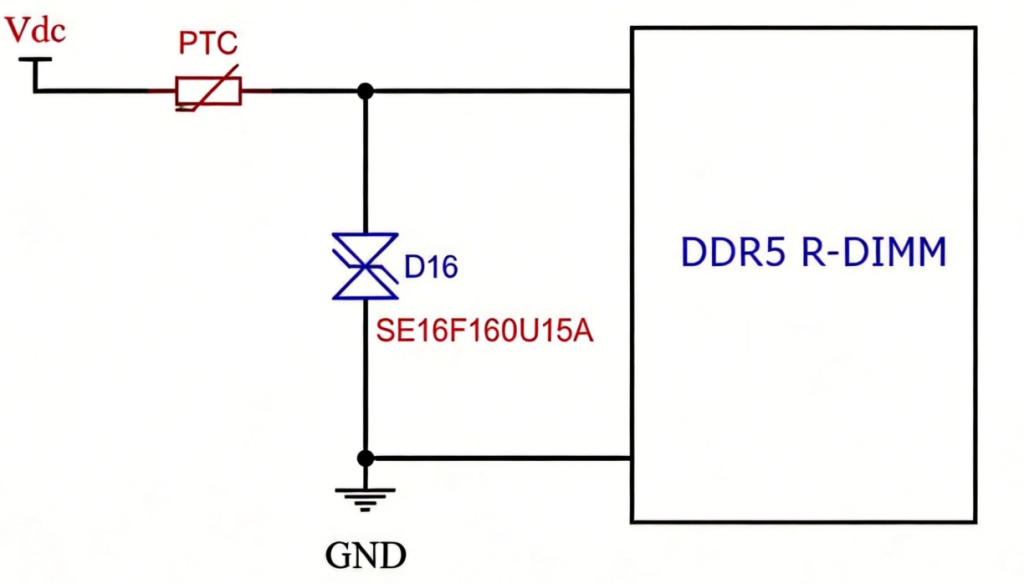
III. Sources of Electrical Risks in DDR5 R-DIMM Modules
DDR5 R-DIMM modules typically obtain 12V input power directly from the motherboard and convert it to multiple low-voltage power rails (such as VDD/VDDQ/VPP) via an onboard PMIC.
Therefore, the module mainly faces two types of risks:
- Electrostatic Discharge (ESD)
Sources:
- Memory module insertion/removal
- Human contact
- PCB edge coupling
- Transient surges and power supply interference
Sources:
- Power supply insertion/removal transients
- System power supply fluctuations
- PCB inductor parasitic effects
IV. Recommended Layout Principles
- TVS should be placed as close as possible to the power input interface.
- Prioritize ensuring the shortest possible ESD current discharge path to ground.
- Place it before the filter inductor to avoid the inductor obstructing the high di/dt discharge path.
- Use short and wide traces to connect power and ground.
- Maintain a complete ground plane and avoid splitting the ground.
- Multiple grounding points reduce equivalent impedance.
Conclusion
With the development of DDR5 and future higher-speed memory, memory modules are no longer just "storage devices," but complex systems integrating power management and high-speed signals.
With the increasing demands of JEDEC standards and system-level reliability requirements, the combined protection scheme of TVS + fuse is becoming one of the standard configurations in DDR5 R-DIMM designs.