Overview
With the rapid growth of desktop and industrial 3D printers, modern machines are becoming more intelligent and highly integrated.
Unlike traditional mechanical equipment, today's 3D printers combine:
- High-speed communication interfaces
- Embedded control systems
- Precision motor control
- High-power heating systems
These modules introduce new electrical reliability challenges, including ESD, surge voltage, EMI interference, and transient stresses.
A properly designed protection strategy is essential to improve system stability, reduce failures, and extend product lifetime.
I. What is the overall structure of a 3D printer?
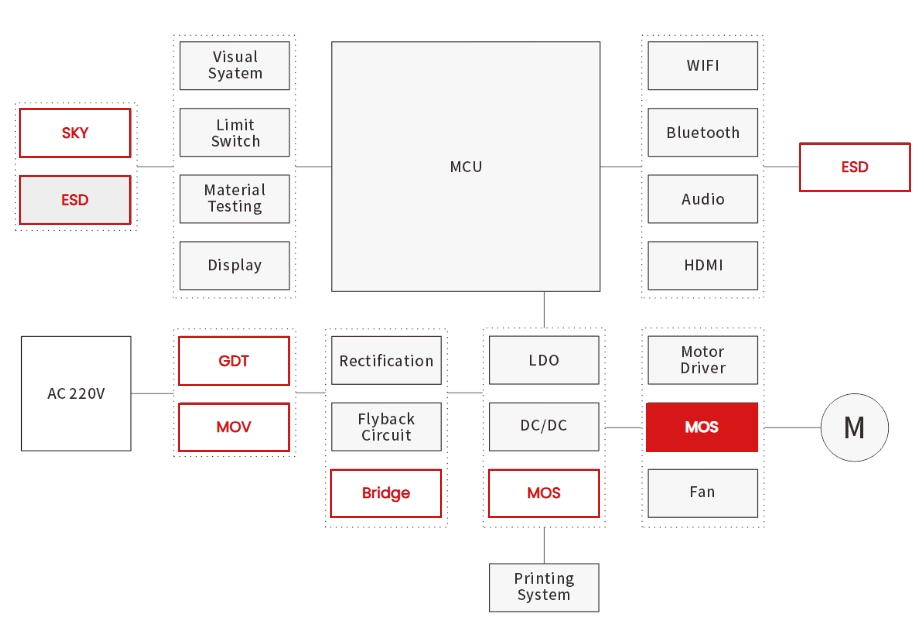
A 3D printer can be divided into four major modules:
1️⃣ Control Core (MCU)
The MCU acts as the "brain" of the machine, responsible for:
- Print path control
- Temperature control (nozzle/heated bed)
- Motor drive logic
- Sensor data processing (limit switches, material detection, etc.)
It also interfaces with:
- Display
- Visual system
- Various communication interfaces (WiFi / Bluetooth / HDMI / Audio)
2️⃣ Communication and Human-Machine Interface (HMI)
3D printers are becoming increasingly "smart"; common interfaces include:
- WiFi / Bluetooth (remote control)
- HDMI / Audio (display and multimedia expansion)
- Touch / Display UI
👉 These interfaces are typically exposed to the external environment, making them high-risk areas for ESD (Electrostatic Discharge).
3️⃣ Power Supply and Power System
Starting from the AC 220V input:
- MOV: Surge absorption
- GDT: Protection against lightning strikes/high-energy transients
- Bridge Rectifier: Rectification
- Flyback / DC-DC / LDO: Multi-stage power conversion
Ultimately supplying power to:
- MCU
- Motor Driver
- MOSFET power control
- Fan / Heater / Printing system
👉 This is the "energy core" of the machine and one of the areas most prone to failure.
4️⃣ Actuation and Motion System
Includes:
- Motor Driver + MOSFET
- Stepper motor (M)
- Fan
- Printing actuators (nozzle, platform)
👉 Characteristics: High current + high-frequency switching + strong EMI interference.
II. What electrical risks do 3D printers face?
There are four main categories of electrical risks associated with 3D printers:
- Electrostatic Discharge (ESD)
Sources:
- USB / WiFi / Bluetooth interfaces
- User interaction with the touchscreen
- Metal chassis structure
Risks:
- MCU I/O damage
- Communication module system freeze
- WiFi module reboot
- Surge and Lightning Strikes
Sources:
- AC power input
- Power grid fluctuations
- Lightning-induced surges
Risks:
- Power supply damage (SMPS burnout)
- MOSFET breakdown
- System startup failure
- Back-EMF/Feedback from Motors and Inductive Loads
Sources:
- Stepper motors
- Fans
- Heating modules
Risks:
- Reverse voltage stress on MOSFETs
- Driver chip failure
- Severe EMI interference
- EMI / Signal Interference
Sources:
- DC/DC conversion
- High-frequency switching of motor drivers
Risks:
- MCU malfunction
- False sensor triggering
- Reduced printing precision
III. How to design system-level electrical protection? Layered, multi-stage protection
🔌 1. Power Input Protection (AC 220V)
Recommended Solution:
- GDT (Primary high-energy protection)
- MOV (Surge absorption)
- TVS (Secondary clamping)
👉 Withstand high-energy surges first
🔋 2. Power Conversion Stage Protection
Key Points:
- TVS on Flyback input side
- DC-DC input/output decoupling + TVS
- Snubber circuits for MOSFETs
👉 Ensure power rail stability
📡 3. Communication and Interface Protection (Focus on ESD)
Critical Interfaces:
- WiFi / Bluetooth
- HDMI
- USB / Debug interfaces
Recommended Components:
- Low-capacitance ESD diode arrays
- TVS arrays (for high-speed signals)
👉 Protect against ±8kV–±30kV ESD without compromising signal integrity
⚙️ 4. Motor and Driver Protection
Key Points:
- TVS or RC snubber for MOSFETs
- Optimized Flyback path design
- Clamping protection for driver chips
👉 Prevent breakdown caused by back-EMF energy
From the power input to motor control and high-speed communication interfaces, the various functional modules of a 3D printer system are exposed to real-world disturbances such as electrostatic discharge (ESD), surges, inductive kickback, and electromagnetic interference (EMI).
Therefore, robust protection is essential.
👀 Looking for practical protection solutions?
👉 https://en.semiware.com/contact/
🔗 Related Products
ESD Protection Diode