I. 60V: The Critical Threshold for LEV Electrical Safety
In recent years, the market for light electric vehicles (LEVs) has grown rapidly, spanning diverse applications such as e-bikes, e-scooters, electric tricycles, electric motorcycles, and industrial logistics vehicles.
As application complexity increases, electrical faults are occurring more frequently, including:
- Sudden vehicle power loss
- BMS communication anomalies (CAN/LIN failures)
- Controller false alarms or loss of control
- Localized overheating in high-voltage systems, or even safety hazards
- Sudden power loss
- CAN / LIN communication failure
- Controller malfunction
- Unexpected thermal issues
Analysis of numerous repair and failure cases reveals that these issues often stem not from the failure of a single component, but from a mismatch between the voltage level and the BMS system-level protection design, leading to a chain reaction of faults.
In industry engineering practice, 60V is widely regarded as the critical threshold for LEV electrical systems:
- <60V (Class A): Low-voltage non-motorized vehicle platform; focus is on component-level protection.
- 60V (Class B): High-voltage motorized vehicle platform; must meet system-level safety and EMC requirements.
This threshold directly influences BMS architecture design, protection level configuration, and the compliance pathway for the vehicle.
II. Overview of LEV Applications and Electrical Parameters
| LEV Type | Power Range | Typical Battery Voltage | Operating Current | Application Scenario |
| Electric Bicycle | 250–900 W | 36–52 V (typ. 48 V) | 10–25 A | Urban commuting, short-distance travel |
| Electric Scooter | 400 W – 4 kW | 36–60 V | 10–30 A | Short-range mobility, sharing platforms |
| Electric Two-Wheeler | 600 W – 1.5 kW | 48–72 V | 20–50 A | Urban transportation |
| Electric Three-Wheeler | 2–8 kW | 48–96 V | 30–100 A | Light cargo transport, delivery |
| Industrial / Logistics Vehicle | 5–20 kW+ | 72–120 V+ | 50–150 A+ | Warehousing, industrial mobility |
| Electric Motorcycle | 3–25 kW | 72–120 V+ | 50–300 A | Personal mobility, performance vehicles |
| High-Performance E-Motorcycle | 20–200 kW | 72–120 V+ | 50–300 A | High-power / premium EV platforms |
III. Why 60V Is the Critical Safety Boundary?
60V is not merely an empirical cutoff point; it is the result of multiple converging engineering factors:
- Increased Electrical Safety Risks
Above 60V, electric arcs form more easily during circuit interruption, placing greater stress on connectors and MOSFETs.
- Stricter EMC and Regulatory Requirements
<60V: Focus is primarily on component-level immunity.
60V: Subject to automotive-grade EMC standards and whole-vehicle certification systems.
- Increased System Architecture Complexity
- High-voltage platforms require the integration of:
- Insulation Monitoring Devices (IMD)
- Contactors or High-Voltage Disconnect Units (HVDU)
- Higher-rated fuse systems
- Human Safety and Engineering Standards
The 60V range serves as a common engineering reference point for safety voltage thresholds; exceeding this limit necessitates stricter control over leakage current and electric shock risks.
IV. BMS Architecture Comparison (<60V vs >60V)
| Protection Node | Function | <60V System (Class A) | >60V System (Class B) |
| Main Fuse | Protects battery pack, wiring harness, and controller from short-circuit faults | 20–60A, medium breaking capacity | 80–150A+, high interrupt rating (kA-level fault current capability) |
| Power Switching Unit | Controls battery pack power on/off | Parallel MOSFET configuration | MOSFET + high-voltage DC contactor (up to 300V / 250A class) |
| Insulation Monitoring Device (IMD) | Detects leakage between high-voltage system and chassis | Not required | Mandatory for safety compliance |
| AFE & Cell Sensing Protection | Protects cell voltage sensing and balancing circuits | Basic fuse + surge protection | Enhanced surge + EMC + isolation reinforcement |
| Secondary Battery Protection | Provides irreversible fault isolation | Low-voltage fuse or resettable protection | High-voltage fuse system (≤125V / 150A class) |
| Temperature Monitoring | Thermal sensing and over-temperature protection | NTC-based sensing system | Same structure, but integrated with high-voltage shutdown logic |
| Communication Interface (CAN / LIN) | Ensures stable data transmission between BMS and vehicle systems | TVS/ESD protection at basic level | High-performance low-capacitance TVS array with stronger EMC robustness |
👉 As system voltage and power increase, the electrical stress on BMS components rises significantly, especially in switching transients, insulation requirements, and EMC robustness.
This directly leads to the need for different protection architectures above and below the 60V boundary.
V. Protection Design for Typical Power and Sampling Circuits
- Main Power Circuit (Critical)
Operational Risks:
- Sudden load changes
- MOSFET switching surges
- Reverse voltage spikes
Recommended Solutions:
- SMDJ / 5.0SMDJ high-power TVS
- Proper fuse design
- Low Rds(on) power components to minimize losses
- AFE Sampling Circuit
Risks:
- Sampling line short circuits
- Electrostatic interference
- AFE damage due to transient overvoltage
Recommended Solutions:
- Dual-protection structure using PPTC and SMBJ
- Enhanced sampling reliability and interference immunity
VI. Protection Design for Key Interfaces
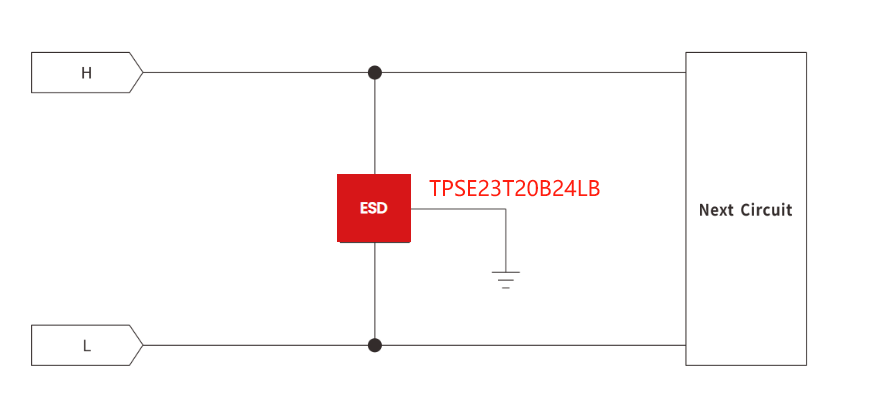
- CAN Bus Protection
Recommended: Low-capacitance TVS array (e.g., TPSE23T20B24LB)
- Junction capacitance < 20pF
- Meets high-speed signal integrity requirements
- IEC 61000-4-2 Level 4 (±20kV contact / ±30kV air)
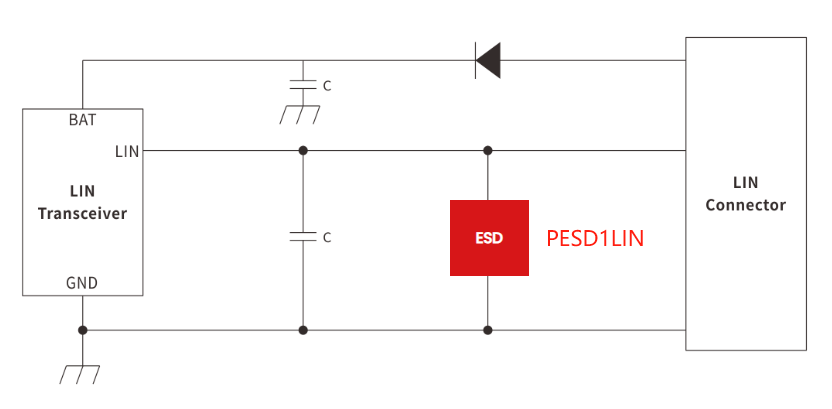
- LIN Bus Protection
Recommended: Low-capacitance ESD device (e.g., PESD1LIN)
- Low-capacitance design to prevent signal distortion
- Meets automotive ESD standards (30kV air discharge capability)
Semiware LEV Battery System Protection Support
Semiware specializes in automotive-grade circuit protection components covering the full LEV voltage range (48V–120V+), offering:
- TVS transient voltage suppressors
- CAN/LIN communication protection solutions
- PPTC resettable overcurrent protection
- Integrated ESD/surge protection solutions
Comprehensive reference designs and component selection support are available for e-bikes, electric two-wheelers, electric motorcycles, and industrial vehicles.
Please contact the Semiware engineering team for LEV BMS reference circuits and component selection advice.
Semiware LEV Power & Signal Interface Protection Recommended Devices
| Type | Part Number | Description | Package | Application |
| ESD | TPSE23T20B24LB | 24V, bi-directional, 13pF, 3A | SOT-23 | CAN Interface ESD Protection |
| ESD | TPSE3D35B24A | 24V, bi-directional, 24pF, 7A | SOD-323 | CAN Interface ESD Protection |
| ESD | PESD1LIN | 24V / 15V, bi-directional, 17pF | SOD-323 | LIN Bus ESD Protection |
| TVS | SMDJ58CA | 3kW, bi-directional | SMC | Battery Disconnect & Surge Protection |
| TVS | 5.0SMDJ64CA | 5kW, bi-directional | SMC | / |
| TVS | 5.0SMDJ85CA | 5kW, bi-directional | SMC | / |
| TVS | 5.0SMDJ100CA | 5kW, bi-directional | SMC | / |
| TVS | SM8S30CA | 30V, 6600W, bi-directional | DO-218AB | 24V Automotive Power Line Load Dump Protection |
| TVS | SM8S33CA | 33V, 6600W, bi-directional | DO-218AB | / |
| TVS | SM8S36CA | 30V, 6600W, bi-directional | DO-218AB | / |