As the automotive cockpit evolves from traditional mechanical gauges into fully digital, 3D-immersive smart instrument clusters, the dashboard has become far more than just a tool for displaying speed and fuel levels; it has transformed into a data hub for information exchange throughout the entire vehicle.
Critical data—including navigation, ADAS alerts, battery status, driving modes, and vehicle health notifications—is presented here in real-time. However, this presents a challenge: this "information hub" operates within a relatively complex electrical environment.
I. Are You Aware of the Four Major Electrical Risks Facing Instrument Clusters?
- Electrostatic Discharge (ESD):
- Generated when a human body touches the screen or buttons
- Contact discharge occurring during the assembly process
- Air discharge events reaching up to ±30kV
👉 Symptoms: Black screens, system crashes, touch interface anomalies
- Surges & Transient Overvoltage:
- Switching of the ignition key
- Activation of relays
- Induced transients from external lightning strikes
👉 Symptoms: Chip damage, system resets
- Load Dump:
- Occurs when the alternator is suddenly disconnected from the battery, causing an instantaneous voltage spike
👉 Symptoms: Breakdown of Power ICs and MCUs
- EMI / Signal Crosstalk:
- Complex high-frequency communication environments
- High-density layout of multiple modules
👉 Symptoms: Data errors, display jitter
II. Comprehensive Protection Strategy
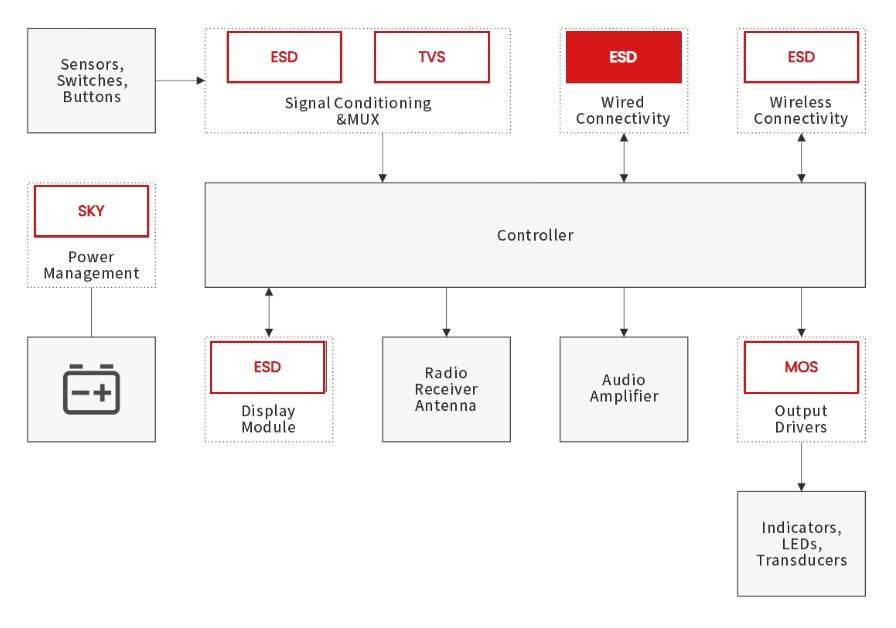
Instrument cluster protection cannot rely on a single component; it requires a multi-layered protection approach:
- Power input protection (Surge + Reverse Polarity)
- ESD protection for signal lines
- Communication interface protection
- Protection for display and low/high-speed signals
- Output driver protection
Semiware's discrete components are ideally suited to cover these critical nodes.
Reference Design Block Diagram:
III. Power Supply Protection
The power module acts as the "heart" of the system, responsible for converting the vehicle battery voltage into a stable power supply for the various subsystems.
Recommended Components:
| Device | Type | Key Specs | Function in Circuit |
| SS54AQ | Automotive Schottky Diode | 5A, 40V, Vf 0.55V | Low-loss rectification, reverse polarity protection |
| SS56AQ | Automotive Schottky Diode | 5A, 60V, Vf 0.70V | Higher voltage margin for power stability |
Both components utilize an SMA package, are AEC-Q101 automotive-qualified, and operate stably across a wide temperature range of -55°C to +150°C, effectively preventing damage from reverse power connections and enhancing power supply efficiency.
IV. Signal Conditioning and ESD Protection
The instrument cluster must process a vast array of signals originating from sensors, switches, and communication interfaces. These signal lines act as the "nerve endings" of the system, making them highly susceptible to interference from ESD and transient overvoltage events.
Recommended Components:
| Device | Type | Key Specs | Application in Circuit |
| TPSE3D35B12A | Automotive TVS Diode Array | 12V,±30kV (Air),25pF,SOD-323 | General signal lines |
| TPSE3D35B24A | Automotive TVS Diode Array | 24V,±30kV (Air),SOD-323 | Higher voltage signal protection |
| TPSE3D35B5.0A | Automotive TVS Diode Array | 5V,±15kV (Air),SOD-323 | Low-voltage digital signals |
| TPSE3D35B3.3MA | Automotive TVS Diode Array | 3.3V,±15kV (Air),1.0pF, SOD-323 | MCU-level protection |
| TPSE10F10B3.3MA | Automotive TVS Diode Array | 3.3V,0.3pF,DFN1006 | High-speed signal lines |
In high-speed signal paths (such as display controllers and data interfaces), selecting ultra-low capacitance components is essential to effectively prevent signal distortion while simultaneously providing ESD protection.
V. TVS Transient Voltage Suppression Protection
TVS diodes are used to absorb transient surges and serve as core components for power supply and I/O protection within instrument clusters.
Recommended Components:
| Device | Type | Key Specs | Function in Circuit |
| TPSVF20B5.0 | Automotive TVS Diode | 5V,SOD-123FL | Low-voltage rail protection |
| TPSVF20U12 | Automotive TVS Diode | 12V,SOD-123FL | Mid-voltage protection |
Suppress surge spikes to protect MCU and ASIC power rails.
VI. Wired Communication Interface Protection (CAN / LIN)
Instrument clusters rely on in-vehicle buses—such as CAN and LIN—for data communication; any interference to these buses will directly impact driving information.
Recommended Components:
| Device | Type | Key Specs | Application in Circuit |
| PESD1LIN | Automotive ESD Suppressors | 15/24V,±15kV,SOD-323 | LIN/CAN bus protection |
| TPSE3D35B24A | Automotive TVS Diode Array | 24V,±30kV,SOD-323 | Automotive communication lines |
VII. Wireless Communication Protection (Bluetooth/Wi-Fi)
Recommended Components:
| Device | Type | Key Specs | Function in Circuit |
| TPSE3D35B5.0A | Automotive ESD Suppressors | 5V,±15kV,SOD-323 | Wireless module ESD protection |
Conclusion
Semiware provides end-to-end protection for digital instrument panels, from power supply to signal transmission, through a complete set of discrete components, ensuring stable operation even in complex automotive electromagnetic environments.
If you are undertaking the following design projects:
- Digital dashboard/3D cockpit system development
- Automotive MCU/display module EMC optimization
- CAN/LIN/Ethernet communication interference immunity design
- Power surge and ESD reliability remediation
We can provide:
- Complete reference protection architecture
- Component selection advice (TVS/ESD/Schottky/MOSFET)
- Alternative component analysis and BOM optimization support
- Test standard (ISO 7637/IEC 61000) adaptation solutions
👉 Contact us for technical support and sample requests