As the "nerve endings" of fire safety systems, the stability of smoke detectors directly impacts the safety of human life and property. However, in practical applications, many detector failures are not caused by sensor aging, but rather by exposure to "invisible" electrical hazards.
I. Why Do Smoke Detector Systems Require Electrical Protection?
Smoke detectors are widely deployed in various settings, including residential homes, commercial buildings, and industrial facilities. Because they operate continuously in a high-sensitivity standby mode, they are extremely susceptible to electromagnetic environments and electrical transients.
If protection measures are inadequate, the following issues may arise:
- False alarms
- Reduced sensitivity or complete failure
- Damage to the MCU or sensors
- Power supply anomalies leading to system restarts or crashes
Therefore, robust electrical protection is absolutely essential.
II. The Three Major Electrical Hazards Facing Smoke Detectors
- Electrostatic Discharge (ESD) Risks
Source:
User contact, dry air conditions, and static charge accumulation on the device casing can all trigger ESD events.
Impact:
- Discharge levels can reach ±15kV to ±25kV
- Direct breakdown of MCU I/O ports or sensor front-ends
- Resulting in false triggers or system resets
- Power Surges and Transient Overvoltage
Sources:
- Reverse polarity or contact bounce during battery replacement
- Power supply plug-in/unplug transients
- Interference from industrial environments
Impact:
- Chip damage
- Power rail anomalies
- Abnormal system restarts
- Electromagnetic Interference (EMI)
Sources:
- Wi-Fi / Bluetooth devices
- Industrial motors
- High-frequency switching power supplies
Impact:
- ADC sampling errors
- Misinterpretation of smoke density levels
- False system alarms
III. Semiware’s Comprehensive Protection Solution for Smoke Detectors
To address the aforementioned risks, Semiware offers a multi-layered circuit protection solution that covers the power supply, signal lines, driver circuits, and ESD protection paths.
1️⃣ Design Approach
Layer 1: External Interference Protection
TVS / ESD Diode ➡️ ESD clamping and discharge at interface ports.
Layer 2: Power Supply and Driver Protection
MOSFET ➡️ based power management
Schottky diodes ➡️ reverse voltage clamping.
Layer 3: Signal and Control Execution
Transistor ➡️ current limiting and filtering for MCU inputs.
2️⃣ Circuit Design Reference
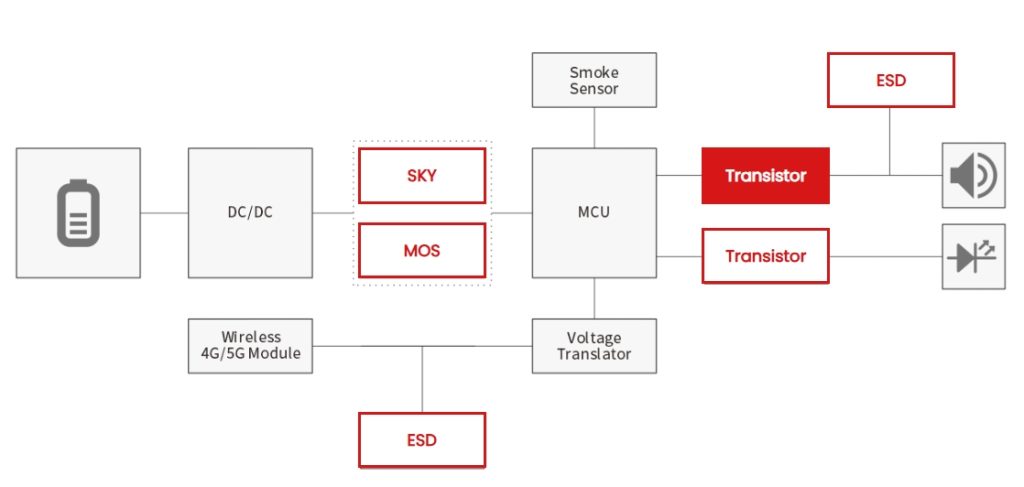
3️⃣ Semiware Protection Component Selection Guide
| Protection | Device | Key Specs | Function |
| ESD Protection | SE10F20B3.3MA ESD Diode | 3.3V,±25kV (Air),0.45pF | Protects MCU and sensor I/O from electrostatic discharge, reducing false triggering risk. |
| Power Switching / Control | SNM2011S MOSFET | 20V,12mΩ; SOT-23 | Used for power switching and efficient load control with low conduction loss. |
| Flyback / Inductive Load Protection | SD103BWS Schottky Diode | 30V,1.5A,SOD-323 | Clamps inductive kickback from buzzer and load, protecting MOSFET and driver circuits. |
| Signal Driving & Amplification | BC807W Transistor | -0.5A,100~600,SOT-323 | Provides stable current amplification for buzzer or LED driving applications. |
As safety-critical products, smoke detectors demand an exceptionally high level of stability and reliability. By incorporating Semiware's multi-layer protection design, engineers can build stable and reliable smoke detection systems.
👉 Design reference: https://en.semiware.com/applications/smoke-detector/
If you are seeking highly reliable semiconductor protection solutions, please feel free to contact us; Semiware offers comprehensive component selection assistance and reference design support.