More and more mid-to-high-end vehicles are now equipped with seat ventilation, heating, massage, and lumbar support adjustment functions. These functions rely on the coordinated operation of multiple electronic control units, drive circuits, and communication interfaces. For example, the seat control module needs to communicate with the vehicle network via LIN and CAN, and connect to sensors and control chips via interfaces such as SPI and I2C.
However, with the increasing level of seat electronics, the risks of interference such as electrostatic discharge (ESD), electrical fast transient pulse (EFT), and power surges at the internal and external interfaces of the system are also constantly increasing.
I. Architecture of Automotive Seat Ventilation and Massage Systems
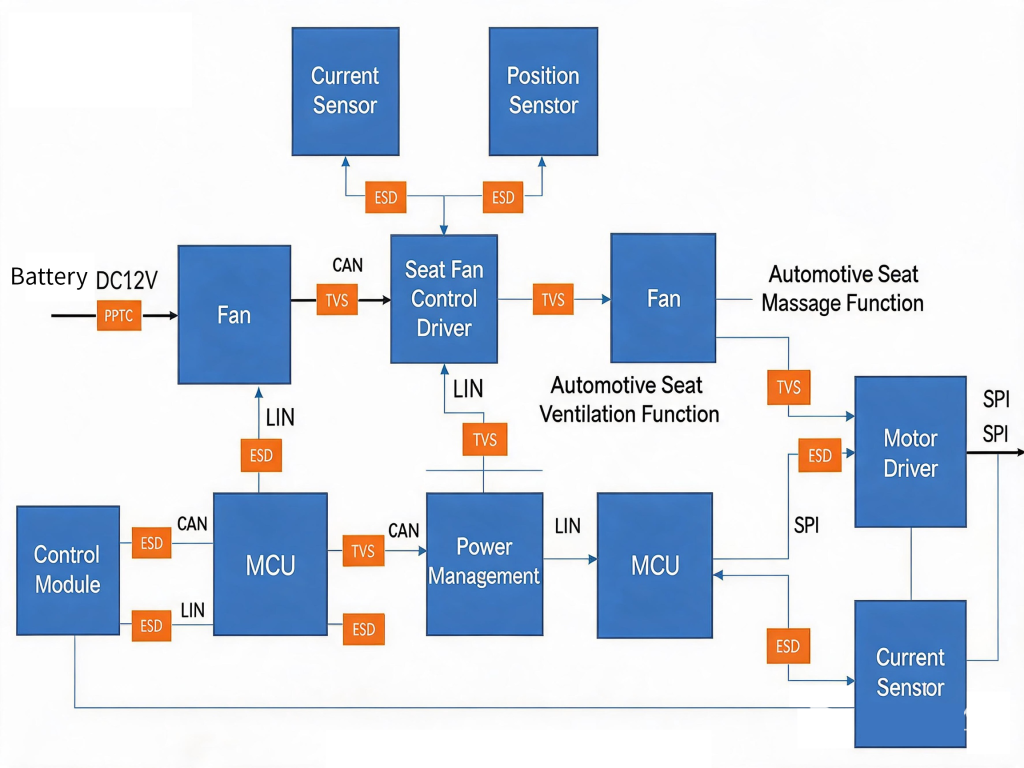
Automotive seat ventilation and massage systems typically consist of multiple electronic modules, mainly including:
- Seat Control Unit
The seat control unit is the core of the entire system. It controls the fan, motor, air pump, and massage actuators through an MCU to manage seat functions.
Typically includes:
- Power input interface
- CAN/LIN communication interface
- Sensor interface
- Motor drive interface
Since the control module directly connects to the vehicle's power supply and communication network, transient voltage and electrostatic discharge (ESD) protection are crucial considerations.
- Ventilation System
Seat ventilation is primarily achieved through a built-in fan and airflow channels, circulating air to reduce seat surface temperature and improve comfort.
Typically includes:
- Fan drive circuit
- Motor control chip
- PWM control signal
Since the fan is an inductive load, transient voltages may be generated during startup and shutdown, requiring power supply protection.
- Massage Control Module
Seat massage functions typically utilize airbags, motor vibrators, etc., with massage modes and intensity adjusted electronically.
Circuit includes:
- Air pump drive
- Vibration motor drive
- Pressure sensor
The motors and drive components in these modules are prone to electromagnetic interference, requiring TVS protection and filtering design to improve system reliability.
II. Circuit Protection Scheme for Automotive Seat Ventilation and Massage Systems
Automotive seat ventilation and massage systems contain multiple communication interfaces and power modules, each facing different transient threats.
- The SPI/I2C interface primarily connects to internal sensors and control chips, requiring attention to ESD protection and signal integrity.
- The LIN/CAN interface connects to the vehicle's communication network, needing protection against electrostatic discharge (ESD), electrical fast transients (EHT), and line interference.
- The 12V power input needs to handle surges and voltage transients during vehicle operation.
Depending on the application location, appropriate ESD protection devices and TVS diodes can be selected for protection.
2.1 Communication Interface ESD Protection Scheme
Communication interfaces in automotive seat systems include SPI, I2C, LIN, and CAN.
Although these interfaces operate at low voltages, they are susceptible to ESD shocks due to their connection to external wiring harnesses or user-accessible areas.
Recommended ESD Protection Devices:
| Part Number | Application | Key Parameters | ESD Protection | Package |
| SMC12 | SPI / I2C Interface | 12V, 11A, 32pF | ±15kV Air / ±8kV Contact | SOT-23 |
| PESD1LIN | LIN Bus Interface | 15V / 24V, 5A, 17pF | ±15kV Air / ±8kV Contact | SOD-323 |
| SE23T35B24B (SMC24) | CAN Bus Interface | 24V, 7A, 50pF | ±30kV Air / ±30kV Contact | SOT-23 |
These ESD protection devices feature low capacitance and miniaturized packaging, effectively reducing the impact of ESD shocks on communication chips while maintaining signal integrity.
2.2 12V Power Input Surge Protection Scheme
Automotive seat control modules are typically powered by a 12V vehicle power supply. During vehicle startup, load switching, and abnormal conditions, transient overvoltages may occur in the power supply line.
TVS diodes can quickly respond to and limit transient voltage peaks, providing protection for the downstream power chip, MCU, and drive circuitry.
Recommended TVS Protection Devices:
| Part Number | Application | Key Parameters | Surge Capability | Package |
| SMCJ15CA | 12V Power Input Protection | 15V, 61.5A | 1500W Peak Pulse Power | SMC |
| SMDJ15CA | High Reliability 12V Power Protection | 15V, 123A | 3000W Peak Pulse Power | SMC |
III. Design Considerations for Automotive Seat Electronic Protection
3.1 Protection Devices Should Be Placed Close to Interfaces
- ESD protection devices should be placed as close as possible to connectors or signal entry points.
- A shorter discharge path reduces parasitic inductance and improves transient discharge effectiveness.
3.2 Selecting Appropriate Capacitors Based on Interface Type
Different interfaces have different requirements for the parasitic capacitance of protection devices:
- High-speed communication interfaces: require low-capacitance ESD devices
- LIN/CAN interfaces: require a balance between protection capabilities and signal integrity
- Power interfaces: focus on surge withstand capability
3.3 Meeting Automotive Reliability Testing Requirements
Automotive seat electronic system design typically requires reference to relevant standards:
- IEC 61000-4-2: ESD Testing
- ISO 10605: Automotive Electrostatic Discharge Testing
- ISO 7637: Road Vehicle Electrical Transient Conducted Testing
Conclusion
With the increasing functionality of smart cockpits, automotive seat systems are becoming integrated electronic systems combining control, communication, and execution functions.
Semiware provides ESD Protection Diodes, TVS Diodes, and automotive electronic transient protection solutions, supporting applications in smart cockpits, body electronics, and new energy vehicles, helping customers improve the reliability of electronic systems.