I. Introduction
With the rapid development of new energy vehicles, thermal management systems have become a crucial component affecting battery performance, vehicle efficiency, and vehicle safety.
Unlike traditional mechanical water pumps, electronic water pumps in new energy vehicles achieve intelligent regulation of coolant flow through ECU control, motor drive, and sensor feedback, providing precise temperature management for core components such as the power battery, motor, and electronic control system.
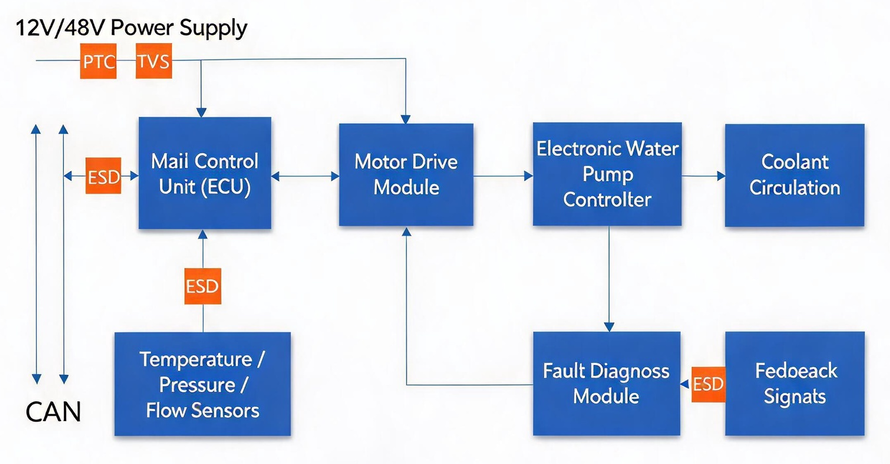
However, while achieving intelligent control, electronic water pump systems also introduce more electronic components, including control chips, communication interfaces, sensors, and power drive modules. These circuits may be subject to various electrical interferences during vehicle operation, such as:
- Electrostatic Discharge (ESD)
- Electrical Fast Transient (EFT)
- Surge
- Power supply transient interference
- Back EMF
Without effective protection design, this may lead to controller damage, communication abnormalities, or even affect the vehicle's overall thermal management functions.
This article will focus on the architecture of the electronic water pump control system for new energy vehicles, analyze its main electrical risks, and introduce ESD and surge protection solutions for power supply, CAN communication, motor drive, and sensor interfaces.
II. The Role of Electronic Water Pumps in the Thermal Management System of New Energy Vehicles
New energy vehicles differ from traditional fuel vehicles in that their power systems heavily rely on electronic control.
As a key actuator in the thermal management system, the electronic water pump controls the coolant circulation speed through PWM speed regulation, dynamically adjusting its heat dissipation capacity according to different operating conditions.
Compared to traditional mechanical water pumps, electronic water pumps offer:
- Precise flow control
- Wide-range speed adjustment
- Fast response speed
- Easy integration with the vehicle control system
- Support for intelligent thermal management strategies
III. Major Electrical Risks and Protection Solutions for Electronic Water Pump Systems
3.1 Power Input Transient Risks and Load Dump Protection
Risks:
- Load Dump
- Battery switching transients
- Voltage surges
- Reverse connection impact
Potential consequences:
- MCU damage
- Driver IC failure
- Power module malfunction
Protection solution:
Recommended: Use TVS diodes (SM8S24CA, SM8S36CA) for voltage clamping.
3.2 CAN Communication Interface ESD and Surge Protection
Risk: The electronic water pump connects to the vehicle network via CAN.
External wiring harnesses may introduce: ESD, EFT, Surge
Causes:
- CAN transceiver damage
- communication anomalies
- ECU malfunction
CAN protection needs to consider:
- Low capacitance
- high ESD rating
- signal integrity
Recommended multi-level protection using SMC24 ESD Protection Diode and low residual voltage P0300SD TSS thyristor.
3.3 Motor drive circuit back EMF protection
Risk: The electric water pump motor is an inductive load.
During PWM speed regulation, the current changes rapidly, and back EMF is generated when the motor stops, which may form a voltage spike—damaging the drive MOS.
Protection solutions:
Recommended use of 1N4007 to suppress voltage spikes; SMBJ28CA TVS diode to suppress transient voltage.
3.4 Sensor interface ESD protection
Risk: Temperature, pressure, and flow sensors are usually connected via wiring harnesses and are susceptible to:
- Human body static electricity
- External interference
- Insertion/removal transients
Protection solutions:
Recommended use of GBLC24CI low capacitance ESD devices.
IV. Semiware Recommended Protection Devices
For critical nodes in electronic water pump systems of new energy vehicles, such as power supply, communication, motor drive, and sensor interfaces, Semiware offers a variety of TVS diodes, ESD protection devices, and TSS protection devices to help improve the system's resistance to ESD, surges, and transient interference.
| Application | Part Number | Device Type | Key Parameters |
| 12V Power Input Load Dump Protection | SM8S24CA | Automotive TVS Diode | VRWM: 24V Peak Pulse Power: 6.6kW Package: DO-218AB |
| 24V Power Input Surge Protection | SM8S36CA | Automotive TVS Diode | VRWM: 36V Peak Pulse Power: 6.6kW Package: DO-218AB |
| CAN Interface ESD Protection | SMC24 | ESD Protection Diode | VRWM: 24V Low Capacitance: ≤50pF IPP: 7A Package: SOT-23 |
| CAN Interface Surge Protection | P0300SD | TSS Thyristor Surge Protector | Breakover Voltage: 25V Capacitance: ≤50pF Package: SMB |
| Temperature / Pressure / Flow Sensor Interface Protection | GBLC24CI | Low Capacitance ESD Diode | VRWM: 24V Low Capacitance Design IPP: 6A Package: SOD-323 |
| Motor Back EMF Suppression | 1N4007 | Rectifier Diode | VRRM: 1000V IF(AV): 1A Package: SOD-323 |
| Motor / Power Transient Protection | SMBJ28CA | TVS Diode | VRWM: 28V Peak Pulse Power: 600W Package: SMB |
Summary
Electronic water pumps in new energy vehicles are an important component of modern thermal management systems, and their reliability directly affects the performance of the power battery, motor, and the entire vehicle.
Semiware provides circuit protection solutions for new energy vehicle applications, including automotive-grade TVS diodes, ESD protection diodes, and transient protection devices, helping customers improve the reliability of electronic water pumps and new energy vehicle thermal management systems.
Please contact us for protection solution design support tailored to your specific application scenarios.
👉 https://en.semiware.com/contact/
🔗 Related Applications and Solutions
ESD Protection Diode