Amid the rapid development of intelligent driving and smart cockpits, the volume of data from automotive sensors is growing exponentially. The transmission of vast amounts of high-definition video and sensor information between cameras, radars, and domain controllers places higher demands on automotive communication systems regarding bandwidth, latency, and reliability.
As the core technology for high-speed automotive data links, SerDes (Serializer/Deserializer) is becoming a critical bridge connecting "perception systems" with "computing platforms."
However, high speed does not automatically equate to stability.
In the complex electromagnetic environment of a vehicle, SerDes links may also face challenges such as:
- Electrostatic Discharge (ESD, IEC 61000-4-2)
- Power Supply Surges (ISO 7637-2)
- Bulk Current Injection (BCI)
- Wiring Harness Crosstalk and Reflection Noise
👉 Therefore, high-speed transmission and circuit protection require a coordinated design approach.
I. Overview of Automotive SerDes Technology
1.1 What is SerDes?
SerDes (Serializer/Deserializer) is a communication architecture for serial-parallel conversion:
Transmitter: Converts multiple parallel data streams into high-speed serial signals.
Receiver: Converts serial signals back into parallel data.
In essence, it:
Replaces multiple sets of low-speed parallel wire harnesses with a small number of high-speed cables.
1.2 Core Advantages of Automotive SerDes
| Feature | Benefit |
| Wiring reduction | Fewer harnesses |
| High bandwidth | Multi-Gbps transmission |
| Long distance | Up to 10–15 meters |
| Noise immunity | Differential signaling |
| Low latency | Real-time data transfer |
1.3 Mainstream Automotive SerDes Protocols
| Protocol | Type | Application |
| GMSL | Proprietary | ADAS cameras |
| FPD-Link | Proprietary | Display systems |
| MIPI A-PHY | Open standard | Next-generation architecture |
II. Automotive Electromagnetic Environment and SerDes Challenges
2.1 Major Sources of Interference
- ISO 7637-2: Ignition pulses (5a/5b)
- ESD: Human body/environmental electrostatic discharge
- Surges from motor load switching
- Reflections and crosstalk in long wiring harnesses
- Ground potential differences between ECUs
2.2 Impacts
- Video data bit errors
- Link resynchronization
- Dropped image frames
- Camera blackouts or intermittent signal loss
👉 Therefore, a layered protection design (Power + Signal) is essential.
III. Semiware Comprehensive SerDes Circuit Protection Solution
3.1 Power Supply Protection (12V / 24V Systems)
Protects the SerDes chip power supply and the ECU power input.
| Device Type | Part Number | Specification | Package |
| TVS Diode | SM8S24A | 24V / 170A | DO-218AB |
| TVS Diode | 5KP24CA | 24V / 129A | P600 |
| TVS Diode | SMDJ24CA | 24V / 77A | SMC |
| TVS Diode | SMCJ24CA | 24V / 38A | SMC |
| PTC | SK30-300 PTC | 30V / 3A | Through-hole |
👉 Suitable for ISO 7637-2 Pulse 5a/5b surge scenarios.
3.2 ESD Protection for Signal Lines (Critical Design)
SerDes signals are extremely sensitive to parasitic capacitance; therefore, ESD devices must meet the following requirements:
- Ultra-low junction capacitance (≤0.5 pF preferred)
- High-speed response (nanosecond range)
- Low insertion loss
IV. Protection Solutions for Different SerDes Architectures
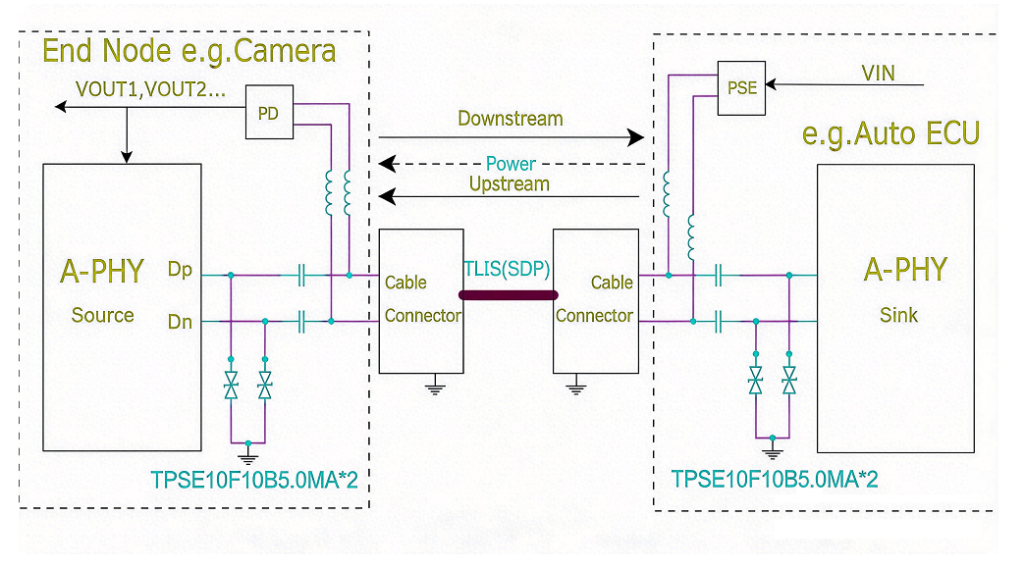
4.1 MIPI A-PHY (Open Standard)
A-PHY targets long-range, high-speed automotive links, supporting interconnection between cameras and domain controllers.
Recommended Solution: TPSE10F10B5.0MA
| Parameter | Value |
| Capacitance | ~1pF |
| ESD Level | IEC 61000-4-2 Level 4 |
| Air Discharge | ±20kV |
| Contact Discharge | ±20kV |
| Certification | AEC-Q101 |
👉 Suitable for coaxial & differential links
4.2 GMSL / FPD-Link
(1) Coaxial single-ended systems (cameras)
Supports power + data multiplexing
Long-range camera links
Recommended device:
SE10F04B18MA-SP
- Cj: 0.5pF
- ESD: ±15kV
- IEC 61000-4-2 Level 4
(2) Differential systems (displays and cockpit)
Center stack display / Instrument cluster / Rear-seat display
Recommended device:
SEULC3324P-SP
- 4-channel integrated protection
- Cj: 0.55pF
- DFN2510 package
V. Automotive SerDes Application Scenarios
5.1 ADAS camera systems
- Front-facing camera (FOV / Stereo)
- Surround view system
- Rear-view camera
👉 Dominated by GMSL / FPD-Link
5.2 Smart cockpit systems
- 4K center stack display
- All-digital instrument cluster
- Rear-seat entertainment display
👉 FPD-Link / A-PHY
5.3 Domain controller interconnection
- Multi-sensor data fusion
- L2–L4 autonomous driving computing
👉 Clear trend toward MIPI A-PHY
Conclusion
As automotive systems evolve toward higher bandwidth and centralized computing architectures, SerDes links have become a cornerstone of ADAS (Advanced Driver Assistance Systems) and smart cockpit architectures.
Contact Us
Semiware offers a comprehensive portfolio of low-capacitance TVS diodes, ESD arrays, and surge protection devices specifically designed for high-speed automotive data networks such as GMSL, FPD-Link, and MIPI A-PHY. Our solutions enable engineers to meet rigorous automotive reliability standards—including AEC-Q101 and IEC 61000-4-2 Level 4—while ensuring signal integrity.
👉 If you are developing SerDes-based camera systems, smart displays, or domain controller platforms, please contact us for reference designs, component selection support, or technical consultation.