In the actual selection of ESD protection devices, engineers often need to consider multiple factors simultaneously: Is the package directly compatible? Are the operating voltages consistent? Is the clamping voltage appropriate? Will the device capacitance affect the signal? Do the ESD and transient protection capabilities meet the requirements?
For 5V bidirectional ESD protection devices, there are already many mature products on the market, such as Bourns CDSOD323-T05C, Nexperia PESD5V0U1BA, Yageo UDD32C05L01, and Littelfuse SP4021. These products each have their own characteristics in terms of package, operating voltage, and protection performance, and are models that are often referred to in the selection or replacement of many projects.
So, can the Semiware GBLC05CI, as a 5V, bidirectional, low-capacitance SOD-323 ESD protection device, serve as an alternative to these commonly used models?
This article will compare the GBLC05CI with several mainstream devices by focusing on key parameters such as packaging, operating voltage, clamping voltage, capacitance, ESD protection capability, and surge performance. It will examine which applications it can replace and what to pay attention to when selecting it.
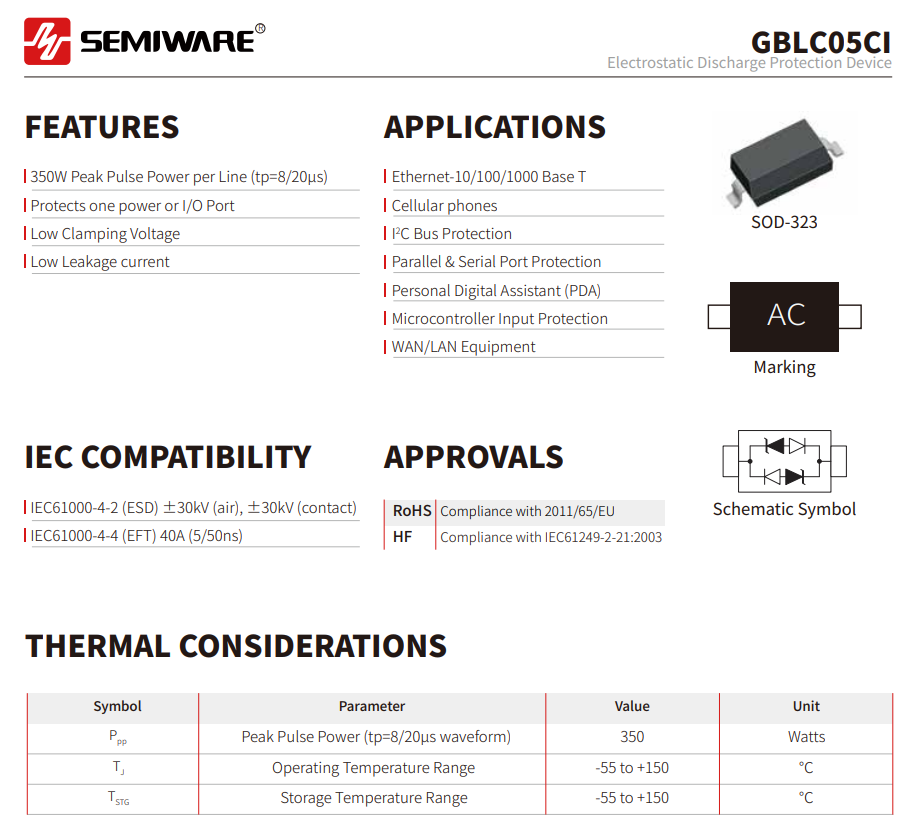
I. Key Specifications of GBLC05CI
| Parameter | GBLC05CI |
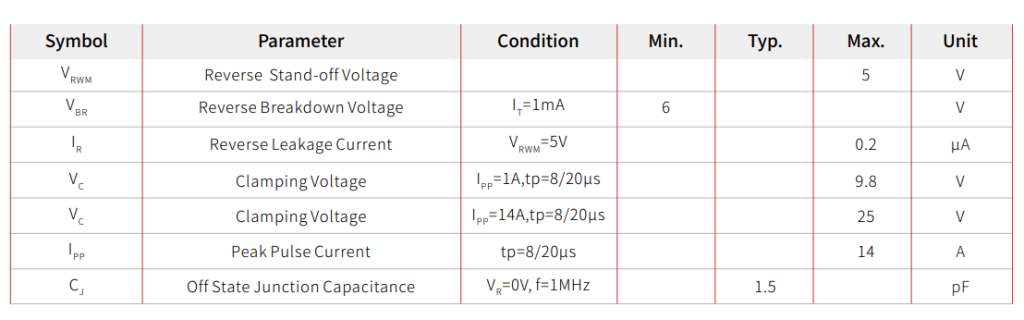
| Working Voltage (VRWM) | 5V |
| Breakdown Voltage (VBR) | 6V |
| Clamping Voltage @ 1A | 9.8V |
| Peak Pulse Current | 14A |
| Junction Capacitance | 1.5 pF |
| ESD | ±30 kV Air / ±30 kV Contac |
| Package | SOD-323 |
II. GBLC05CI vs. Mainstream Brands: Parameter Comparison
| Parameter | Semiware GBLC05CI | Bourns CDSOD323-T05C | Nexperia PESD5V0U1BA | Yageo UDD32C05L01 | Littelfuse SP4021 |
| Package | SOD-323 | SOD-323 | SOD-323 | SOD-323 | SOD-323 |
| VRWM | 5V | 5V | 5V | 5V | 5V |
| VBR | 6 V | 6 V | 7 V | 6 V | 6.3 V |
| VC @ 1A | 9.8V | 9.8V | - | 9.8V | 9.8V |
| Capacitance | 3 pF | 2.9 pF | 0.8 pF | 2.5 pF | |
| ESD Contact | ±30 kV | ±30 kV | ±30 kV | ±30 kV | ±30 kV |
In summary, the GBLC05CI offers a good foundation for comparison with several mainstream SOD-323 devices in key parameters such as package, 5V operating voltage, clamping voltage, ESD protection, and low capacitance. Therefore, it can be evaluated as an alternative candidate or second-tier supplier solution for similar devices from Bourns, Nexperia, Yageo, Littelfuse, and other manufacturers.
III. Suitable Applications for GBLC05CI?
3.1 Industrial Control Equipment
External I/O, control signals, and communication interfaces on industrial equipment are easily exposed to the external environment. ESD and EFT can both enter the equipment through connectors.
Placing the GBLC05CI near the interface helps reduce the risk of transient interference entering core components such as MCUs and communication ICs.
3.2 Ethernet/LAN Devices
For network devices, external network cables are also a significant path for ESD and transient interference to enter the device; therefore, interface-side protection is a common design approach.
3.3 I²C and MCU Interface
I²C is inherently a low-speed communication interface, but if the line is connected to external modules, sensors, or connectors, it can still be susceptible to electrostatic interference.
Adding ESD protection near the interface reduces the chance of transient voltages directly entering the MCU I/O.
3.4 Consumer Electronics and Portable Devices
Mobile phones, PDAs, and serial interfaces are also application areas listed in the GBLC05CI datasheet.
For products with limited space, the SOD-323 package provides interface protection within a confined PCB space.
Conclusion
From the perspectives of packaging, operating voltage, ESD protection capability, and low capacitance, the GBLC05CI has a good parameter matching foundation with many commonly used SOD-323 ESD devices on the market, which can meet the design requirements of many interface protection applications.
If you are looking for an alternative to 5V SOD-323 ESD protection devices, a second supplier, or wish to optimize your existing protection solution, please contact us. Our Semiware technical team can provide device selection advice, parameter comparisons, and sample support based on your application needs, helping you complete product verification more quickly.