Introduction
Industrial environments are complex; factors such as dust, high temperatures, humidity, and mechanical vibration can all impact the operational stability of automation equipment. Industrial Programmable Logic Controllers (PLCs) are specially ruggedized to withstand obvious environmental stressors—such as extreme temperatures, humidity, and mechanical shock—thereby meeting the basic operational requirements of harsh industrial settings.
However, in practice, many PLC malfunctions lack an obvious physical cause. The root cause often lies in hidden interference prevalent in industrial environments: Electromagnetic Interference (EMI), Electrostatic Discharge (ESD), Electrical Fast Transients (EFT), and various types of transient surges.
This article systematically analyzes the generation mechanisms and equipment risks associated with transient surges and presents a practical, standardized surge protection solution for PLCs.
I. Core Threats of Transient Surges to PLCs
The core of a PLC consists of semiconductor chips and precision microelectronic circuits. These components are inherently characterized by low voltage tolerance thresholds and extreme sensitivity to instantaneous high voltages.
The evolution of industrial control systems from traditional mechanical control to microprocessor-based electronic control has significantly improved automation precision and efficiency. However, the physical characteristics of semiconductor devices have also introduced potential risks regarding electromagnetic interference within these systems.
Various electromagnetic activities in industrial settings continuously induce transient current surges, which can generate abnormally high voltages in nearby connected cables. When the instantaneous voltage exceeds the PLC circuit's maximum tolerance threshold, it can cause chip breakdown, thereby compromising the equipment's stable operation.
II. Three Major Sources of Transient Surge Interference in Industrial Settings
Electromagnetic interference faults in industrial PLCs primarily stem from three types of high-frequency transient surges; addressing these is a key priority for the protection of industrial control equipment.
- Electrostatic Discharge (ESD)
When a charged human body or object comes into contact with precision components—such as PLC ports, terminal blocks, or equipment connectors—an instantaneous electrostatic discharge occurs, generating a high-intensity, momentary high-voltage spike.
Although the total energy of such high-voltage events is relatively low, it is sufficient to cause dielectric breakdown in precision semiconductor components, leading to latent PLC faults or direct hardware damage.
2. Electrical Fast Transient (EFT) Bursts
EFTs are a form of continuous, high-frequency, and repetitive steady-state interference that persists throughout the equipment's normal operation.
Inductive loads—such as motors and solenoid valves—widely deployed in industrial settings continuously generate EFT transient pulses whenever they are switched on or off via relays or switches.
EFT interference exhibits strong coupling and conduction characteristics. Once EFT pulses couple onto PLC signal lines, sensor cables, or communication buses, they can cause signal fluctuations, equipment malfunctions, and module damage; the persistent nature of this interference makes effective protection challenging.
- Ground Potential Differences and Lightning-Induced Transients
In actual industrial environments, equipment ground potential is rarely absolute zero. Factors such as soil impedance, aging grounding lines, poor contact at connection points, and improper multi-point grounding can create static or dynamic ground potential differences—ranging from tens to hundreds of volts—between different pieces of equipment or locations.
Simultaneously, high-magnitude transient currents induced by lightning can enter the equipment through cabling, damaging PLC I/O modules, measurement interfaces, and precision microelectronic components.
III. Standardized Implementation Plan for PLC Transient Surge Protection
In accordance with international electromagnetic compatibility (EMC) standards such as IEC 61000-4-4, industrial equipment must withstand transient pulse interference of up to 4,000 V. To ensure the long-term, uninterrupted, and stable operation of PLCs, a three-level layered protection system can be employed to resolve various transient surge interference issues cost-effectively and efficiently.
- Front-end Clamping Protection: TVS Diodes for Suppressing High-Frequency Transient Pulses
ESD (Electrostatic Discharge) and EFT bursts are characterized by high voltage, short duration, and low energy. Transient Voltage Suppressor (TVS) diodes are recommended to achieve precise clamping and absorption of these pulses. Key design and installation specifications are as follows:
- TVS diodes feature low capacitance, ensuring that their deployment does not interfere with normal signal transmission or communication quality;
- Components must be installed close to ports—such as cable entry points, device connectors, and pin headers—to minimize the surge conduction path;
- Differential signal lines utilize a common-mode deployment strategy, fully covering both lines of the differential pair;
- Ground plane connections must be reinforced to ensure reliability, prevent loop currents within the PCB, and eliminate secondary high-voltage spikes.
- Electrical Isolation Protection: Mitigating Ground Potential Difference Interference
Electrical decoupling between the PLC system ground and the field earth ground is achieved through isolation structures, thereby eliminating interference caused by conducted potential differences. Current mainstream industrial electrical isolation methods fall into two categories:
(1) Transformer Isolation
This technology is mature and highly stable; it is suitable for low-frequency power isolation scenarios, allows for a floating system ground, and effectively avoids interference from field ground potential differences.
Its limitation lies in its suitability only for low-frequency AC signals, making it unable to meet the requirements of high-speed applications such as DC control and high-frequency communication.
(2) Optocoupler Isolation
Suitable for DC control and high-frequency communication scenarios, with a wide range of industrial applications.
However, it has significant drawbacks: the core light-emitting component (LED) gradually ages with temperature fluctuations and prolonged use, leading to continuous performance degradation and unsuitability for industrial control scenarios requiring high reliability and long-term operation. Additionally, the device's limited frequency response constrains data transmission rates.
- Advanced Protection Solution: Semiconductor Capacitive Coupling Isolation
To address the technical limitations of transformer and optocoupler isolation, high-end industrial control equipment commonly employs semiconductor isolation devices (such as the ISO7131CC). These devices offer a balance of stability, efficiency, and long-term reliability, making them the preferred choice for industrial applications. Advantages:
(1) Utilizes an on-chip capacitive coupling isolation architecture; the absence of LED components eliminates aging-related degradation, ensuring stable long-term performance;
(2) Offers excellent insulation capabilities, achieving electrical isolation exceeding 2500 VRMS and fully complying with industrial EMC standards;
(3) Delivers high data transmission rates, supporting high-speed communication at 40–50 Mbit/s and suiting various high-frequency industrial control applications;
(4) Achieves complete electrical isolation, allowing for independent grounding and power supply systems on either side of the device, thereby thoroughly eliminating interference transmission paths caused by ground potential differences and transient surges.
IV. Semiware PLC System-Wide Integrated Protection Reference Solution
The technologies mentioned above—such as TVS clamping, electrical isolation, and semiconductor isolation—are discrete protection methods designed to address specific interference issues.
To support the standardized development of industrial PLCs, Semiware has introduced an engineering-validated, system-wide layered protection reference design. This solution covers the entire hardware signal chain—from power input to interface output—and employs multi-stage protection to deliver a systematic, integrated defense against transient surges and electromagnetic interference.
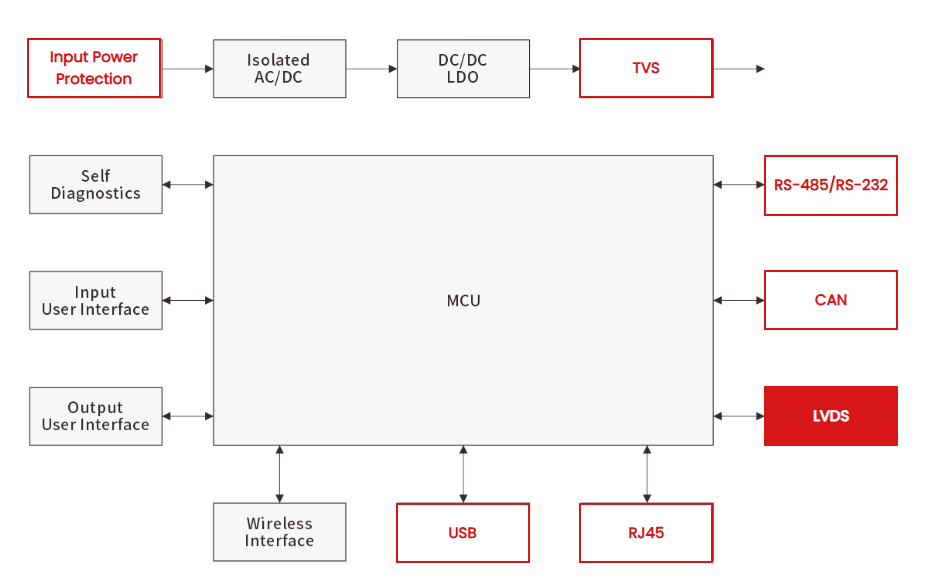
For specific solution details, please visit the Semiware official website.
👉 https://en.semiware.com/applications/plc
Conclusion
Systematic transient protection design enhances a PLC's immunity to ESD, EFT, and surge interference encountered in industrial environments, while reducing the risk of system failures and component damage caused by transient overvoltage.
If you are facing challenges regarding EFT (Electrical Fast Transient/Burst), ESD (Electrostatic Discharge), or surge compatibility during PLC hardware development, please contact us. Explore our PLC system protection solutions and specialized component portfolio to create customized, reliable surge and interference protection for your industrial control equipment.