A smart cockpit includes a cockpit domain controller (CDC), multiple displays, a head-up display (HUD), USB-C fast charging, CAN-FD/vehicle Ethernet, ambient lighting, seat/air conditioning LIN bus, audio amplifiers, and various touch buttons. It features long wiring harnesses, numerous exposed interfaces, and sophisticated manufacturing processes for the main control SoC, PHY, and SerDes chips. Load drop is a high-energy power supply overvoltage surge, while ESD">ESD is a nanosecond-level high-speed signal surge; these are the two most significant electrical risks to cockpit hardware.
I. Load Drop Risk
1、Causes
When the engine is running and the alternator is continuously generating power, loose battery terminals, aging wiring harnesses causing poor contact, or battery removal/removal during maintenance can cause the battery to suddenly disconnect from the power supply circuit. The battery, originally intended to buffer voltage, releases its stored energy from the generator's magnetizing inductance instantaneously upon disconnection, generating a high-voltage, long-lasting pulse. In a 12V passenger vehicle system, this pulse peaks at 65-87V, lasting 100-400ms, corresponding to ISO-7637-2 Pulse5a/5b and ISO16750-2 automotive-grade testing standards.
2、Commonly Damaged Modules in the Smart Cockpit
- Cockpit Domain Controller 12V Main Power Supply, PMIC Power Chip
- Central Control Screen, Instrument Panel, Passenger Screen Backlight Driver Board
- High-Power USB Fast Charging Power Supply Module, Ambient Light LED Driver
- Power Amplifier, Seat Motor, Air Conditioner Fan Drive Circuit
3、Typical Fault Phenomena
- Instantaneous high voltage breakdown of PMIC and main control chip, permanent hardware burnout
- Power rail voltage disturbance, cockpit black screen, screen flickering, system restart, system crash
- Audio popping, bus communication disconnection, sensor sampling drift
- DC-DC power chip overheating, repeated entry into protection lockout
II. Electrostatic Discharge (ESD">ESD) Risk
1、Causes
- Human contact with exposed cockpit components: USB interface, Type-C charging port, screen bezel, physical buttons, rear entertainment interface, wiring harness connector plugging/unplugging; high electrostatic discharge in dry environments.
- Automotive-grade standards: ±8kV contact discharge, ±25kV air discharge, pulse rise time <1ns. This involves extremely high voltage, low energy, but extremely high speed, making it highly susceptible to damaging the chip's gate oxide layer. Currently, cockpit main control, Ethernet PHY, and SerDes chips are manufactured with sophisticated processes, resulting in very low electrostatic discharge tolerance.
2、High-Risk Locations for Electrostatic Discharge (ESD">ESD) in the Cockpit
- All External I/O: USB-C, HDMI, AUX Audio, Automotive Ethernet
- CAN-FD, LIN Bus, Touch-Sensing Buttons
- Screen LVDS/MIPI High-Speed Serial Signal Lines
- Microphone, Camera, Door Control Harness Connector Pins
3、ESD">ESD Fault Classification Symptoms
- Soft Faults: Brief screen freezes, touch malfunction, automotive Ethernet disconnection, Bluetooth disconnection, intermittent cockpit restarts, audio noise
- Hard Damage: Permanent breakdown of PHY chip, touch IC, MIPI transceiver, interface failure
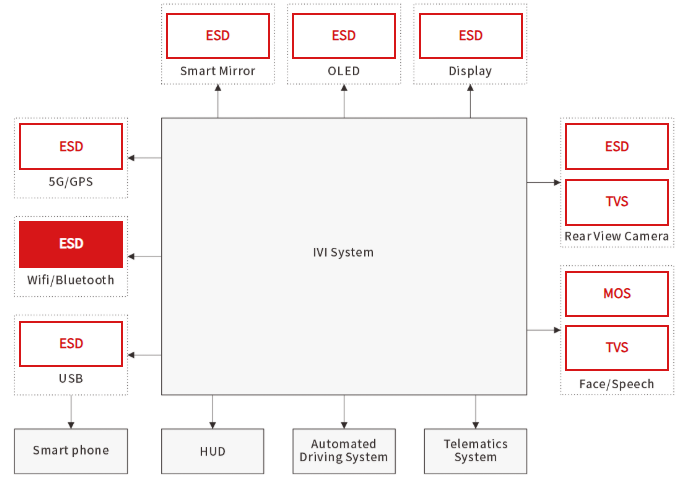
III. Circuit Protection Solutions Provided by Semiware
Learn More
The smart cockpit is a core part of automotive digitalization and intelligence, integrating Human-Machine Interface (HMI), Infotainment, Advanced Driver Assistance Systems (ADAS), and personalized services. Semiware provides customers with comprehensive circuit protection solutions to achieve intelligent cockpits. For more details on our solutions, please visit: https://en.semiware.com/applications/smart-cockpit/
About Semiware
Semiware is a comprehensive provider of circuit protection solutions. Leveraging its expertise in semiconductor technology and end-product applications, we serve customers in the electronics, automotive, and industrial markets. We offer a broad portfolio of circuit protection devices to meet customer needs, including overvoltage protection, overcurrent protection, combined protection, discrete devices, and advanced packaging technologies. Through our global EMC laboratories and FAE engineers, we provide complete solutions and product portfolios. For more information, please visit https://en.semiware.com