I. What are LVDS Connectors?
LVDS, or Low-Voltage Differential Signaling, is a low-voltage signaling technology that transmits data using a differential method.
Unlike single-ended signaling, LVDS transmits data via a pair of complementary signal lines; the receiver primarily detects the differential voltage between the two lines rather than the voltage of an individual line relative to ground (GND).
A distinct advantage of this approach is that when external noise couples onto both lines simultaneously in a common-mode manner, the receiver can cancel it out to a certain extent, giving LVDS excellent common-mode noise rejection capabilities. Tight coupling between the differential lines also helps reduce electromagnetic radiation.
II. Characteristics and Advantages of LVDS
| Feature | LVDS |
| Signaling | Differential |
| Voltage | Low voltage |
| Common-mode noise rejection | Good |
| EMI | Relatively low |
| Data rate | High speed |
| Typical connection | PCB differential pair, connector, FFC, cable |
| Typical applications | Displays, industrial equipment, automotive electronics, embedded systems |
III. Why Do LVDS Interfaces Require ESD Protection?
Although LVDS inherently possesses good common-mode noise rejection capabilities, LVDS signals often pass through connectors, FFCs (Flexible Flat Cables), or other external connection structures in practical applications. These points can serve as entry paths for electrostatic discharge (ESD) into the system.
If ESD energy directly enters the LVDS transceiver, it may cause:
- Transceiver damage
- Data transmission errors
- Display flickering or black screens
- Intermittent system resets
- Interface function failure
Additionally, LVDS signals have a low voltage swing, making transceivers sensitive to overvoltage and transient surges. Therefore, ESD protection for LVDS must balance clamping capability, parasitic capacitance, and differential signal integrity.
IV. Core Principles of LVDS ESD Protection
4.1 Is the ESD rating sufficient?
Ensure that the protection device can effectively dissipate transient energy when connectors, FFCs, or similar components are subjected to electrostatic discharge.
4.2 Is the capacitance low enough?
Ultra-low capacitance minimizes the impact of the ESD device on high-speed differential signals.
4.3 Is the layout reasonable?
Place protection devices close to the interface, maintain symmetry in the differential lines, and minimize the ESD discharge path length.
V. Semiware LVDS ESD Protection Solutions
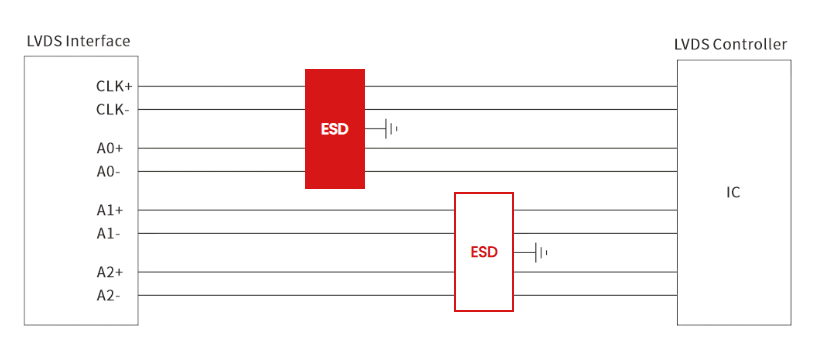
Semiware offers low-capacitance ESD protection solutions specifically designed for LVDS interfaces.
Reference Block Diagram:
 ESD Protection" class="wp-image-18814"/>
Recommended ESD Devices:
| Semiware ESD Diode | Working Voltage | ESD Rating(Air) | Capacitance | Package |
| SEULC0524PA | 5V | ±25 kV | 0.6 pF | DFN2510-10L |
| SEULC3324P10 | 3.3V | ±25 kV | 0.6 pF | DFN2510-10L |
| SESRV05-4A | 5V | ±15 kV | 0.8 pF | SOT-23-6L |
Summary
If you are designing interfaces for LVDS displays, industrial controls, or automotive electronics, please check out Semiware's LVDS ESD protection reference designs or contact us for device selection and application support.