I. The Role of Safety Light Barriers in Industry
Safety light barriers are used to protect personnel around industrial equipment. They detect the presence of people or objects within a protected zone using infrared light beams transmitted between a sender and a receiver.
When a beam is obstructed, the receiver detects the change in the optical signal and transmits a signal to an external safety control system via its safety outputs, triggering the machine's safety control system to execute the appropriate safety actions.
II. Why Do Safety Light Barriers Require Circuit Protection?
While a safety light barrier may appear to be primarily a photoelectric detection system, actual hardware implementation requires addressing several challenges simultaneously: industrial power supply transients, ESD, external cable interference, infrared transmission power consumption, signal integrity at the receiver, and the reliability of safety outputs.
This is particularly critical in 24V industrial equipment, where light barriers operate continuously over long periods. Factors such as the leakage current of protection components, voltage drops across PPTC devices, infrared LED driving methods, and transient current paths on the PCB can all impact overall system performance.
Therefore, circuit protection is essential for safety light barriers.
III. Hardware Design Concepts and Key Considerations
A typical safety light barrier system comprises several sections, including power input, infrared transmission, photoelectric reception, signal processing, MCU control, and safety outputs. Engineers must consider the following aspects during design:
3.1 Power inputs and external interfaces serve as the primary entry points for external interference; meanwhile, infrared transmission and photoelectric reception subsystems require careful management of power consumption and signal integrity.
3.2 The starting and stopping of industrial equipment—such as motors, relays, and contactors—can generate transient voltages, while external cables and connectors may introduce disturbances like ESD and electrical fast transients (EFT) into the device.
3.3 Safety light barriers require continuous, long-term operation, and the infrared transmitter is typically a major source of power consumption. Consequently, the design must balance the need for a sufficiently strong optical signal with the requirement to control average power consumption.
IV. Semiware Low-Power Design Solutions
4.1 Power Input Port (24V DC)
Protection Highlights:
Industrial 24V power supplies are susceptible to transient overvoltages caused by the switching of relays and motors, as well as risks such as reverse polarity and abnormal overcurrent conditions. The design must balance protection capabilities with low power consumption requirements.
Recommended Solution:
- Schottky Barrier Diode (SBD) (Reverse Polarity Protection)
Placed in series at the power input, an SBD with a low forward voltage drop is selected to protect against reverse polarity. The SBD's low forward voltage (VF) helps minimize power loss during normal operation.
- TVS Diode (Connected in parallel between Power and GND)
Used to suppress transient overvoltage at the power input and shunt transient energy to ground, thereby protecting downstream power and control circuits.
4.2 Safety Output Port
Protection Considerations:
The OSSD interface connects to external safety control equipment; cables and connectors are susceptible to ESD, electrical fast transients (EFT), and other external transient disturbances.
Protection devices must offer sufficient ESD immunity while minimizing parasitic capacitance and leakage current.
Recommended Solution:
- Low-Capacitance ESD Protection Devices
Key parameters to consider for ESD protection">ESD protection devices include ESD withstand capability, operating voltage, clamping voltage, and junction capacitance.
- Schottky Diode Clamping
If the reference circuit employs an SBD for signal clamping, it can work in conjunction with ESD devices to rapidly limit abnormal positive and negative transients, thereby reducing voltage stress on downstream circuitry.
4.3 Infrared Emission Drive Circuit
Protection Considerations:
The infrared emission drive circuit is typically one of the highest power-consuming components of a safety light curtain. The transmitter must control average power consumption and component temperature rise while meeting detection range and optical signal margin requirements.
Transient voltages and reverse voltage spikes within the drive circuit can increase voltage stress on switching components; therefore, transient suppression tailored to the specific drive topology is required.
Recommended Solution:
- Schottky Barrier Diode
Configure an SBD based on the specific drive topology to rapidly clamp reverse voltages or transient spikes in the drive circuit, reducing voltage stress on the driving components.
4.4 Receiver-Side Analog Signal Conditioning Port
Protection Considerations:
The infrared receiver section consists of low-level analog circuitry; the front-end signal amplitude is small, making it sensitive to noise, leakage current, and parasitic parameters. The design requires ESD protection">ESD protection devices characterized by low leakage current and low parasitic capacitance.
Recommended Solution:
Placed between sensitive signal nodes and GND based on the actual circuit configuration to mitigate the impact of ESD on the optical receiver front-end.
- Schottky Barrier Diodes (SBDs)
Used for auxiliary clamping based on the actual circuit topology to rapidly limit abnormal positive and negative voltages.
V. Reference Design Block Diagram
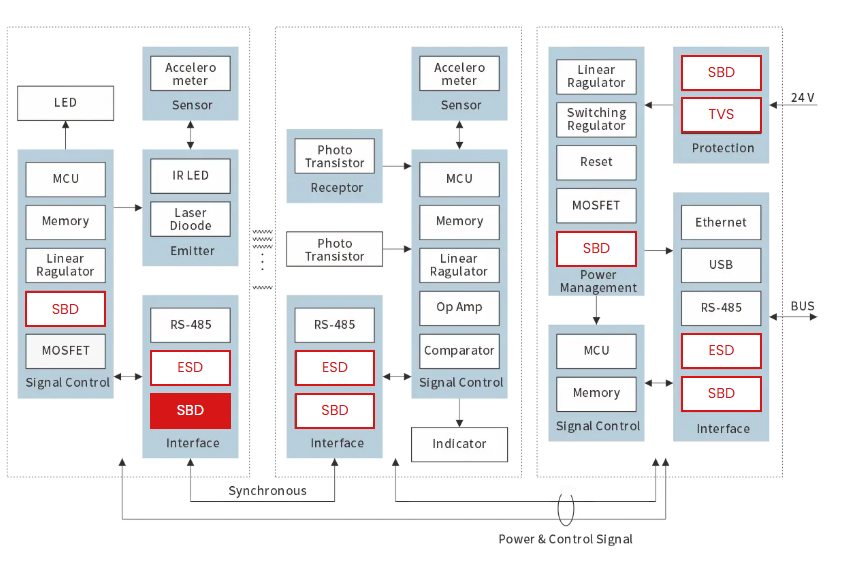
👉 Semiware Safety Light Barrier Application
Summary
The core of safety light curtain hardware design lies in balancing protection, power consumption, and signal integrity. By judiciously selecting protection devices and combining them with pulse modulation at the transmitter and power management at the main controller, stable and continuous equipment operation is ensured.