Overview
With the rapid development of Internet of Things (IoT) technology, a large number of smart terminal devices are being applied in smart cities, smart homes, smart metering, environmental monitoring, industrial data acquisition, and other fields.
To meet the demands of large-scale device connectivity, low-power operation, and wide-coverage communication, Narrow Band Internet of Things (NB-IoT) technology is gradually becoming one of the important wireless communication solutions.
I. Main Features of NB-IoT
NB-IoT evolved from LTE networks and is specifically optimized for low-speed, low-power, and high-connectivity IoT applications.
Main Features:
1.1 Low Power Consumption
Through optimized RF design and communication protocols, NB-IoT terminals can operate for extended periods, effectively extending battery life.
1.2 Wide Coverage
Based on existing cellular network infrastructure, NB-IoT can provide stronger signal coverage, making it suitable for weak signal environments such as underground pipe networks and remote monitoring.
1.3 High Reliability
Data transmission stability is improved through retransmission mechanisms and error checking technologies.
1.4 Low Deployment Cost
Deployment utilizes the mature LTE network, eliminating the need for independent communication infrastructure.
II. Why Does the NB-IoT Antenna Interface Require ESD and Surge Protection?
NB-IoT device antennas are typically connected to external antennas, PCB antennas, or RF connectors. Since the antenna is one of the interfaces directly exposed to the external environment, it is susceptible to various transient overvoltages.
- Electrostatic Discharge (ESD) Damage
When static electricity enters the device through the antenna interface, it creates a momentary high-voltage pulse, which may lead to:
- Breakdown of the gate oxide layer inside the RF chip;
- Degradation of RF front-end device performance;
- Reduced communication distance;
- Inability for the device to connect to the network normally.
Especially for NB-IoT modules, the RF front-end typically contains highly sensitive devices such as low-noise amplifiers (LNAs) and RF switches, which are extremely sensitive to transient voltages.
- Electrical Surge (EOS/Surge) Risk
Some NB-IoT devices are used in outdoor environments, such as:
- Smart meters;
- Environmental monitoring equipment;
- Smart streetlights;
- Industrial sensors.
These devices may be exposed to lightning strikes, power grid fluctuations, electromagnetic interference, etc., for extended periods. Surge pulses may couple into the device through the antenna or connecting cables, damaging the internal circuitry.
Therefore, effective protection schemes need to be designed at the antenna interface to quickly dissipate transient energy through protective devices, limiting overvoltage to a safe range.
III. Key Design Considerations for NB-IoT Antenna ESD Surge Protection
3.1 Ultra-Low Junction Capacitance to Ensure RF Signal Integrity
NB-IoT typically operates in the cellular communication frequency band, and the antenna interface is a high-speed RF signal path, requiring the selection of low junction capacitance ESD protection">ESD protection devices.
3.2 Fast Response Capability
The rise time of an ESD pulse is typically only in the nanosecond range. The protection device needs to conduct quickly to clamp the transient voltage before it reaches the sensitive chip.
3.3 Miniaturized Packaging
NB-IoT terminals typically require small size and low power consumption, thus necessitating small-package protection devices.
IV. Semiware NB-IoT Antenna ESD and Surge Protection Solution
To address the antenna interface protection requirements of NB-IoT wireless communication devices, Semiware offers a combined protection solution using a low-capacitance ESD diode and a surge discharge device (GDT).
A typical protection structure is as follows:
- Antenna Interface → GDT Surge Discharge Device;
- Low-Capacitance ESD Protection Diode → NB-IoT Module.
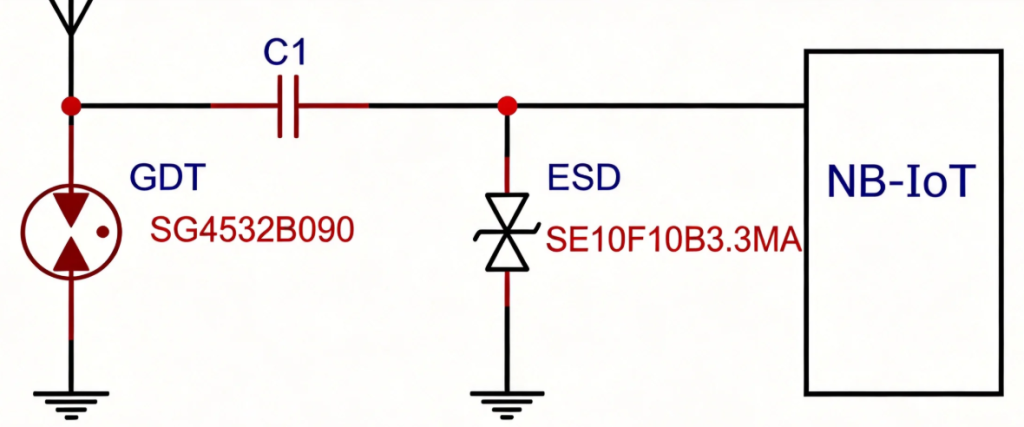 ESD and Surge Protection Solution
" class="wp-image-18155"/>
ESD and Surge Protection Solution
" class="wp-image-18155"/>Recommended Devices:
| Part Number | Key Parameters | Package | Application |
| SE10F10B3.3MA Bidirectional ESD Diode | 3.3V, 0.22pF, 4A ±23kV Contact / ±30kV Air | DFN1006 | Designed for 3.3V NB-IoT module antenna protection. |
| SE10F10B5.0MA Bidirectional ESD Diode | 5V, 0.25pF, 4A ±15kV Contact / ±15kV Air | DFN1006 | Designed for 5V NB-IoT module antenna protection. |
| SG4532B090 Gas Discharge Tube | 90V, 5kA, 1pF | SMD 5.5 × 6mm | Typically placed at the front end of the ESD device to discharge lightning strikes and high-energy surges. |
V. Semiware NB-IoT Antenna Protection Solution Applications
- Smart Meters
- Smart City Sensors
- Environmental Monitoring Equipment
- Industrial IoT Terminals
- Smart Parking Systems
- Smart Home Devices
- Remote Data Acquisition Devices
Conclusion
The Semiware SE10F10B3.3MA, SE10F10B5.0MA, and SG4532B090 provide miniaturized, high-performance electrostatic discharge (ESD) and surge protection solutions for NB-IoT wireless terminals, helping design engineers build more stable and reliable IoT devices.
Contact Semiware for customized circuit protection recommendations.