Introduction
Compared to indoor lighting, solar streetlights are installed in outdoor environments—such as roadways and parks—where they must withstand greater environmental fluctuations and are more susceptible to lightning strikes, electromagnetic interference, and transient overvoltages on the lines.
Solar streetlights typically consist of components such as photovoltaic (PV) panels, charge/discharge controllers, batteries, LED drivers, and LED strings. These circuits are interconnected by long DC cables; when a lightning strike occurs nearby, the resulting electromagnetic field can induce transient overvoltages on the cables, which then propagate into the controller and downstream circuitry.
Therefore, protection design for solar lighting systems must address not only lightning surges but also open-circuit faults in LED strings and transient interference entering through external interfaces.

I. What are the primary electrical risks facing solar street lights?
1.1 Lightning-Induced Surges
Solar street lights are typically installed outdoors, meaning the PV panels and connecting cables have a large exposed surface area.
Even without a direct lightning strike, the electromagnetic field generated by a nearby strike can induce high-amplitude transient voltages on the cables. This is particularly true when the DC cables connecting the PV panels, controllers, and batteries are long, as these lines can easily serve as pathways for surges to enter the system.
These transient overvoltages can affect:
- Charge/discharge controllers
- DC/DC circuits
- Power devices (e.g., MOSFETs)
- Battery management circuits
- LED driver circuits
1.2 Transient Overvoltages from Circuit Switching
In addition to lightning strikes, transient voltages can be generated on power lines by DC/DC conversion, inductive load switching, and other switching operations.
The energy associated with such transients is generally lower than that of severe lightning surges; however, repeated, long-term exposure to overvoltage stress can still compromise component reliability.
1.3 ESD and Surges via External Interfaces
For smart solar street lights equipped with communication, sensor, or external control interfaces, these interfaces can serve as entry points for electrostatic discharge (ESD) and surges to reach the controller.
II. Key locations for surge risks in solar street lights
2.1 PV input and battery terminals: These are the primary entry points where energy concentration is highest. If a voltage surge exceeds the component's withstand voltage, it will first impact the Battery Management System (BMS) and the controller; for lithium battery systems, if the protection circuitry fails, the consequences could extend far beyond the failure of a single component.
2.2 Controllers and signal interfaces: Signal lines—such as those for optical sensing and communication—are highly susceptible to electrostatic discharge (ESD); electrostatic pulses of several kilovolts can travel along these lines directly into the controller and MCU.
2.3 LED strings: The LEDs operate in series, meaning an open-circuit failure in any single LED causes the entire string to go dark; simultaneously, the drive circuit increases the voltage to maintain the output current, further endangering the remaining LEDs.
III. Protection Strategies for Solar Street Lights – Semiware
Effective surge protection does not rely on a single component but rather on a layered protection approach covering various parts of the system. Details are as follows:
3.1 Power Supply Side: Use TVS diodes for clamping protection. Since surge energy is significant on the photovoltaic (PV) panel and battery sides, high-power models should be selected.
SVC500B30 (5.0SMDJ30CA): Suitable for primary protection at the power input.
5KP30A: Also suitable for power lines.
Selection must satisfy two conditions: the reverse working voltage must exceed the line's normal operating voltage, while the clamping voltage must remain below the maximum withstand voltage of the downstream circuitry.
3.2 LED String Side: Connect an LED open-circuit protector (PLED) in parallel with the LED.
PLED06F, PLED09F, and PLED13F protection devices correspond to different LED voltage ratings.
Under normal operating conditions, the device remains non-conductive and does not affect the circuit. If an LED fails open-circuit, the PLED immediately conducts and maintains the current path; this keeps the string illuminated and prevents the driver from raising the output voltage due to a no-load condition.
Additionally, a robust grounding design is a prerequisite for the effectiveness of the entire protection scheme. No matter how high the discharge capacity of the protection device is, if the energy discharge path is incomplete, transient energy may still find alternative routes to intrude into the system.
IV. Reference Design for Solar Street Light Protection
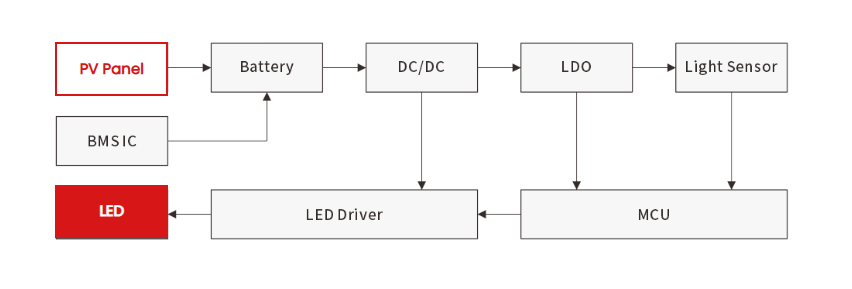
For details, please visit:https://en.semiware.com/applications/solar-lights/
Conclusion
Surge protection for solar street lights essentially involves limiting transient energy to levels the components can withstand, based on their specific locations.
TVS devices are used at the power input to handle lightning surges; electrostatic discharge (ESD) protection is implemented at signal interfaces; and PLED devices are employed at the LED string output to address open-circuit failure—a common failure mode. Proper component selection, a well-designed discharge path, and reliable grounding are the combined factors that ensure the long-term, stable operation of the lighting fixture in outdoor environments.
If you need assistance selecting protection components for solar street lights, please contact Semiware to discuss your application requirements and find the right protection solution.