Overview
Label printers involve various components—such as power inputs, printhead drivers, and data interfaces (USB, serial, Ethernet, Bluetooth, etc.)—that are susceptible to overvoltage and electrostatic discharge (ESD) risks. Consequently, robust protection design is essential. Semiware offers circuit protection components, including transient voltage suppressor (TVS) diodes and ESD protection diodes, which provide a high level of defense against electrostatic discharge and electrical fast transients (EFT).
Electrostatic Risks
Electrostatic discharge (ESD) is a well-documented cause of printhead damage, often leading to the “direct breakdown” of heating elements, which results in “broken pins” (non-functional heating elements). There are three primary entry paths for such discharges:
Friction within the paper path is the most significant internal source of static electricity. During the printing process, friction between the plastic rollers, the printhead, and the paper continuously generates electrostatic charges. Research indicates that if these charges are not dissipated promptly, they will seek the path of least impedance—frequently targeting the printhead’s array of heating elements, which are highly susceptible to electrical breakdown.
Human-body contact is another common source of ESD. When operators replace paper rolls or ribbons, static electricity—often accumulated through the friction of synthetic-fiber clothing—can reach several thousand volts. Maintenance records show that in winter, an operator wearing synthetic-fiber workwear can easily accumulate up to 8,000 volts of static electricity; when their hands touch the printhead during a roll change, the discharge path inevitably passes through these sensitive components.
Poor grounding exacerbates these risks. Industry maintenance standards typically require a device grounding resistance of less than 4Ω. If a grounding point becomes corroded or develops a loose connection, the resistance can rise to over a dozen ohms, preventing static charges from dissipating effectively and forcing them to discharge through the printhead instead.
It is important to note the cumulative nature of ESD damage. A single discharge event may not cause immediate, catastrophic failure; rather, damage accumulates over time until it eventually manifests as a persistent white line or a “broken pin” in the print output.
Surge Risks
The threat that surges pose to printers extends beyond direct lightning strikes. Maintenance records indicate that the movement of thunderclouds can induce high-voltage pulses in nearby power lines, Ethernet cables, or even serial cables, which then travel along these lines and enter the device. In one documented case, network cables, serial cables, and power cords were bundled together within a cable tray next to a printer station. During a lightning strike, the cables became electromagnetically coupled, causing an induced voltage to surge directly into the printhead’s flexible printed circuit (FPC) ribbon cable.
Surges typically cause more extensive damage than electrostatic discharge (ESD). ESD-induced breakdown is usually localized to a small, clean-edged burn point on the printhead, whereas a surge can cause collateral damage to the mainboard or power supply board. One way to distinguish between the two is by examining the nature of the damage: if the ceramic substrate of the printhead is cracked across its entire length and the mainboard fuse has blown, it is likely a surge; if there is only a small, localized black spot with the surrounding ceramic remaining intact, it is more likely to be ESD.
An often-overlooked risk factor is that the failure of ESD protection components can exacerbate surge damage. In one repair case, a severely worn anti-static brush on a printhead led to an increase in grounding impedance. When a lightning surge occurred, the energy—which should have been dissipated through the anti-static brush—followed a path of lower impedance: it traveled through the printhead’s thermal-sensitive layer, breaking down the heating resistors. In this instance, the wear on the anti-static brush was not merely a “result” of the failure, but a critical “accomplice” that enabled the surge damage to occur.
Application Framework
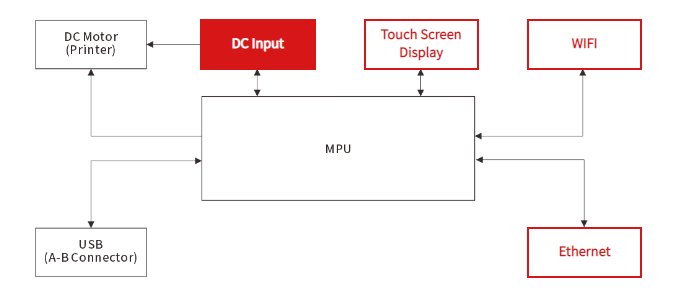
Key Control Points
A reliable ground connection is the fundamental prerequisite. All energy-dissipation paths ultimately depend on a solid, low-impedance connection to the earth. It is essential to verify that power outlets have an independent protective ground and to conduct periodic checks of the grounding resistance. If the grounding is poor, energy clamped by TVS (Transient Voltage Suppressor) or ESD diodes has nowhere to go, significantly undermining the effectiveness of the protection.
The “proximity” principle for protective components is non-negotiable. MOVs (Metal Oxide Varistors) should be placed near the power input, interface-specific TVS diodes near their respective connectors, and ESD protection components for the printhead near the FPC (Flexible Printed Circuit) connector socket. The further a protective component is from the port it is intended to safeguard, the greater the parasitic inductance introduced, which degrades the clamping performance.
Ambient humidity is an often-overlooked variable. When relative humidity drops below 30%, triboelectric charging (static electricity generation) increases significantly. Maintaining an operating environment with a relative humidity of 40%–60% allows water molecules in the air to facilitate the natural dissipation of static charges—a highly cost-effective auxiliary protective measure. It is recommended that verification standards be aligned with IEC 61000-4-5 Level 4 (±8 kV contact / ±15 kV air discharge), which serves as the baseline for ESD immunity commonly adopted by most consumer and industrial printing equipment. Regarding surge protection, port testing should be conducted in accordance with the relevant levels specified in IEC 61000-4-5, based on the actual power supply environment.
More Information
For more application details, please visit: https://en.semiware.com/applications/label-printer/

评论 (0)