Overview
An electric vehicle (EV) on-board charger (OBC) is directly connected to both the AC power grid (220V/380V) and the vehicle’s high-voltage DC battery (400V/800V) during operation. It is susceptible to threats such as lightning surges, switching transients, and electrostatic discharge (ESD), necessitating a robust surge protection design.
1. AC Input Protection (Grid Interface Side)
Primary threats:
Lightning surges, grid voltage spikes, and power-frequency transient overvoltages.
Common protection components:
- Fuses: Provide overcurrent protection, preventing sustained short circuits in the event that a surge damages other components.
- Common-mode/differential-mode inductors + X/Y capacitors: Filter out high-frequency interference and improve electromagnetic interference (EMI) suppression.
- Metal-oxide varistors (MOVs): Absorb lightning surges; common types include 14D/20D models with ratings of 470V–820V (depending on the grid voltage level).
- Gas discharge tubes (GDTs): Serve as the first line of defense against high-energy lightning surges by shunting current to the ground.
- Thermistors (NTC/PTC): Suppress inrush current during power-up, protecting the rectifier bridge.
- Rectification and PFC Circuit Protection
2. Rectification and PFC Circuit Protection
Primary threats:
High dv/dt (rapid voltage change) and inductive flyback surges.
Common protection components:
- TVS diodes: Protect the gates and drain-source junctions of power switching devices (MOSFETs/IGBTs) from transient overvoltages.
- RC snubber circuits: Absorb voltage spikes across switching devices and rectifier bridges.
- Diode reverse protection: Suppress surges caused by inductive flyback.
3. DC/DC Conversion and Output Protection (High-Voltage Battery Interface Side)
Primary threats:
Surges fed back from the battery side and inductive switching spikes.
Common circuit protection components:
- High-voltage TVS diodes: Protect the OBC output port (e.g., the SM8S series, capable of withstanding 600W–1500W surges). TVS diodes in parallel with the drain-source terminals of power MOSFETs/IGBTs: Provide rapid clamping of voltage spikes.
- Fuses at the battery interface: Prevent overcurrent into the battery in the event of an OBC (On-Board Charger) failure.
4. Protection for Communication and Control Interfaces (CAN / LIN / Signal Lines)
Primary threats:
Electrostatic Discharge (ESD) and lightning-induced surges.
Commonly used protection components:
- Low-capacitance ESD diode arrays: Protect CAN/LIN signals to prevent communication interruptions.
- Common-mode chokes: Filter out common-mode noise.
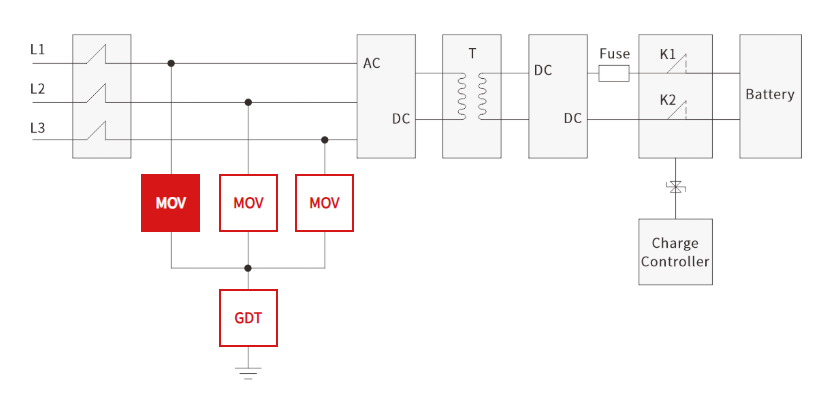
Semiware Recommended Protection Circuit Solutions
Summary
Surge protection for On-Board Chargers (OBCs) typically employs a multi-stage protection scheme:
- Input side: GDT + MOV + EMI filtering + Fuse
- Power stage: TVS + Snubber circuit
- Output side: High-voltage TVS + Fuse
- Communication ports: ESD suppressors + Common-mode chokes
- This approach ensures comprehensive protection against lightning-induced surges, power-frequency transient overvoltages, and electrostatic discharge.
Learn More
The above information outlines the surge protection solutions recommended by Semiware for EV On-Board Chargers. For further details, please contact our engineers or explore our available reference designs at https://en.semiware.com/applications/on-board-charger/.

评论 (0)