Although 12V DC power supplies operate at low voltages, they are still susceptible to various surge risks (transient overvoltage/overcurrent) in real-world systems. These risks generally stem from two sources: external ingress and internal switching events.
I. Externally Induced Surges
- Lightning-Induced Surges (Indirect Lightning)
- Path: Lightning strikes nearby power lines, antennas, or metal structures, entering the 12V circuit via spatial coupling or cable conduction (particularly affecting long-distance power lines and outdoor equipment).
- Characteristics: Fast rising edge (microsecond range); coupled transient voltage spikes ranging from tens to hundreds of volts; low energy, yet sufficient to cause dielectric breakdown in MOSFETs or ICs.
- Mains Surges Coupled via Power Adapters
- Scenario: 12V power is derived from 220V AC via an AC-DC adapter. When lightning strikes or switching surges occur on the grid, low-quality adapters with poor common-mode rejection can allow voltage spikes to leak into the secondary side.
- Manifestation: Transient voltages of 100–200V detected at the DC output; extremely short duration.
- Electrostatic Discharge (ESD)
- Discharge occurring when a human body or tool touches the 12V interface or gaps in the enclosure.
- Standards (IEC 61000-4-2): ±8kV contact discharge, ±15kV air discharge.
- Direct ESD to 12V power pins can damage LDOs or DC-DC converter chips.
II. System-Internal Surges
- Back-EMF from inductive load turn-off
- Typical loads: Relay coils, motors, solenoid valves, and buzzers driven by the 12V supply.
- At the moment of turn-off, the coil generates a reverse voltage spike ranging from -100V to several hundred volts (depending on coil inductance and current).
- If the 12V bus is shared, this spike feeds back into the power rail, potentially causing MCU resets or sensor malfunctions.
2. Hot-swapping / Plug-and-Play Transients
Hot-plugging a 12V device containing large capacitors into the bus:
- Capacitors act as a momentary short circuit → instantaneous current can reach several to tens of amperes.
- The bus voltage drops and then rebounds, causing voltage overshoot (especially with long cables and high-ESR power sources).
- DC-DC Switching Noise and Ringing
- In 12V-to-5V/3.3V Buck converter circuits, ringing at the switching node can couple into the 12V input (especially if input capacitors are placed too far away).
- Although not a conventional "surge," peak voltages can exceed 15V, causing component aging due to long-term stress.
III. Protection Circuit Diagram
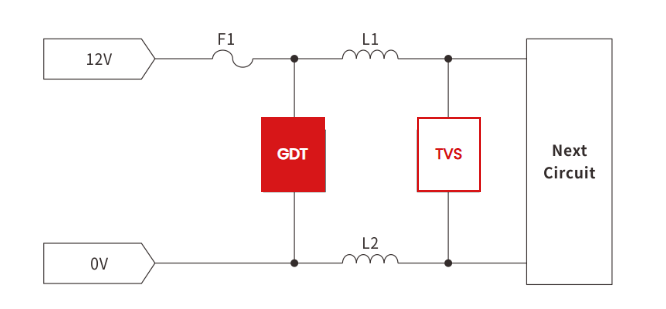
IV. Recommended Circuit Protection Components
- Ceramic Gas Discharge Tube (GDT) – SG3D05B230
The SG3D05 series Gas Discharge Tube (GDT) is designed to provide high-level protection against fast-rising transient voltages caused by lightning strikes. Key features include:
- Square surface-mount package (φ5.0 x 7.5 mm)
- 5kA surge handling capability
- Off-state capacitance ≤1.5pF
For more product details, please visit: https://en.semiware.com/gas-discharge-tubes/sg3d05b230/
- Transient Voltage Suppressor (TVS) - SMCJ15CA
Key features of the SMCJ15CA:
- Standard surface-mount SMC package
- Peak pulse power of 1500W (10×1000μs waveform)
- Ultra-fast response time (sub-nanosecond)
- Excellent clamping capability and low leakage current
Specifically designed to protect sensitive electronic equipment from transient voltages caused by lightning strikes and other transient voltage events.
For more product details, please visit: https://en.semiware.com/tvs-diodes/smcj15ca/
About Semiware
Semiware is a comprehensive provider of circuit protection solutions. Leveraging its semiconductor technology expertise and experience in end-product applications, the company serves customers across the electronics, automotive, and industrial markets.
We offer an extensive portfolio of circuit protection devices to meet customer needs, including overvoltage protection, overcurrent protection, composite protection, discrete components, and advanced packaging technologies. We provide customers with complete solutions and product portfolios through our global network of EMC laboratories and Field Application Engineers (FAEs).