Overview
In industrial environments, 4-20mA loop-powered transmitters occasionally experience signal fluctuations, abnormal readings, or even malfunctions or burnout. After ruling out wiring and sensor-related issues, a common cause is electrostatic discharge (ESD/Surge).
I. What is a 4-20mA Loop-Powered Transmitter?
1️⃣ Definition and Working Principle
A 4-20mA loop-powered transmitter converts physical quantities such as temperature, pressure, and flow rate into a standard 4-20mA current signal.
It requires only two wires for power supply and signal transmission:
- Power Supply: The transmitter draws a lower limit current of 4mA from the loop as its operating power.
- Signal Output: The physical quantity measured by the sensor is linearly converted into a 4–20mA current and superimposed on the loop.
- Receiver: The PLC/DCS converts the current into voltage for acquisition via a sampling resistor (e.g., 250Ω).
2️⃣ Why choose the 4–20mA standard?
1. Strong anti-interference capability: Current signals are not sensitive to EMI, ensuring reliable long-distance transmission;
2. Self-powered design: Power supply and signal transmission can be completed with just two wires, simplifying wiring;
3. Supports fault detection:
- 4mA = Lower limit of measurement (zero point);
- 20mA = Upper limit of measurement (full scale);
- <4mA indicates a broken wire or fault; >20mA indicates measurement exceeding the range.
II. Wide Voltage Range Design for Transmitters
- Mainstream Transmitters: Commonly used in industry are two-wire 4–20 mA transmitters for pressure, temperature, and level measurement. These typically employ a wide voltage power supply design, with an operating range generally between DC 12–36V. System designs usually utilize a 24V DC power supply.
Within this range, the transmitter can operate stably and ensure loop current output accuracy. Therefore, the same model is usually compatible with different field power supply conditions, improving system adaptability.
- Special Types: In addition to traditional two-wire transmitters, there are models designed for low-power scenarios, primarily used in IoT or applications where power supply is difficult, such as remote monitoring or fire water pressure monitoring.
Features:
- Low power design, suitable for battery or energy harvesting power supply;
- Lower operating voltage, commonly 3V, 3.3V, or 5V.
III. Electrostatic Damper (ESD) Surge Protection Circuit for Sensor Transmitters
In industrial environments, the signal lines of 4–20mA loop-powered transmitters may be subject to transient overvoltage interference from PLC/DCS modules or the power supply.
Dangerous overvoltages may originate from:
- Voltage surges during power-on;
- Inductively coupled interference from large current or voltage changes near the signal lines;
- Surges, electrical fast transient bursts (Bursts), or electrostatic discharges (ESDs), creating voltage differences between signal lines (commonly used in EMC testing).
Semiware Protection Circuit Design
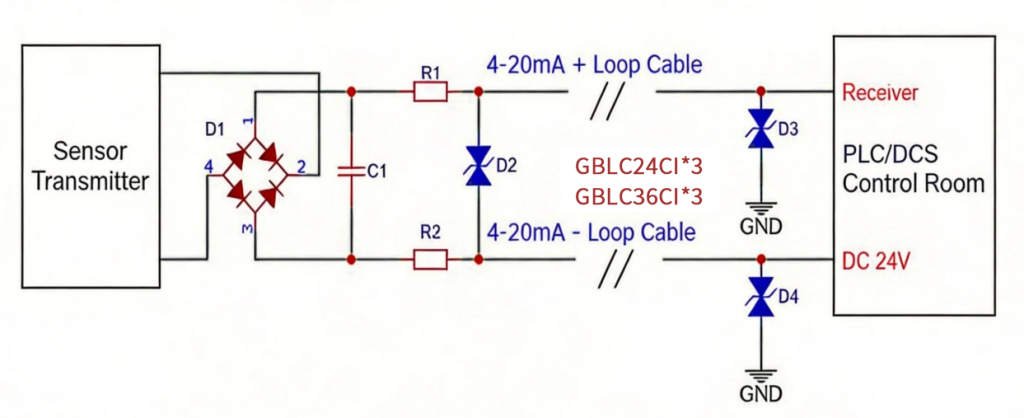
This is a classic industrial interface protection circuit design. For surges on 4-20mA signal lines, this circuit achieves protection through a combination of clamping, current limiting, rectification, and filtering.
The following is a detailed explanation of the specific functions of each component in handling surges:
| Component | Function | Technical Description |
| TVS Diode Array (D2) | Voltage Clamping | When a high-voltage surge occurs, the TVS diode conducts instantly, limiting the voltage to a safe range (e.g., 24V/36V) and diverting the surge current to protect downstream ICs |
| Current-Limiting Resistors (R1, R2) | Current Limiting & Voltage Division | Share part of the surge voltage and limit the current flowing into the TVS and downstream circuit, reducing residual voltage and preventing device damage |
| Bridge Rectifier (D1) | Polarity Protection | Prevents reverse connection and ensures correct current direction during surges, guiding the surge safely to the downstream protection circuit |
| Filter Capacitor (C1) | High-Frequency Filtering | Bypasses high-frequency noise, smooths voltage fluctuations, and mitigates the impact of surge high-frequency energy on downstream circuits |
D2 clamps and limits surge voltage;
R1/R2 limits and shares current;
D1 ensures polarity safety;
C1 filters out high-frequency spikes.
The four components work together to effectively protect the 4–20mA signal line and transmitter from damage caused by surges or electrostatic discharge.
IV. Recommended Electrostatic Surge Protection Devices
| Component | ESD Capability | Peak Pulse Power Ppp (W) | Key Specs | Channels / Direction | Package |
| GBLC03CI | ±30kV / ±30kV | 350W | Vrwm: 3.3V VBR: 3.6V VCmax: 16V @ 20A Cj: 0.6pF | 1 Channel Bidirectiona | SOD-323 |
| GBLC05CI | ±30kV / ±30kV | 350W | Vrwm: 5V VBR: 6.0V VCmax: 25V @ 14A Cj: 1.5pF | 1 Channel Bidirectiona | SOD-323 |
| GBLC12CI | ±30kV / ±30kV | 350W | Vrwm: 12V VBR: 13.3V VCmax: 28.6V @ 12A Cj: 1pF | 1 Channel Bidirectiona | SOD-323 |
| GBLC24CI | ±30kV / ±30kV | 350W | Vrwm: 24V VBR: 26.7V VCmax: 56V @ 6A Cj: 1pF | 1 Channel Bidirectiona | SOD-323 |
| GBLC36CI | ±30kV / ±30kV | 350W | Vrwm: 36V VBR: 40.0V VCmax: 60V @ 4.5A Cj: 0.8pF | 1 Channel Bidirectiona | SOD-323 |
V. Application Industries and Equipment
4–20 mA loop-powered transmitters are widely used in industrial automation and process control, including:
- Petrochemical Industry: Pressure, temperature, and level monitoring, such as in reactors, storage tanks, and industrial pipelines
- Power Systems: Generator temperature, transformer oil level, and power equipment status monitoring
- Water Treatment: Flow meters, water quality analyzers, and pump station control systems
- Pharmaceutical Industry: Reactor temperature, pressure, and process control systems
- Smart Manufacturing: Sensor signal transmission for machine tools, industrial robots, and automated production lines
Conclusion
As a critical measurement node in industrial automation systems, the reliability of the 4–20 mA transmitter directly affects equipment stability and production safety. By adding surge protection devices such as TVS at the signal interface, transient interferences such as ESD, Surge, and EFT/Burst can be effectively suppressed, improving the system's anti-interference capability and long-term operational reliability.
With its fast response, high reliability, and extensive experience in industrial applications, Semiware TVS protection devices have been widely used in industrial sensors, PLC/DCS interfaces, and process control systems, providing stable and reliable circuit protection solutions for industrial equipment.
If you are designing industrial sensors, contact Semiware for professional circuit protection solutions and component selection support.