I. Overview
Handheld POS terminals are mobile financial payment terminals that are frequently touched by hand, have their cables plugged and unplugged, and are used in various environments such as dry supermarkets and outdoor settings. They are subject to high-frequency ESD risks as well as surge overvoltage risks from adapters, mains power, long cables, and lightning strikes. These risks directly affect transaction reliability, fund data security, and hardware lifespan. They also need to comply with IEC/GB/T electromagnetic compatibility and PCI payment security standards.
II. Electrostatic Discharge (ESD) Risks
1、Causes and origins
- Human Touch (Primary): In dry environments (autumn and winter, air-conditioned rooms), the human body can accumulate thousands to tens of thousands of volts of static electricity. Touching the touchscreen, buttons, metal frame, USB/charging ports, card reader/NFC area causes a momentary discharge (HBM on a human body model), with an extremely fast rise time (nanosecond level), high voltage, and low energy.
- Environmental Friction: Friction between clothing, plastic bags, desktops, and receipts on the device casing; friction with surrounding equipment/shelves during movement generates static electricity accumulation; wireless communication interfaces and metal connectors are prone to coupling electrostatic fields.
- Interface Potential: The metal casing of external data cables and charging cables, and poor grounding, prevent effective static electricity discharge, which can then infiltrate the main control chip, card reader chip, NFC module, and display driver circuitry through signal/power lines.
2、Failure Mechanism
- Hard damage: Chip gate oxide breakdown, transistor burnout, micro-fuse breakage of PCB traces, damage to card reader heads/RF modules, causing permanent hardware failures.
- Soft failures: Instantaneous ground potential disturbances and signal distortions can cause touchscreen malfunctions, screen flickering, system crashes/resets, card swiping/NFC card reading failures, transaction data errors/packet loss, encryption chip malfunctions, wireless communication disconnections, and garbled receipt printing; intermittent, sporadic failures are the most difficult to troubleshoot; long-term repeated electrostatic discharge accelerates component aging and causes battery protection board malfunctions.
- Special financial risks: Transaction verification errors, abnormal payment instructions, potential security vulnerabilities in keys/sensitive card information, non-compliance with PCI PTS payment terminal security specifications, leading to reconciliation disputes, fund discrepancies, and compliance risks.
III. Surge Impact Risk
1、Causes and origins
- Mains power grid disturbances: Start-up and shutdown of high-power equipment (refrigerators, induction cookers, air conditioners, freezers), capacitor switching, grid switching, voltage fluctuations; conducted surges generated by inferior charging adapters/vehicle power supplies.
- Lightning-induced surges: Overvoltage induced by lightning strikes on external cables in shops, which can intrude into adapters and handheld POS charging ports along power lines and long communication lines; the risk is higher in outdoor vending scenarios.
- Plug-in/out surges: Transient power surges generated by repeated hot-plugging of charging cables and external accessories.
- Standards: IEC 61000-4-5 / GB/T 17626.5, power ports are commonly tested for ±1kV~±4kV surges to ground.
- Differences: Compared to ESD, surge energy is significantly greater, mainly through conducted intrusion at power ports, and can repeatedly impact power management chips, lithium battery protection circuits, and rectifier devices.
2、Failure Mechanism
- Power circuit damage: adapter/charging management chip burnout, fuse blowout, varistor/TVS protection device breakdown, lithium battery overvoltage/overcurrent, battery bulging, and even fire hazards.
- Main board circuit damage: main control, storage, and encryption chips are damaged by high voltage, preventing the entire device from powering on; underlying firmware is damaged, and parameters are lost.
- Hidden aging: Repeated surge impacts reduce the power supply component's margin, and the equipment failure rate increases with the years of use; unstable power supply causes serious payment disputes such as transaction interruptions, payment process interruptions, and duplicate deductions.
- Specific pain points: Handheld POS machines mostly rely on battery power, but charging periods are surge intrusion windows; portability leads to poor grounding conditions, lacking the comprehensive lightning protection grounding system of a fixed cabinet, making their surge resistance weaker than desktop POS machines.
IV. Circuit Protection Measures
1、Static electricity protection
- Hardware: Add ultra-low capacitance ESD TVS arrays, varistors, and ferrite beads to exposed interfaces; use conductive foam and spring contacts for low-impedance grounding of metal casings/connectors; ensure a complete ground plane on the PCB, separate analog/digital grounds, and place interface protection devices close to the connectors; appropriately increase shielding and conductive coatings; select high-grade HBM-compliant chips.
- Firmware: Add watchdog reset, CRC check, transaction log, timeout retransmission, and status verification mechanisms to prevent abnormal transactions.
- Usage Environment: Maintain moderate ambient humidity; minimize direct, repeated contact with metal interfaces with bare hands; avoid prolonged use in extremely dry environments.
2、Surge protection
- The power input features multi-stage protection: a gas discharge tube (GDT), varistor, high-power TVS, fuse, and common-mode filter circuit, along with Y/X capacitor filtering; a compliant and certified adapter is selected, and an external surge protector is added; the overall grounding design is improved to reduce surge discharge impedance.
- On the battery side: Overvoltage/overcurrent protection of the lithium battery BMS is strengthened to prevent surge damage to the cells.
- Certification and verification: Surge immunity testing is performed according to standards, with a focus on verifying surge resistance during charging.
3、Testing and Verification Standards
- ESD: IEC 61000-4-2 (Contact/Air Discharge)
- Surge: IEC 61000-4-5
- Includes verification of transient interference tests such as Electrical Fast Transient/Burst (EFT, IEC 61000-4-4) to ensure the overall EMC immunity performance of the device.
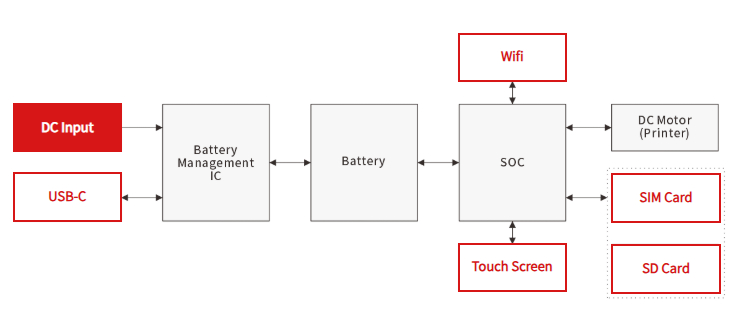
V. Circuit Protection Application Block Diagram from Semiware
Learn more
For more information on surge and electrostatic discharge (ESD) protection solutions for various interfaces in POS machines, please visit: https://en.semiware.com/applications/pos/
About Semiware
Semiware boasts a comprehensive portfolio of circuit protection devices. Leveraging its expertise in semiconductor technology and end-product applications, the company serves customers in the electronics, automotive, and industrial markets. For technical assistance, please contact our technical support team at: email: fae01@semiware.com; phone: 86-21-3463-7654; toll-free technical support hotline: 400-021-5756; or visit the Semiware website for more information: https://en.semiware.com.