Introduction
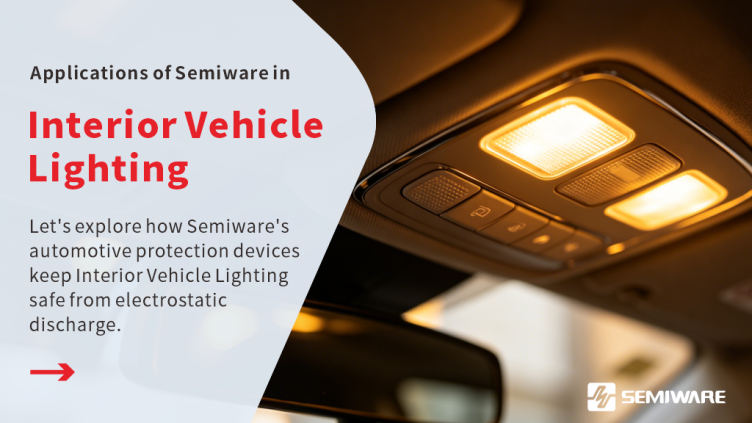
With the advancement of automotive intelligence, automotive interior lighting systems have evolved beyond simple illumination modules.
Furthermore, the automotive interior environment is complex; factors such as 12V battery systems, intricate wiring harnesses, and electromagnetic interference between various electronic modules expose interior lighting circuits to risks including surges, ESD, voltage transients, and overcurrent conditions.
Consequently, the strategic selection of compact electronic components—such as TVS diodes and LED protectors—within limited PCB space is essential to ensuring the stable operation of automotive interior lighting systems.
I. Automotive Interior Lighting Systems
Interior lighting includes:
- Dome lights
- Reading lights
- Ambient lighting
- Door handle lights
- Touch-controlled lighting
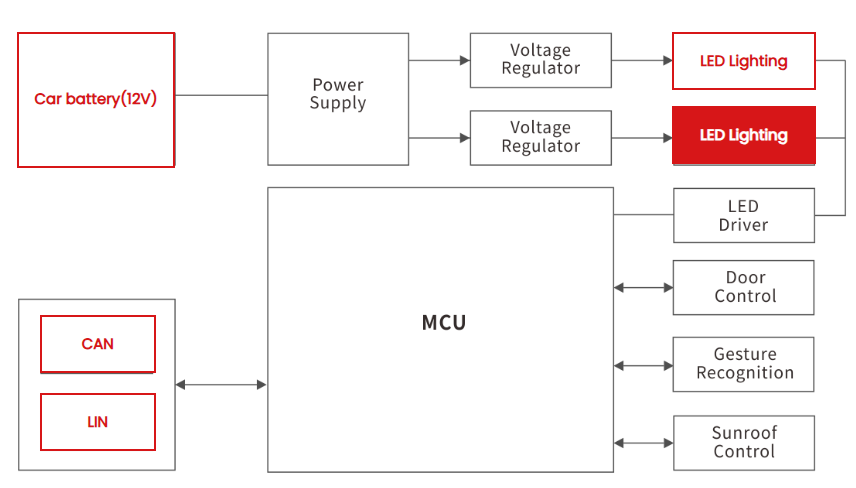
Intelligent interior lighting systems typically comprise:
- LED drivers
- MCU control modules
- CAN/LIN communication interfaces
- PWM dimming controls
- Touch or sensor interfaces
II. How Do Electrical Risks Affect Interior Lighting Circuits?
2.1 Load Dump Causing High-Voltage Surges
If the battery is suddenly disconnected while the vehicle is running (e.g., due to a loose connection or battery failure), the alternator output can generate high-voltage transient pulses lasting hundreds of milliseconds; in severe cases, these can reach tens of volts or higher.
Such transient voltages can directly damage components like LED drivers and MCUs.
2.2 ISO 7637 Power Supply Transient Interference
Automotive electronics must comply with relevant testing standards, such as ISO 7637.
During vehicle startup, relay switching, and motor operation, positive and negative transient pulses as well as high-frequency interference can occur on the power supply line, potentially compromising the stability of LED control.
2.3 ESD (Electrostatic Discharge) Risks
Although interior lights are located inside the vehicle, frequent user interaction with touch panels and door switches creates a risk of electrostatic discharge from the human body entering the internal circuitry.
According to the IEC 61000-4-2 standard, ESD events can reach:
±8kV for contact discharge
±15kV for air discharge
Without ESD protection, this can lead to damage to MCU I/O ports, malfunctions in communication interfaces, and other issues.
2.4 Risks of LED Open Circuits and Abnormal Currents
LEDs constitute the primary load for interior lighting systems; during operation, issues such as open circuits, short circuits, and abnormal currents may occur.
Particularly in configurations where multiple LEDs are connected in series, the failure of a single LED can impact the entire lighting module.
III. Semiware Automotive Interior Lighting Protection Solutions
Semiware offers comprehensive circuit protection solutions for interior lighting applications, including TVS diodes, ESD protection diodes, and LED protectors.
3.1 Power Input Surge Protection
Recommended Device: TPSVC150B33 (TPSMCJ33CA) Automotive-grade TVS Diode
Used to absorb high-energy transient pulses and reduce voltage peaks reaching the LED driver.
Key Features:
- AEC-Q101 Qualified
- 33V Working Voltage
- 1500W Peak Pulse Power
- SMC Package
Applications:
- 12V Battery Input Protection
- Load Dump Protection
- Power Line Surge Suppression
3.2 CAN Communication Interface ESD Protection
Recommended Device: TPSE23T20B24LB Automotive-grade ESD Diode
Features:
- AEC-Q101 Qualified
- ±30kV ESD Protection
- Low Leakage Current
Applications:
- CAN Bus Protection
- Automotive Communication Interface Protection
3.3 LIN Bus ESD Protection
Features:
- AEC-Q101 Qualified
- Designed for LIN Bus
- Low Capacitance
- Low Leakage Current
Applications:
- Door Module
- Interior Lighting Control
- Body Electronics
3.4 LED Open Circuit Protection
Recommended Device: PLED06F LED Open Circuit Protector
Features:
- LED Open Circuit Protection
- 6V–16V Operating Range
- Compact SOD-123FL Package
Applications:
- LED Lighting Module
- Automotive Interior Lamps
Miniature components such as TVS diodes, ESD diodes, and LED protectors can respond to transient events within milliseconds or even nanoseconds, providing the first line of defense for the entire interior lighting system.
Conclusion
Automotive interior lighting systems are evolving from traditional lighting modules into intelligent electronic systems that integrate LED drivers, communication interfaces, and control units.
Selecting appropriate protection devices to address electrical risks—such as load dump, ISO 7637 transients, power surges, ESD, and LED anomalies—can effectively enhance the stability and service life of interior lighting systems while meeting design requirements for miniaturization and high reliability in automotive electronics.
Semiware offers comprehensive circuit protection solutions for automotive electronics. If you are developing automotive lighting modules, please contact the Semiware technical team; we provide professional component selection support and customized solutions tailored to your specific application needs.