I. What is the BC856?
The BC856 is a typical PNP small-signal transistor housed in a compact SOT-23 package. It features a maximum collector-emitter voltage of 65V and a continuous collector current of up to 100mA, making it suitable for common applications such as switching and audio frequency (AF) amplification.
If your design requires a PNP transistor with a relatively high voltage rating, a small footprint, and suitability for low-to-medium current control, the BC856 is a model worth considering.
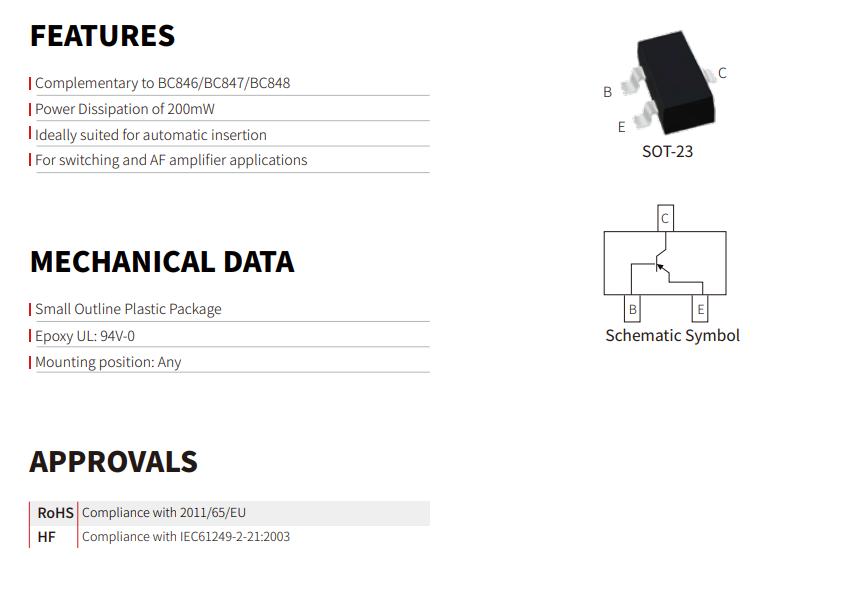
II. Key Specifications of the BC856 Transistor
| Parameter | BC856 Specs |
| Type | PNP |
| Package | SOT-23 |
| VCBO | −80 V |
| VCEO | −65 V |
| VEBO | −6 V |
| IC | −100 mA |
| PC | 200 mW |
| hFE | 125–250 (A) / 220–475 (B) |
| fT | 100 MHz |
III. BC856A vs. BC856B: How to Choose Between Grades A and B?
Semiware offers the BC856 in two grades, A and B, distinguished by their DC current gain (hFE). Test conditions: VCE = -5V, IC = -2mA.
- BC856A: hFE = 125–250
Lower gain; Grade A is preferred for switching applications. Since the hFE is not excessively high, issues such as insufficient saturation or high leakage current are less likely to occur, making it a reliable choice for high-side switching and level shifting. - BC856B: hFE = 220–475
Higher gain; preferred for small-signal voltage amplification circuits, such as audio pre-amplifiers or weak signal acquisition. When using Grade B in switching circuits, carefully calculate the base resistor value to prevent the transistor from entering the active (linear) region instead of achieving deep saturation.
IV. BC856 vs. BC857: What Are the Differences?
Many people directly substitute the BC857 for the BC856, but it is important to note the difference in voltage ratings:
- BC856 VCEO = -65V
- BC857 VCEO = -45V
Scenarios where the BC856 is the preferred choice:
- When a higher voltage margin is required (BC856 offers -65V vs. BC857's -45V);
- Industrial modules or auxiliary power signal circuits that demand a high voltage safety margin;
- Applications requiring a PNP transistor for small-signal amplification while needing to maintain ample voltage headroom.
⚠️ Forced substitution is not recommended: If your circuit operates at 12V or 24V without exposure to high-voltage surges, the BC857 is perfectly adequate, and the BC856's superior voltage rating offers no practical advantage. While the two are pin-compatible, do not simply assume they are interchangeable on a direct pin-to-pin basis; you must still verify the gain classification (hFE bin).
Its complementary NPN counterpart is the BC846; when designing push-pull circuits, prioritize pairing it with the BC846 (of the same gain class) rather than the BC847.
V. Applications of the BC856 Transistor
5.1 High-Side Switching
- As a PNP device, the BC856 can be used in high-side switching configurations to control power to small loads.
5.2 Small-Signal Amplification
- The BC856 is also suitable for small-signal amplification and AF (audio frequency) amplifier circuits.
- In such applications, parameters like hFE, VBE, operating current, and frequency characteristics must be evaluated in conjunction with the specific biasing circuit.
5.3 Level Shifting
- The BC856 can serve as a simple level shifter or control stage between MCUs, logic control circuits, and different voltage domains.
- However, for high-speed logic or circuits with strict timing requirements, a re-evaluation based on actual frequency, load, and pull-up/pull-down configurations is necessary.
5.4 General-Purpose Switching Control
- The BC856 serves as a standard PNP switching device for relays, small indicator lights, control signals, and other low-current loads.
Contact Us
If you are looking for a replacement for the BC856 or require a second-source solution, please contact us for datasheets, samples, and selection support.