I. What is the MMBT2222A?
The MMBT2222A is a general-purpose NPN bipolar junction transistor (BJT) housed in an SOT-23 package, primarily used for switching control and signal amplification.
Key electrical characteristics of the MMBT2222A:
- Collector-emitter breakdown voltage (VCEO): 40V
- Continuous collector current (IC): 600mA
- DC current gain (hFE): 100–300; the wide gain range accommodates various amplification requirements
- Low saturation voltage (VCE(sat)) and stable switching response
- Power dissipation: 300mW; plastic encapsulation meets UL94V-0 flame-retardant standards; no restrictions on mounting orientation
- The complementary device to the MMBT2222A is the MMBT2907A (PNP type); they can be paired in designs to implement circuit architectures such as push-pull stages.

II. What are the Differences Between the MMBT2222A and the 2N2222A?
In terms of electrical parameters, the MMBT2222A and 2N2222A are functionally equivalent and interchangeable; the differences lie primarily in packaging and assembly methods:
2N2222A (TO-92 Through-hole): Suitable for manual soldering, prototyping, and breadboarding where PCB space is not strictly limited; disadvantages include incompatibility with high-speed pick-and-place assembly and unsuitability for large-scale automated mass production.
MMBT2222A (SOT-23 SMD): Suitable for consumer electronics, industrial control boards, and compact modules; occupies less PCB space, is fully compatible with SMT pick-and-place machines, and offers higher efficiency for mass production; however, it is not ideal for manual soldering or debugging scenarios.
III. MMBT2222A Transistor Applications
3.1 LED Driving
Microcontroller (MCU) GPIO pins sometimes cannot directly drive certain loads; in such cases, the MMBT2222A can be used as a switching stage.
The MCU output controls the transistor's base, while the transistor manages the switching (on/off) of the LED or other small loads.
3.2 Relays and Small-Load Switching
The MMBT2222A can be used in low-side switching circuits for small loads, provided the operating conditions remain within its ratings.
When driving inductive loads such as relay coils, a flyback diode is typically required to protect the transistor from the reverse induced voltage generated when the coil is de-energized.
3.3 MCU Interfacing and Signal Control
- Signal inversion
- Interface level control
- Enable control
- Switching control
- Simple logic control
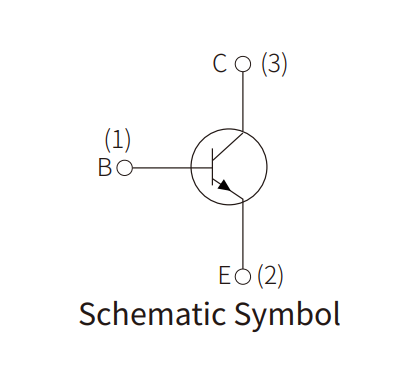
IV. MMBT2222A Pinout
The pinout for the Semiware MMBT2222A (SOT-23 package) is defined as follows:
Pin 1 = Base
Pin 2 = Emitter
Pin 3 = Collector
V. MMBT2222A Datasheet
Summary
If your project requires a general-purpose NPN transistor (equivalent to the 2N2222A) in an SOT-23 package, please contact us to learn more about the Semiware MMBT2222A.