In high-speed signal design, engineers often encounter a very real problem:
ESD protection is passed, but the chip still fails. The reason is usually not the lack of protection, but rather the excessively high clamping voltage.
Semiware introduces two 5V small-package ultra-low capacitance snapback ESD devices:
- SE10F10B5.0MA-SP (DFN1006-2L)
- SE06F10B5.0MA-SP (DFN0603-2L)
These two products are optimized for scenarios such as USB 3.0, RF, and high-speed I/O, ensuring ESD protection while reducing the clamping voltage to a lower level.
I. What is a Snapback ESD Structure?
Ordinary ESD diodes exhibit relatively linear characteristics: the larger the IPP (Input Voltage Proportion), the higher the VC (Voltage Capacity).
However, the characteristic of a flyback structure is that after breakdown, it will exhibit a snapback, first lowering the voltage before entering the stable clamping region.
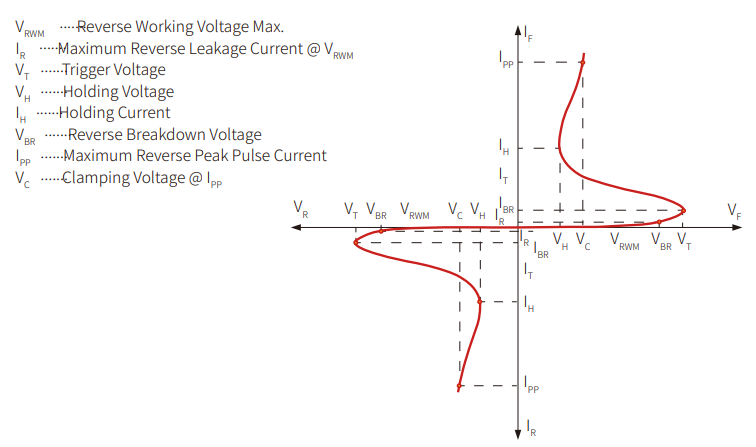
Simply put:
👉 For the same ESD impact, a flyback type can suppress the voltage spike to a lower level, which is crucial for sensitive ICs.
II. Comparison of Parameters between Snapback and Ordinary Models
DFN1006 Series:
| Parameter | SE10F10B5.0MA | SE10F10B5.0MA-SP |
| Vrwm | 5V | 5V |
| Vbr | 6V | 6V |
| Ipp | 4A | 9A |
| Clamping Voltage (Vc) | 25V | 8V |
| ESD Rating (Contact/Air) | ±15kV/±15kV | ±25kV/±25kV |
| Leakage Current | 1 µA | 0.5µA |
| Junction Capacitance | 0.25 pF | 0.3 pF |
| Operating Temp | -55 to +150°C | -55 to +125°C |
DFN0603 Series:
| Parameter | SE06F10B5.0MA | SE06F10B5.0MA-SP |
| Vrwm | 5V | 5V |
| Vbr | 5.6V | 6V |
| Ipp | 5.5A | 9A |
| Clamping Voltage (Vc) | 12.5V | 5V |
| ESD Rating (Contact/Air) | ±8kV / ±15kV | ±20kV/±20kV |
| Leakage Current | 0.5 µA | 0.1 µA |
| Junction Capacitance | 0.6 pF | 0.5 pF |
| Operating Temp | -55 to +150°C | -55 to +125°C |
It can be seen that the SE10F10B5.0MA-SP and SE06F10B5.0MA-SP with flyback have clamping voltages VC of 8V and 5V respectively at an IPP of 9A.
The two ordinary ESD diodes, at IPPs of 4A and 5.5A, have clamping voltages of 25V and 12.5V respectively, significantly higher than those with flyback.
For the IC to be protected, the lower the clamping voltage of the ESD diode, the better it protects the integrated circuit and improves its electrostatic discharge immunity. Therefore, selection engineers prefer to choose sweepback type ESD diodes.
III. Advantages and Applications of Snapback-Type ESD Diodes
Compared to traditional ESD solutions, the main advantages of Snapback-type diodes are:
✔ Lower clamping voltage (core advantage)
✔ Stronger IC protection capability
✔ More suitable for low-voltage, high-speed chips
✔ More suitable for USB 3.0 / RF / high-speed I/O
✔ Ultra-low capacitance, less signal interference
Application Scenarios:
USB 3.0 / USB Type-C
High-speed data interface
RF signal lines
Camera modules
IoT high-speed data interfaces
Portable devices
🔚 Conclusion
The core value of the DFN1006 and DFN0603 series flyback ESD diodes is not only ESD protection, but also reducing the voltage that the IC actually withstands.
For applications such as USB 3.0, RF, and high-speed I/O, low capacitance + low clamping voltage is the key combination.
❓ FAQ
A ESD diode">snapback ESD diode is a protection device that exhibits a “snapback” behavior after breakdown.
Instead of increasing clamping voltage with higher surge current, it temporarily drops to a lower voltage level before stabilizing, helping to reduce stress on the protected IC.
The main difference is in the clamping behavior:
- Standard ESD diode: Clamping voltage increases with surge current
- Snapback ESD diode: Clamping voltage drops after breakdown, resulting in lower peak voltage on the IC
This makes snapback devices more suitable for sensitive low-voltage circuits.
- Why is low clamping voltage (VC) important?
Lower clamping voltage means the IC is exposed to less stress during an ESD event.
This significantly improves system reliability, especially for modern low-voltage and high-speed interfaces.
- How should I choose between DFN1006 and DFN0603?
A simple selection guide:
- DFN0603: Lower capacitance, better for ultra-high-speed or RF-sensitive signals
- DFN1006: Higher robustness, better surge handling capability and higher ESD ratings