In modern electronic systems, electromagnetic compatibility (EMC) issues are often not caused by component failures, but by improper PCB layout and current path design.
High-speed signals, especially in MHz to GHz range, are highly sensitive to layout structure. Small design mistakes can significantly increase electromagnetic interference (EMI), leading to failed compliance testing and unstable system performance.
This article summarizes four fundamental EMC design rules based on practical engineering experience.
- Minimize Current Loop Area (Ensure a Short Return Path)
At high frequencies, current does not simply take the lowest resistance path—it follows the lowest inductance path.
This means signal current and return current must remain tightly coupled.
Key principles:
- Signal trace and return path should be closely aligned
- High-speed signals must have an adjacent reference ground plane
- Larger loop area directly increases radiated emissions
Design recommendation:
Keep signal layer and ground plane as close as possible to minimize loop inductance and reduce EMI.
- Maintain a Continuous Reference Ground Plane
A stable and continuous ground plane is critical for maintaining predictable return current paths.
When the ground plane is split or interrupted:
- Return current is forced to detour
- Loop impedance increases
- EMI emissions significantly rise
Important guideline:
In most high-speed designs, a continuous ground plane is preferred over segmented grounding structures.
Exception cases:
Only isolated low-frequency or sensitive analog sections may require separated return paths, and even then, careful planning is required.
- Avoid Routing High-Speed Signals Between Connectors
Connectors act as natural electromagnetic entry and exit points for noise.
When high-speed signals are placed between connectors:
- Voltage differences between connectors increase
- External cables can easily pick up noise
- Radiated emissions are amplified
- Layout best practice:
- Place connectors on one side of the PCB whenever possible
- Keep high-speed traces away from connector-to-connector regions
- Avoid routing sensitive signals through “connector corridors”
- Control Signal Edge Rate (Do Not Chase the Fastest Transition)
Faster signal edges generate higher-frequency harmonics.
For example:
- 1 ns edge → harmonic content up to GHz range
- 5 ns edge → significantly reduced high-frequency EMI components
Design insight:
Faster is not always better. In many cases, slightly slowing down the transition time can greatly improve EMC performance without affecting functionality.
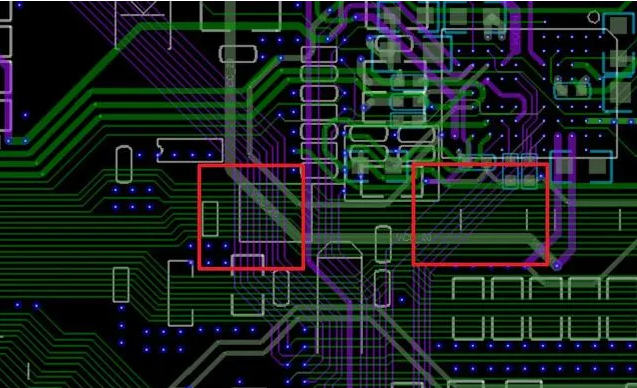
📌 Typical EMC Risk Example in PCB Layout
The image below illustrates a typical high-speed PCB layout where multiple EMC issues can occur:
- Disrupted return paths
- Cross-region high-speed routing
- Connector-induced coupling effects
- Increased loop area due to improper routing
👉 These layout patterns are common root causes of EMC test failures.
Conclusion
EMC design is not about adding more protection components. It is fundamentally about controlling how current flows on the PCB.
A well-designed high-speed system always ensures:
- Controlled current paths
- Continuous return planes
- Proper signal routing architecture
- Managed switching behavior
When these principles are followed, EMC performance becomes predictable and stable.