I. Why Do Elevator Call Boards Require Circuit Protection?
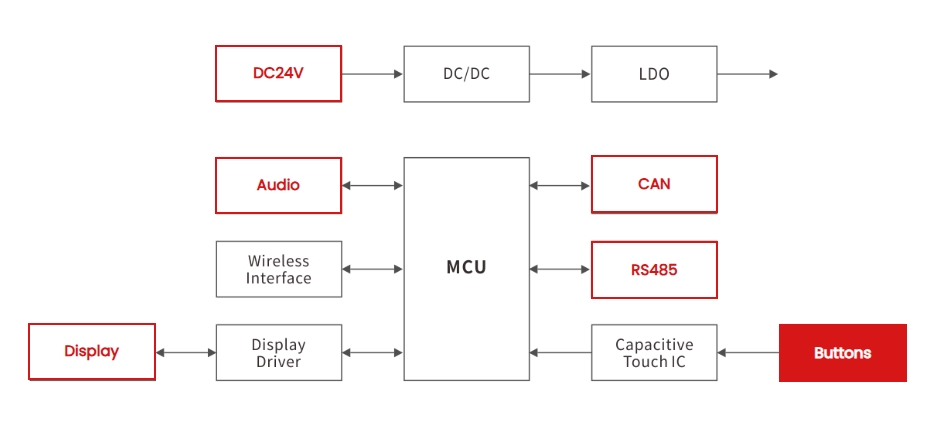
The Elevator Call Board serves as the central interface through which passengers interact with the elevator system. As a frequently utilized electronic device, its internal circuitry integrates sensitive components such as microcontrollers (MCUs), display screens, touch buttons, and communication interfaces (e.g., CAN, RS485).
Due to prolonged exposure to complex electromagnetic environments, these components are highly susceptible to voltage fluctuations. Should they encounter electrostatic discharge (ESD) or power surges, the consequences can range from minor issues—such as system resets or data loss—to severe outcomes, including permanent hardware damage.
This article will delve into the risks posed by electrostatic surges to elevator call boards and present the specialized protection solutions offered by Semiware.
II. ESD Surge Risks Facing Elevator Call Boards
Power Input (DC 24V): Elevator systems typically operate on a 24V DC power supply; however, power grid fluctuations, lightning-induced transients, or sudden load changes can trigger high-voltage surges capable of damaging power management ICs.
Audio Interfaces: Audio lines are susceptible to external electromagnetic interference. ESD events can intrude via microphone or speaker pins, potentially damaging the audio codec.
Display Modules: The driver circuitry for display screens is voltage-sensitive; ESD transients can couple through data lines or power lines, resulting in screen anomalies such as garbled images or a complete blackout.
Communication Interfaces (CAN/RS485): CAN and RS485 buses are commonly employed for group control communication within elevator systems. Their long-distance cabling makes them vulnerable to surge impacts induced by lightning strikes or ground potential differences.
Touch Buttons: Passengers frequently interact with the call buttons; consequently, human-generated static electricity (which can exceed 15kV) may be directly injected into the circuitry, causing damage to the touch detection IC or the MCU pins.
III. Semiware's Circuit Protection Solutions
To address the aforementioned risks, Semiware offers a comprehensive range of high-performance protection devices, implementing a layered defense strategy to ensure the stable and reliable operation of elevator call boards.
1. DC 24V Power Input Protection
Design Rationale: The power input port is primarily exposed to surge transients; therefore, high-power TVS diodes are required to effectively absorb and dissipate this excess energy.
👉 Protection Devices:
| Device | Type | Key Specs | Function |
| SVA40B36 | TVS Diode | 40–44.2V, 400W, Bi | Clamp surge on DC line |
| SVB60B36 | TVS Diode | 40–44.2V, 600W, Bi | Higher power surge absorption |
2. Audio Interface Protection
Design Rationale: Audio signals are sensitive to capacitance; therefore, low-capacitance ESD diodes must be used to ensure undistorted audio quality.
👉 Protection Devices:
| Device | Type | Key Specs | Function |
| SE10F10B5.0A | ESD Diode | 5V, 15pF, ±15kV | ESD protection without audio distortion |
3. Display Protection
Design Rationale: High-speed data interfaces require ultra-low capacitance protection to prevent signal integrity degradation.
👉 Protection Devices:
| Device | Type | Key Specs | Function |
| SE10F10B3.3MA | ESD Diode | 3.3V, 0.22pF, ±30kV | Protect high-speed display lines |
4. CAN Bus Protection
Design Rationale: CAN bus communication demands high stability; thus, the design must balance the requirements for both electrostatic protection and signal transmission.
👉 Protection Devices:
| Device | Type | Key Specs | Function |
| SE23T20B24LB | ESD Diode | 24V, ±20kV, 13pF | Protect CAN transceiver |
5. RS485 Communication Interface Protection
Design Rationale: RS485 typically involves long-distance transmission, making it susceptible to surges induced by lightning strikes; consequently, a multi-layered protection scheme is employed.
👉 Protection Devices:
| Device | Type | Key Specs | Function |
| SG3D05B090 | GDT | 90V, 5kA | Handle high-energy surge (lightning) |
| SVB60B15 | TVS Diode | 600W, 15V, Bi | Fast voltage clamping |
| SE23T40B712B | ESD Diode | +7/-12V, ±25KV, 55pF, SOT-23 | Fine ESD protection |
| STB100B6.0 | Thyristor (TSS) | 6kV, 100A, SMB | Secondary surge protection |
6. Button/Touch Interface Protection
Design Rationale: Components that come into direct contact with the human body face the highest risk of electrostatic discharge; therefore, they require protection with high voltage withstand capabilities.
👉 Protection Devices:
IV. Analysis of Solution Highlights
☑️ Zonal Protection
Dedicated handling for Power, Interfaces, and Signals
☑️ Multi-level Protection
A combination of high energy absorption and rapid response capabilities
☑️ Low-Capacitance Design
Ensures signal integrity
☑️ Standards Compliance
IEC 61000-4-2 (ESD)
IEC 61000-4-5 (Surge)
V. Circuit Block Diagram
Conclusion
The reliability of an elevator call panel is directly linked to passenger safety and user experience. By adopting Semiware's specialized circuit protection solutions, engineers can ensure that their equipment effectively withstands the threats posed by electrostatic discharge (ESD) and surge voltages, thereby guaranteeing the long-term stable operation of the system.
Choose Semiware to equip your elevator call panels with a "lightning-proof shield," making every call safe and reliable!