Introduction
With the rapid development of the low-altitude economy, UAV applications are expanding from consumer-grade aerial photography to industrial inspection, logistics delivery, agricultural and forestry plant protection, and security monitoring. Driven by the demands of complex missions and long-endurance operation, high reliability, lightweight design, environmental adaptability, and system stability have become core design indicators for UAVs.
Based on international standards such as IEC 61000-4-2 (ESD) and IEC 61000-4-5 (surge), Semiware Semiconductor focuses on the system-level electromagnetic protection needs of UAVs, providing low-capacitance, low-clamping, miniaturized, and highly reliable ESD/TVS device solutions covering power, signal, and high-speed interfaces to help improve the stability and reliability of systems in complex electromagnetic environments.
This article will systematically analyze the design methods for UAV ESD and surge protection from four dimensions: principle mechanism, system architecture, application solutions, and device selection.
I. UAV EMC Verification Classification
From a testing and certification system perspective, UAV EMC verification is generally divided into two categories:
Consumer-grade products mainly adhere to standards such as GB/T 17626, FCC, and EN, focusing on basic electromagnetic compatibility requirements such as electrostatic discharge (ESD), surge immunity, and radiated emissions.
Industrial/airworthy grade (especially export, BVLOS, and manned models) must meet the DO-160G aerospace-grade environmental and EMC standards, covering more stringent high and low temperatures, vibration, lightning strikes, and strong EMI immunity, with requirements far exceeding those of ordinary consumer-grade products.
II. Sources and Hazards of UAV Interference
- ESD (Electrostatic Discharge)
Sources: During UAV flight, friction between the fuselage and air, friction on composite material surfaces, and interface plugging and unplugging operations by maintenance personnel can lead to static electricity accumulation.
Hazards: Electrostatic discharge instantaneously generates nanosecond-level high-voltage pulses, which can penetrate the electronic system through conduction or electromagnetic coupling, potentially damaging chip gates or interfering with flight control signal timing, causing attitude control loss or GPS positioning drift.
- Surge Impacts (EOS / Lightning Induction)
Power Surge: Lithium battery charging and discharging, and the high-speed switching of ESC MOSFETs, can generate voltage spikes of tens to hundreds of volts, impacting the power management chip and main control power supply.
Lightning Induction: When drones operate at high altitudes, electromagnetic induction from lightning can couple through the fuselage cables, potentially generating surges of ±1kV to ±4kV (IEC 61000-4-5), damaging the power module or RF communication chip.
Interface Surge: Hot-swapping of interfaces such as USB and memory cards can generate transient overvoltages, potentially damaging the transceiver or interface circuitry.
III. EMC Testing Conditions for UAVs
| Test Item | China (GB/T 38909) | EU (EN / CISPR / RED) | USA (FCC) | Purpose |
| Radiated Emission | 30 MHz – 6 GHz | CISPR 32 / EN 55032 (30 MHz – 6 GHz) | FCC Part 15B (30 MHz – 1 GHz, extended measurements above 1 GHz) | Prevent electromagnetic interference to external electronic devices |
| Conducted Emission | 150 kHz – 30 MHz (power ports) | CISPR 32 / EN 55032 | FCC Part 15B | Prevent noise propagation through power lines |
| ESD Immunity | ±8 kV contact / ±15 kV air | IEC 61000-4-2 | IEC 61000-4-2 | Simulates electrostatic discharge from human/environment |
| RF Immunity | 10 V/m (80 MHz – 2 GHz) | IEC 61000-4-3 | IEC 61000-4-3 | Evaluates resistance to external RF interference |
| Surge Immunity | 1 kV differential / 2 kV common mode (IEC 61000-4-5) | IEC 61000-4-5 | IEC 61000-4-5 | Simulates lightning-induced surge and power disturbances |
| RF Transmission Compliance | SRRC requirements | RED (ETSI EN 300 328 / EN 301 893) | FCC Part 15C / 15E | Ensures compliance of frequency band, output power and spectrum usage |
IV. UAV Circuit Protection Architecture
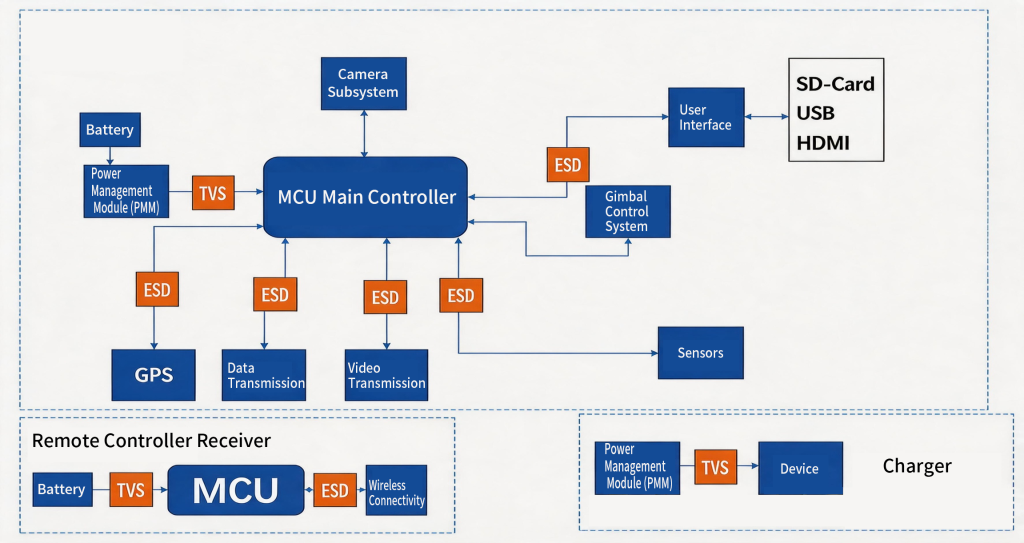
The UAV circuit is divided into four core areas: power supply domain, flight control domain, signal communication domain, and peripheral interface domain. Semiware adopts a multi-level protection architecture of "power surge suppression + signal ESD protection," as shown in the protection block diagram below:
V. Semiware Protection Scheme Analysis
- Power System (Lithium Battery/Electronic Speed Controller/DC-DC)
The UAV power supply consists of three levels: 2S/3S/4S/6S lithium battery input (7.4V/11.1V/14.8V/22.2V), ESC power supply, and 5V/3.3V DC-DC output. Surge absorption, overvoltage clamping, and low power consumption must be considered.
| Battery Type | Cell Count | Nominal Voltage | Full Charge Voltage | Recommended TVS | Application |
| 2S | 2 | 7.4V | 8.4V | SMF10CA | Entry-Level FPV / DJI Mini Series |
| 3S | 3 | 11.1V | 12.6V | SMAJ15CA | Mainstream Consumer Drones |
| 4S | 4 | 14.8V | 16.8V | SMBJ18CA | High-Performance FPV Drones |
| 6S | 6 | 22.2V | 25.2V | SMBJ26CA | Professional Racing Drones |
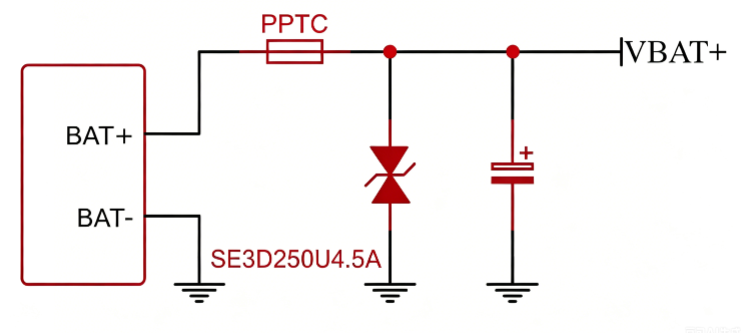
(1) Lithium Battery Input Terminal
Interference Characteristics: Power-on surge, reverse connection transient, lightning-induced surge;
Protection Requirements: Absorb large-energy surges, clamping voltage ≤40V, current carrying capacity ≥50A;
Solution: TVS + PPTC combination is recommended. The front-end PPTC protects against overcurrent, while the rear-end TVS provides precise clamping to prevent voltage spikes from entering the ESC; meets IEC 61000-4-2 Level 4 standard (contact/air discharge ±30kV).
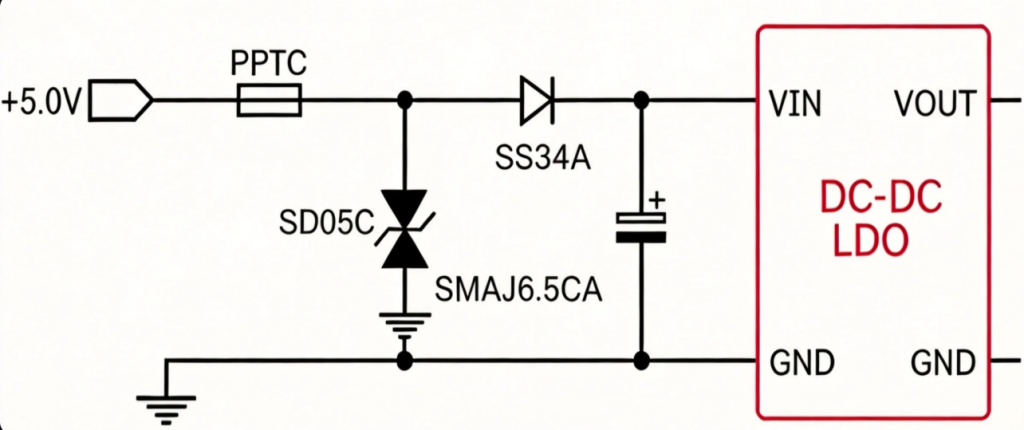
(2) DC-DC Output Terminal (5V/3.3V)
Interference Characteristics: Switching noise, ESD electrostatic coupling, load switching surge;
Protection Requirements: Fast response, clamping voltage ≤10V (5V system);
Solution: Small package high-current ESD or TVS, connected in parallel at the output terminal, discharges static electricity and small surges without affecting power ripple and efficiency, suitable for long-term battery life requirements. The protection level meets the requirements of IEC 61000-4-2 standard level 4 (contact discharge 8kV, air discharge 15kV).
- Signal Communication System Protection Scheme (GPS/WiFi/Gyroscope/Bus)
The UAV signal link includes high-frequency radio frequency signals (GPS 1.575GHz, WiFi 2.4G/5G), low-speed control signals (I2C/SPI), and differential signals (CAN/RS485). The core challenges are ESD interference and signal integrity. Parasitic capacitance needs to be sufficiently small to avoid high-frequency signal attenuation.
(1) High-frequency radio frequency signals (GPS)
Level 2 protection is adopted to ensure high-temperature signal integrity, meeting IEC61000-4-2, level 4; contact discharge 30kV, air discharge 30kV; meeting IEC61000-4-5 8/20μs, 5kA.
(2) Differential Control Signal (CAN-FD/RS485)
Interference Characteristics: Contact ESD (±8kV) interference;
Protection Requirements: Differential symmetrical protection, clamping voltage ≤12V, parasitic capacitance ≤3pF; Multi-channel integrated device protection is used, with capacitance <5pF, ensuring signal integrity while filtering out noise and passing electrostatic discharge tests.
Meets IEC61000-4-2, Level 4, contact discharge 30kV, air discharge 30kV.
(3) Interface Protection
The UAV peripheral interfaces are directly exposed, posing the highest risk of ESD during plugging and unplugging, and surges induced by cables. This is a key protection focus, requiring compliance with both IEC 61000-4-2 ±15kV air discharge and IEC 61000-4-5 ±2kV surge standards.
For specific protection solutions, please visit our website or contact us.
Conclusion
With the continuous development of the low-altitude economy, the UAV industry's requirements for safety and reliability are also increasing. Semiware Semiconductor has been deeply involved in EMC protection for over a decade. Leveraging its full range of protection devices, precise parameter matching, and mature protection solutions, and strictly adhering to standards such as IEC 61000-4-2/4-5 and GB/T 17626.2/5, we provide end-to-end ESD/surge protection solutions for drones, covering power supply, signals, and interfaces.