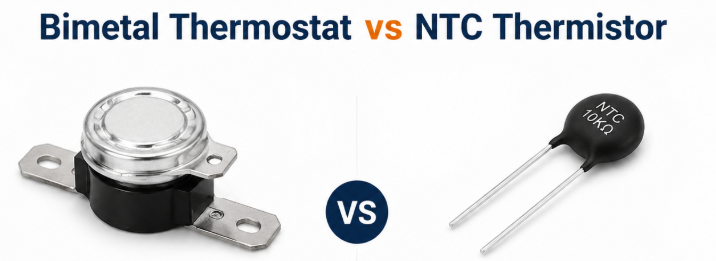
Both bimetallic thermistors and NTC thermistors are commonly used in temperature protection designs for electronic devices, but their working principles are quite different.
I. Understanding their fundamental nature: One is a "switch," the other a "sensor"
- Bimetallic Thermistor
🔸 Definition: It is not a temperature sensor, but a mechanical thermostat/thermal switch that directly controls the circuit's on/off state through physical deformation.
🔸Working Principle: Thermal Expansion and Contraction
The bimetallic strip is composed of two metals with different coefficients of thermal expansion. When the temperature changes, the different expansion rates cause the structure to bend, driving the contacts to actuate and control the circuit's on/off state.
🔸 Operating Mode: Switch-type temperature control based on a fixed temperature point
- Temperature rise → Bimetallic strip bends → Pushes contacts to open → Circuit de-energized, heating stops;
- Temperature decreases → Bimetallic strip recovers → Contacts reconnect → Circuit is powered on, heating begins.
- NTC Thermistor
🔸 Definition: A temperature-sensitive resistor based on the properties of semiconductor materials.
It is an electronic component whose resistance changes with temperature. It does not have a switching function; it only "senses" temperature.
🔸 Working Principle: Properties of Semiconductor Materials
NTCs are made of metal-oxide-semiconductor (MOS) materials. When the temperature rises, the number of charge carriers inside the material increases, causing its resistance to decrease; the opposite is true when the temperature decreases.
Therefore, it outputs a continuously changing analog resistance signal, not a switching signal.
🔸 Operating Mode:
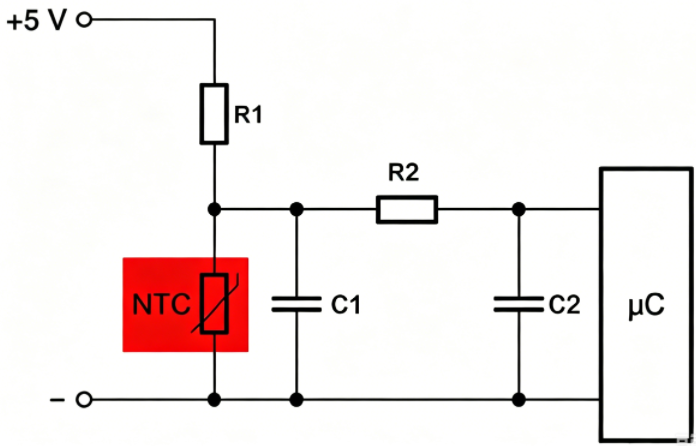
In practical applications, NTCs are usually used in conjunction with fixed resistors to form a voltage divider circuit, converting resistance changes into a voltage signal, which is then sampled and processed by the subsequent control system.
The NTC itself does not participate in control actions; it only provides temperature information.
II. Core differences overview
| Feature | Bimetal Thermostat | NTC Thermistor |
| Device Type | Mechanical Temperature Switch | Temperature Sensor |
| Output | ON/OFF Signal | Analog Resistance Signal |
| Temperature Accuracy | Moderate | High |
| Response Speed | Relatively Slow | Fast |
| Control Method | Direct Switching | Electronic Monitoring |
| External Circuit Required | No | Yes |
| Cost | Higher | Lower |
| EMI Immunity | Excellent | Depends on Circuit Design |
| Mechanical Wear | Yes | No |
| Service Life | Limited Switching Cycles | Long-Term Solid-State Operation |
| Linearity | Not Applicable | Nonlinear |
Advantages and Disadvantages Summary:
Temperature-Controlled Bimetallic Strip:
- Advantages: Simple structure, extremely low cost, direct drive of high power, high reliability, no power supply required.
- Disadvantages: Low accuracy, slow response, only has switching function, limited mechanical lifespan, large size.
NTC Thermistor:
- Advantages: High accuracy, fast response, provides continuous temperature readings, small size, no mechanical wear, can achieve complex control (such as PID).
- Disadvantages: Requires matching circuitry, cannot directly control the load, easily damaged by overload, non-linear output.
III. Recommended applications of Bimetallic Thermistors and NTC Thermistors
- Application of Bimetallic Thermistors
These products are typically characterized by: cost sensitivity, low control accuracy requirements, simple functions, and the need to directly control large currents.
🔸 Thermostats/Overheat Protectors in Household Appliances:
- Electric Kettle (automatically shuts off after water boils);
- Electric Iron (maintains soleplate at set temperature);
- Coffee Maker/Water Dispenser (maintains soleplate at set temperature);
- Rice Cooker (acts as a temperature limiter or keep-warm switch);
- Microwave Oven (electromechanical door switch or overheat protection).
🔸 Motor/Transformer Protection:
- Embedded in the motor windings, directly cuts off the power supply when the motor overheats to prevent burnout.
🔸 Automotive Electrical Appliances:
- Overheat protection for seat heating and rear window defroster.
- Applications of NTC Thermistors
These products typically require: precise temperature measurement, digital display, complex control logic, and a high degree of product intelligence.
🔸 Battery Management System
- Smartphones/Laptops/Electric Vehicles: Accurately monitor battery temperature to prevent overcharging and over-discharging hazards; a key sensor for achieving fast charging.
🔸 Automotive Electronics
- Engine coolant temperature sensor, intake air temperature sensor, air conditioning internal/external circulation temperature sensor: Provides accurate temperature parameters to the engine electronic control unit.
🔸 High-Precision Temperature Control Equipment
Incubators/Incubators, Medical Equipment, Environmental Monitoring Stations: Require precise maintenance within a narrow temperature range.
🔸 Smart Home Appliances
- Inverter Air Conditioners: Precisely sense indoor, outdoor, and pipe temperatures to achieve energy-saving and comfortable temperature control.
- Smart Rice Cookers/Ovens: Work with an MCU to achieve precise control of various cooking curves.
- Smart Rice Cookers/Ovens: Work with an MCU to achieve precise control of various cooking curves.
🔸 Consumer Electronics
- Used to monitor the internal temperature of devices and prevent overheating of chips such as CPUs.
Conclusion
The bimetallic strip acts like a "doer," directly performing the switching action on its own, simple and reliable; the NTC thermistor acts like an "intelligence officer," accurately collecting temperature information, which needs to be passed to the system (MCU) for decision-making and driving subsequent actions.
If your equipment requires precise temperature monitoring and a highly reliable temperature control solution, Semiware's NTC thermistors offer stable resistance characteristics and excellent reliability, making them ideal for applications such as BMS, power adapters, and industrial control.
Learn more about our products ↗️ https://en.semiware.com/products/ntc/