In the input protection design of switching power supplies, transient voltage suppressor diodes (TVS) are one of the most common core protection devices, used to cope with transient overvoltage impacts such as surges, lightning strikes, and ESD.
However, in practical engineering applications, the applicability of TVS with different structures (including standard and flyback/snap-back types) to power supply ports varies significantly. Inappropriate selection may actually introduce system risks into the protection device itself.
I. Typical Risks at the Input Terminal of Switching Power Supplies
The input terminal of a switching power supply typically includes rectification, EMI filtering, and large-capacity electrolytic capacitors. Significant changes in electrical characteristics occur at power-on:
- Inrush Current
- The input capacitor is approximately "short-circuited" initially.
- Peak inrush current can reach tens to hundreds of amperes.
- Short duration, but concentrated energy.
- External Transient Impacts
- IEC 61000-4-5 Surge
- Grid switching impact
- Inductive load reverse voltage
👉 Therefore, input protection devices must simultaneously meet the following requirements:
- High surge absorption capability
- High stability
- No false triggering or lockout
II. What is a Snap-back TVS?
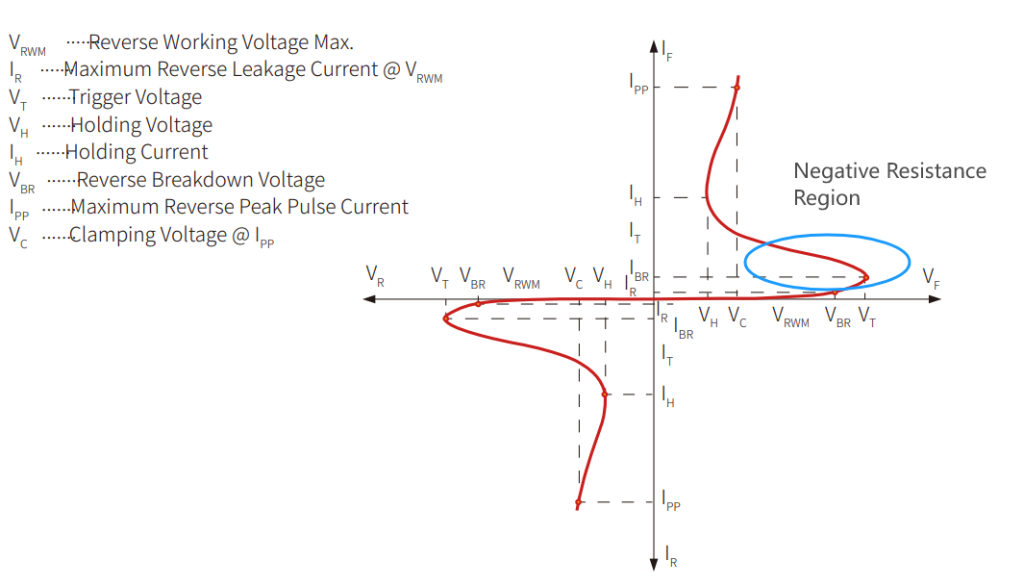
A snap-back TVS is essentially a type of transient suppression device with negative differential resistance characteristics (snap-back behavior).
Its I-V characteristics typically consist of three stages:
- Off-state: Voltage is below the breakdown voltage VBR. The device is in a high-resistance state.
- Avalanche breakdown: Rapid conduction occurs after the breakdown voltage is exceeded.
- Snap-back/Holding region: Voltage drops to the holding voltage VH. The device enters a low-resistance conducting state. Current sustains conduction.
👉 Unlike standard TVS, its clamping behavior exhibits "hysteresis."
III. Key Differences: Standard TVS vs. Snap-back TVS
| Parameter | Standard TVS | Snap-back TVS |
| Clamping Behavior | Clamping voltage increases gradually with surge current | Enters a low holding-voltage region after triggering |
| I-V Characteristic | Monotonic avalanche characteristic | Exhibits snap-back and hysteresis behavior |
| Dynamic Resistance | Relatively stable | Can decrease significantly after triggering |
| Stability | Highly stable and predictable | May be susceptible to unintended triggering under certain conditions |
| Typical Applications | Power supply protection, industrial interfaces, surge suppression | High-speed data lines, low-voltage IC protection, ESD protection |
| Clamping Voltage | Generally higher | Typically lower, providing better protection for sensitive devices |
| Latch-up Risk | Very low | Depends on holding voltage and circuit conditions |
| Recommended Use | Power rails, DC power inputs, industrial equipment | USB, HDMI, Ethernet, RF interfaces, and other signal lines |
IV. Why Are Snap-back TVS Not Recommended for Power Input Applications?
- Inrush current can easily trigger false conduction.
👉 At the moment of power-on of the switching power supply, the input capacitor charging current is very large, which may exceed the TVS trigger threshold. A flyback TVS may be falsely triggered into the conduction state.
- Continuous conduction may occur after entering a low holding voltage state.
When the device enters the snap-back region, the voltage drops to the holding voltage VH. If VH is lower than the system operating voltage, the TVS may remain on.
👉 The consequences are:
- Continuous high input current
- Device overheating
- System power failure or restart
V. Can a flyback TVS be used in a power supply? The key lies in the type selection.
✔ Applicable situations:
- Current-limited power supply paths
- Designs with current limiting or soft-start
- Low-power auxiliary power supplies
❌ Not recommended applications:
- Main power supply input (AC-DC input)
- High-energy surge environments
- Designs without current protection
In short, for flyback TVS applications, we must select the type based on the actual circuit conditions.
Semiware Semiconductor is committed to becoming a leading brand in electromagnetic compatibility solutions and component supply, offering products such as TVS diodes, ESD diodes, TSS thyristors, GDTs, MOVs, MOSFETs, Zeners, Schottky diodes, and Triacs. Our technical team can provide customized services based on customer needs, offering the highest quality solutions.